
Worm Gear Motor Efficiency Explained: Power Loss, Heat, and How to Improve Performance in Industrial Applications
One of the most common questions engineers ask before choosing a worm gear motor is: “Are worm gearboxes inefficient?” The short answer is yes — compared to other gearbox types — but that doesn’t mean they’re the wrong choice.
In this guide, we explain exactly how worm gear motor efficiency works, why power losses occur, and how to minimise heat, wear, and wasted energy through correct selection. If efficiency is critical in your application, this article will help you avoid costly mistakes.
What Is Worm Gear Motor Efficiency?
Efficiency is the percentage of input power from the motor that is converted into usable output torque. In worm gear motors, efficiency is typically lower than inline or helical gearboxes due to the sliding contact between the worm and the worm wheel.
- Typical worm gearbox efficiency: 50–90% (depending on ratio and size)
- Higher ratios = lower efficiency
- More sliding = more heat
If you’re new to worm gear motors in general, start here: What Is a Worm Gear Motor and When Should You Use One?
Why Are Worm Gear Motors Less Efficient?
Unlike helical or spur gears that roll against each other, worm gears rely on a sliding motion. This sliding contact creates:
- Friction losses
- Heat generation
- Higher lubrication demands
As the gear ratio increases, the sliding action becomes more pronounced, which is why very high ratios can significantly reduce efficiency.
If efficiency is your top priority, you may want to compare alternatives such as: Inline Gearboxes or review Bevel Helical Gearbox vs Worm Gearboxes.
How Gear Ratio Affects Efficiency
Worm gear ratio has a direct impact on efficiency. As a general rule:
- Low ratios (7.5:1 – 20:1): higher efficiency
- Medium ratios (30:1 – 60:1): moderate efficiency
- High ratios (80:1 – 100:1+): lower efficiency
This is why ratio selection should never be based on speed alone. Torque, duty cycle, and thermal limits must also be considered.
For selection fundamentals, read: Things To Know Before Selecting A Gearbox.
Heat Build-Up: The Hidden Efficiency Killer
Heat is the by-product of inefficiency. If a worm gearbox runs too hot, you risk:
- Premature lubricant breakdown
- Seal failure
- Reduced service life
This is especially important in continuous-duty (S1) applications. Worm gear motors are often best suited to intermittent or moderate-duty cycles unless carefully oversized.
How to Improve Worm Gear Motor Efficiency
While worm gear motors will never match helical efficiency, there are several ways to reduce losses and improve performance:
1) Choose the Lowest Acceptable Ratio
Avoid extreme ratios where possible. Sometimes using a slightly higher motor speed with a lower gearbox ratio improves overall efficiency.
2) Select the Correct Motor Power
Undersized motors increase heat and wear. Oversizing slightly can improve thermal stability and efficiency.
3) Use an Inverter (VFD) Where Appropriate
Variable frequency drives allow smoother starts, reduced shock loads, and controlled acceleration. If you’re unfamiliar with VFDs, start here: What is an Inverter?
4) Ensure Proper Lubrication
Correct oil type and level are essential. Poor lubrication dramatically increases friction and power loss.
5) Verify Mounting Orientation
Mounting position affects oil distribution. Incorrect orientation can starve critical components of lubrication.
When a Worm Gear Motor Is Still the Right Choice
Despite lower efficiency, worm gear motors remain the best solution when:
- Space is limited
- High reduction is required in one stage
- Quiet, smooth low-speed motion is important
- Cost and simplicity outweigh energy savings
This is why worm gear motors are still widely used in conveyors, packaging machines, gates, and light-duty automation systems.
Worm Gear Motor vs Inline Gearbox: Efficiency Comparison
If efficiency is mission-critical and the machine runs continuously, an inline or helical gearbox may deliver lower lifetime energy costs. However, these units are often larger, heavier, and more expensive than worm gear alternatives.
Compare both options here: Mastering the Power of Inline Gearboxes.
Common Efficiency Mistakes to Avoid
- Choosing the highest ratio without checking thermal limits
- Ignoring duty cycle and ambient temperature
- Running undersized motors at maximum load continuously
- Assuming efficiency doesn’t matter in low-speed systems
Avoiding these mistakes dramatically improves service life and reliability.
Choosing the Right Worm Gear Motor
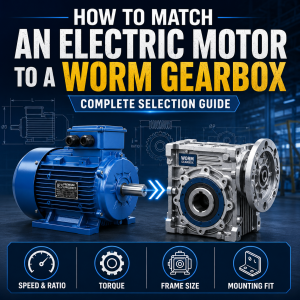
Efficiency is only one part of the selection process. Torque, ratio, duty cycle, mounting, and braking requirements must all be considered together.
For a complete selection framework, read: How to Choose the Right Worm Gear Motor in 2026.
Or browse available solutions here: Browse Worm Gear Motors & Gearboxes →