
How to Match an Electric Motor to a Worm Gearbox
Matching an electric motor to a worm gearbox is one of the most important parts of building a reliable industrial drive system. The motor provides the input power and speed, while the worm gearbox reduces that speed and increases the output torque for the machine. If the motor and gearbox are not matched correctly, the system may run too fast, lack torque, overheat, wear prematurely or fail under load.
A correct motor and worm gearbox combination should match the required output speed, output torque, motor power, gearbox ratio, frame size, input flange, shaft size, mounting position and duty cycle. This guide explains how to choose the right motor for a worm gearbox and how to avoid common selection mistakes.
At Worm Gear Motors Online, we supply a wide range of motors for gearboxes, 4 pole electric motors, IE3 electric motors and worm gearbox options including Motovario NMRV050 worm gearboxes, Transtecno CM050 worm gearboxes and Varvel FRS50 worm gearboxes.
Why Motor and Gearbox Matching Matters
A worm gearbox does not work properly unless the motor is correctly matched to it. The motor speed affects the gearbox output speed, the motor power affects the torque load through the gearbox, and the motor frame size affects whether the motor physically fits the gearbox input.
If the motor is too small, the machine may struggle to start, stall under load or fail to deliver enough torque. If the motor is too large, it can overload the gearbox and cause premature wear or failure. If the motor speed is wrong, the final output speed may be too fast or too slow for the application.
Correct matching helps to:
- Achieve the correct output speed for the machine.
- Provide enough output torque to move the load safely.
- Protect the gearbox from overloading.
- Reduce overheating and premature wear.
- Improve efficiency and long-term reliability.
- Ensure physical compatibility between the motor and gearbox.
Step 1: Start with the Required Output Speed
The first step is to work out the output speed you need from the gearbox. This is the speed of the final driven shaft, conveyor roller, mixer shaft, turntable, feeder or machine component.
Once you know the required output speed, you can estimate the gearbox ratio using the motor speed.
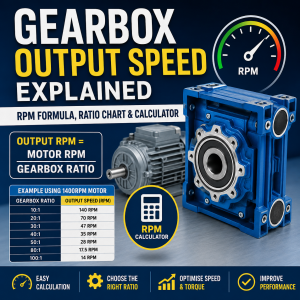
Gearbox Ratio = Motor Speed ÷ Required Output Speed
For example, if you are using a 1400rpm motor and need an output speed of approximately 28rpm:
1400 ÷ 28 = 50:1 gearbox ratio
This means a 50:1 worm gearbox would be a sensible starting point, assuming the torque rating and frame size are also suitable.
| Motor Speed | Gearbox Ratio | Approximate Output Speed |
|---|---|---|
| 2800rpm | 50:1 | 56rpm |
| 1400rpm | 50:1 | 28rpm |
| 900rpm | 50:1 | 18rpm |
| 700rpm | 50:1 | 14rpm |
This is why motor speed is so important. The same gearbox ratio will give a different output speed depending on whether you use a 2 pole, 4 pole, 6 pole or 8 pole motor.
Step 2: Choose the Right Motor Pole Speed
Industrial AC motors are commonly selected by pole speed. The pole count affects the motor speed, which then affects the gearbox output speed. For most worm gearbox applications, 4 pole motors are the most common choice because they provide a practical balance of speed, torque and availability.
| Motor Type | Approximate Speed at 50Hz | Typical Use with Worm Gearboxes |
|---|---|---|
| 2 Pole Motor | Approx. 2800rpm | Higher output speeds, lighter reduction applications |
| 4 Pole Motor | Approx. 1400rpm | Most common choice for general worm gearbox systems |
| 6 Pole Motor | Approx. 900rpm | Lower output speeds and smoother operation |
| 8 Pole Motor | Approx. 700rpm | Very low-speed applications with reduced input speed |
If you need higher gearbox output speed, browse 2 pole electric motors. For general industrial gearbox applications, 4 pole electric motors are usually the first option to consider. For slower output speeds, 6 pole electric motors and 8 pole electric motors may be more suitable.
Step 3: Calculate the Required Output Torque
After speed, the next important factor is torque. The gearbox must provide enough output torque to move the load reliably. Torque requirements depend on the load weight, driven shaft size, conveyor diameter, friction, acceleration, duty cycle and application type.
A worm gearbox increases torque by reducing speed, but the final torque is affected by gearbox efficiency. Higher ratios normally provide more torque multiplication, but worm gearbox efficiency can reduce at higher ratios, especially under continuous duty.
As a basic guide:
- Higher gearbox ratio: Lower output speed and higher torque multiplication.
- Lower gearbox ratio: Higher output speed and lower torque multiplication.
- Larger gearbox frame: Higher torque capacity and stronger mechanical construction.
- Higher motor power: More input power, but only if the gearbox is rated to handle it.
Do not choose a motor simply because it fits the gearbox. The gearbox must be rated for the motor power, ratio and required output torque.
Step 4: Match the Motor Power to the Gearbox Rating
Motor power is usually shown in kilowatts, such as 0.18kW, 0.37kW, 0.75kW, 1.5kW, 2.2kW or higher. The gearbox must be suitable for the motor power at the selected ratio.
A common mistake is fitting a motor that is too powerful for the gearbox. Even if the motor physically bolts on, the gearbox may not be rated to handle the torque created by that motor and ratio combination.
For example, a small worm gearbox may be suitable with a 0.18kW motor at one ratio, but not suitable with a 0.75kW motor at another ratio. Always check the gearbox power rating, output torque rating and service factor.
You may need to move up to a larger gearbox frame size if:
- The motor power is too high for the gearbox.
- The output torque requirement is above the gearbox rating.
- The machine has shock loading or frequent starts and stops.
- The gearbox will run for long hours each day.
- The gearbox runs hot under load.
For compact applications, smaller units such as Motovario NMRV030 worm gearboxes and Motovario NMRV040 worm gearboxes may be suitable. For medium-duty systems, Motovario NMRV050 worm gearboxes, Motovario NMRV-P063 worm gearboxes and Motovario NMRV-P075 worm gearboxes are commonly considered depending on torque demand.
Step 5: Check IEC Frame Size and Mounting Compatibility
Motor and gearbox compatibility is not only about speed and power. The motor must also physically fit the gearbox. Most industrial motor and worm gearbox combinations use IEC motor frame sizes and standard input flanges.
When matching a motor to a worm gearbox, check:
- Motor frame size: Common examples include IEC 63, 71, 80, 90, 100 and 112.
- Motor flange type: B5 or B14 flange mounting is commonly used for gearboxes.
- Motor shaft diameter: The motor shaft must match the gearbox input bore or coupling.
- Motor shaft length: The shaft must suit the gearbox input design.
- PCD and spigot size: The motor flange dimensions must match the gearbox adapter.
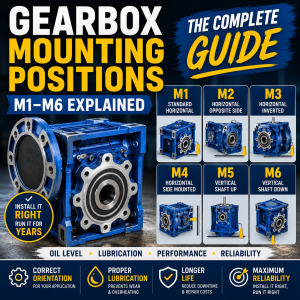
- Mounting position: Make sure the gearbox can be mounted in the required orientation.
If the motor frame size or flange dimensions are wrong, the motor may not fit the gearbox even if the power and speed are correct. This is especially important when replacing an existing motor or building a new motor and gearbox combination.
Step 6: Choose the Correct Motor Efficiency Class
Motor efficiency affects running cost, heat generation and long-term performance. Many industrial applications now use IE3 motors because they offer improved efficiency compared with older or lower-efficiency motors.
For applications running long hours, an efficient motor can help reduce energy usage and operating cost. For occasional-duty machines, the efficiency difference may be less critical, but motor quality and suitability still matter.
You can compare IE2 electric motors and IE3 electric motors depending on the application, duty cycle and budget.
Step 7: Consider the Application Type
The application has a major effect on motor and gearbox selection. A conveyor, pump, fan, mixer or indexing table may all need different motor speeds, gearbox ratios, torque ratings and service factors.
Conveyors
Conveyors often use worm gearboxes because they need controlled output speed and useful torque. A 4 pole motor with a worm gearbox is a common choice for many conveyor systems. For conveyor-specific options, browse motors for conveyors.
Pumps
Pumps often need reliable continuous operation and correct speed matching. In many pump applications, the motor may be selected directly by speed and power rather than through a worm gearbox. For pump applications, see motors for pumps.
Fans
Fans usually require careful speed selection because airflow changes significantly with motor speed. For fan applications, browse motors for fans.
Stop-Start Machinery
Applications with frequent starts and stops may need a higher service factor, stronger gearbox frame or a brake motor. If the driven load needs to hold position when stopped, a brake motor may be required.
Heavy Loads and Shock Loads
Heavy-duty applications, shock loads and long running hours often require a larger gearbox frame and careful motor power selection. Under-sizing the gearbox can lead to overheating, wear and early failure.
Step 8: Decide Whether a Brake Motor Is Needed
A standard motor is suitable for many worm gearbox applications, but some systems need controlled stopping or holding torque. In these cases, a brake motor may be the better choice.
Brake motors are useful when the gearbox drives:
- Incline conveyors
- Hoists or lifting equipment
- Packaging machinery
- Indexing tables
- Door systems
- Stop-start handling equipment
- Applications where back-driving must be prevented
If the application needs the gearbox output to stop quickly or hold position, browse Amtecs brake motors as a starting point.
Common Mistakes When Matching Motors to Worm Gearboxes
Motor and gearbox matching mistakes are common, especially when replacing old equipment or building a new machine. The most common errors include:
- Choosing the gearbox ratio without checking output torque.
- Using a motor that is too powerful for the gearbox.
- Using the wrong motor speed and getting the wrong output rpm.
- Assuming all IEC motor flanges are the same.
- Ignoring motor shaft diameter and shaft length.
- Not checking gearbox service factor.
- Using a small gearbox on a high-duty or shock-loaded application.
- Forgetting about thermal limits on continuous-duty systems.
- Not checking whether a brake motor is required.
- Replacing only the motor without checking why the previous system failed.
Quick Motor and Worm Gearbox Matching Checklist
Before selecting a motor and worm gearbox, check the following:
- Required output speed: What rpm does the machine need?
- Motor speed: 2 pole, 4 pole, 6 pole or 8 pole?
- Gearbox ratio: What reduction is needed?
- Output torque: Can the gearbox handle the load?
- Motor power: Is the motor suitable without overloading the gearbox?
- Service factor: Is there enough safety margin for the application?
- IEC frame size: Does the motor physically fit the gearbox?
- Flange type: Is the motor B5, B14 or another mounting style?
- Shaft size: Does the motor shaft match the gearbox input?
- Duty cycle: Is the machine occasional, frequent or continuous duty?
- Load type: Smooth, moderate shock or heavy shock?
- Brake requirement: Does the load need stopping or holding control?
Recommended Motor and Gearbox Categories
If you are selecting a motor for a worm gearbox, the categories below are useful starting points for comparing motor speed, motor type, efficiency class and suitable gearbox frame sizes.
Frequently Asked Questions
What motor is best for a worm gearbox?
For many worm gearbox applications, a 4 pole electric motor is the most common choice because it provides a good balance of speed, torque and availability. However, the best motor depends on the required output speed, gearbox ratio, load torque and application type.
Can I fit any motor to a worm gearbox?
No. The motor must match the gearbox input flange, IEC frame size, shaft diameter, shaft length, power rating and speed requirement. A motor may be the right power but still not physically fit the gearbox.
How do I calculate gearbox output speed?
Divide the motor speed by the gearbox ratio. For example, a 1400rpm motor with a 50:1 gearbox gives approximately 28rpm output speed.
Can a motor be too powerful for a gearbox?
Yes. If the motor is too powerful for the gearbox, it can overload the gears, bearings and shafts. This can cause overheating, premature wear or gearbox failure.
Should I use a 2 pole or 4 pole motor with a worm gearbox?
A 2 pole motor gives a higher input speed, which means a faster gearbox output speed. A 4 pole motor gives a lower input speed and is the most common option for general worm gearbox applications.
When should I use a brake motor with a worm gearbox?
A brake motor should be used when the application needs controlled stopping, holding torque or prevention of back-driving. This is common on incline conveyors, hoists, positioning systems and stop-start machinery.
Does motor efficiency matter when using a gearbox?
Yes. Motor efficiency affects running cost, heat and long-term performance. IE3 motors are commonly used for industrial applications where reliability and energy efficiency are important.
Final Advice: Match Speed, Torque, Power and Fitment Together
The correct electric motor and worm gearbox combination should be selected as a complete drive system. Do not choose the motor first and assume the gearbox will cope, and do not choose the gearbox ratio without checking the motor speed and torque requirement.
Start with the required output speed, calculate the gearbox ratio, check the torque requirement, confirm the motor power, then verify the IEC frame size, flange, shaft and mounting position. If the machine has frequent starts, heavy loads or long running hours, also check service factor and duty cycle carefully.
For a reliable motor and gearbox combination, compare our motors for gearboxes, 4 pole electric motors and Motovario NMRV050 worm gearboxes, or contact Worm Gear Motors Online for help matching the correct motor to your worm gearbox application.