
How to Choose the Right Worm Gear Motor in 2026 – The Ultimate Buying Guide
Worm gear motors remain one of the most widely used power transmission solutions across industrial automation, material handling, food processing, packaging machinery, and OEM equipment. Despite the growth of high-efficiency helical and planetary gearboxes, worm gear motors continue to dominate applications that demand compact size, high torque at low speeds, smooth operation, and cost-effective performance.
As we move into 2026, worm gear motor technology has evolved with improved materials, better lubrication systems, expanded mounting options, and enhanced compatibility with modern inverter drives. Choosing the correct worm gear motor is critical — selecting the wrong unit can lead to overheating, premature wear, poor efficiency, or unnecessary cost.
This ultimate buying guide explains exactly how to choose the right worm gear motor in 2026, step by step, so you can confidently specify the correct solution for your application.
What Is a Worm Gear Motor?
A worm gear motor is a combined unit consisting of an electric motor and a worm gearbox. Inside the gearbox, a hardened steel worm (screw) meshes with a bronze worm wheel, allowing large speed reductions in a compact footprint.
This design makes worm gear motors ideal for applications that require:
- High torque at low output speeds
- Compact installation space
- Smooth and quiet operation
- Simple mechanical design
- Cost-effective gearing solutions
They are commonly used in conveyors, lifts, mixers, packaging equipment, food processing machinery, and light-to-medium duty automation systems.
Step 1: Define Your Application Requirements
The first step in selecting the correct worm gear motor is clearly defining your application requirements. Before choosing ratios or motor sizes, you should identify:
- Type of load (constant, variable, or shock load)
- Required output speed (RPM)
- Required output torque (Nm)
- Operating duty cycle (continuous or intermittent)
- Installation environment (clean, dusty, wet, or outdoor)
Accurate application data prevents oversizing, reduces energy consumption, and significantly extends gearbox service life.
Use Our Gearbox & Motor Selection Calculators
Correctly calculating speed, torque, and load requirements is essential before selecting a worm gear motor. To help with this process, we provide a range of free online calculators designed specifically for industrial motor and gearbox sizing.
👉 View Worm Gear Motor & Gearbox Calculators
These tools help you estimate output speed, torque requirements, and suitable motor power, ensuring you select equipment that performs reliably without being under- or oversized.
Step 2: Choosing the Correct Gear Ratio
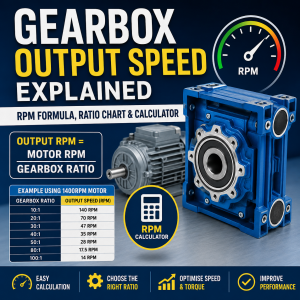
The gear ratio determines how much the motor speed is reduced and how much torque is multiplied at the output shaft. Worm gearboxes can achieve high ratios in a single stage, typically ranging from 5:1 up to 100:1 or more.
To calculate the required ratio:
Gear Ratio = Motor Speed (RPM) ÷ Required Output Speed (RPM)
For example, a standard 4-pole motor running at approximately 1,400 RPM with a desired output speed of 28 RPM would require a 50:1 gearbox.
Higher ratios provide greater torque but reduce efficiency, making correct ratio selection especially important in continuous-duty applications.
Step 3: Understanding Torque Requirements
Torque is one of the most critical — and often misunderstood — aspects of worm gear motor selection. Your gearbox must be capable of producing enough torque to move the load under all operating conditions, including startup.
Key torque considerations include:
- Required output torque at the shaft
- Startup and acceleration torque
- Shock or impact loads
- Appropriate service factor
For light-duty applications, a service factor of 1.2–1.4 is often sufficient. For heavy-duty or shock-loaded applications, a service factor of 1.5–2.0 is recommended.
Step 4: Selecting the Correct Motor
Once the gearbox ratio and torque requirements are known, the motor can be selected. Worm gear motors are typically paired with standard AC induction motors, inverter-duty motors, or brake motors depending on the application.
For most industrial environments, we recommend selecting from our range of high-quality AC electric motors , available in multiple power ratings, voltages, mounting configurations, and efficiency classes.
If variable speed control is required, ensure the motor is inverter-rated and suitable for operation with a variable frequency drive (VFD).
Step 5: Efficiency Considerations in 2026
Efficiency is often raised as a concern when selecting worm gear motors. While worm gearboxes are generally less efficient than helical or planetary designs, modern improvements in materials and lubrication have significantly improved performance.
Efficiency becomes particularly important for:
- Continuous-duty applications
- High operating hours
- Energy-sensitive installations
In many cases, the compact design, smooth operation, and cost benefits of worm gear motors still outweigh efficiency losses.
Step 6: Mounting Options and Shaft Configurations
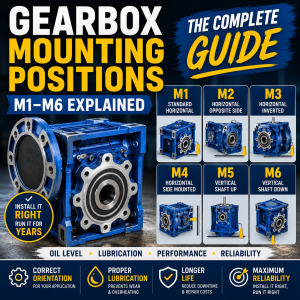
Worm gear motors are available in a wide variety of mounting arrangements, offering excellent installation flexibility.
- Foot-mounted designs
- Flange-mounted configurations
- Hollow shaft outputs
- Shaft-mounted gearboxes with torque arms
Correct mounting selection ensures proper lubrication, alignment, and long-term reliability.
Step 7: Environmental Protection and IP Ratings
The operating environment has a major impact on gearbox longevity. Worm gear motors are available with various IP protection ratings to suit different conditions.
- IP55–IP65 for dusty or damp environments
- IP66 for washdown or outdoor use
- Special coatings for corrosive or hygienic environments
Always match the protection rating to the application to prevent contamination and premature failure.
Step 8: Self-Locking and Backdriving
One advantage of worm gear motors is their potential self-locking capability. At higher ratios, the gearbox may resist backdriving, helping to hold loads in position when power is removed.
However, self-locking should never be relied upon for safety-critical applications. Where load holding is essential, mechanical brakes or additional safety devices should always be used.
Browse Worm Gearboxes and Complete Solutions
If you are ready to specify or purchase equipment, we offer a comprehensive range of industrial worm gear solutions suitable for conveyors, automation systems, packaging machinery, and general industrial use.
Final Thoughts
Choosing the right worm gear motor in 2026 requires a balanced approach that considers torque, speed, efficiency, environment, and installation constraints. While worm gear motors may not suit every application, their compact design, smooth operation, and cost-effectiveness continue to make them a reliable and popular choice.
By following the steps in this guide and using the correct calculation tools, you can confidently select a worm gear motor that delivers long service life, dependable performance, and excellent value.