
Electric Motor Frame Sizes Explained: IEC 56 to IEC 160 Buyer’s Guide
Electric motor frame size is one of the most important details to check when replacing a motor or matching a motor to a gearbox. Even if the power rating, voltage and speed are correct, the motor may still not fit if the IEC frame size, shaft dimensions, flange size or mounting arrangement are wrong.
IEC frame sizes such as 56, 63, 71, 80, 90, 100, 112, 132 and 160 are used to define the physical size of the motor. The frame number normally relates to the shaft centre height in millimetres for foot-mounted motors. For example, an IEC 80 frame motor typically has an 80mm shaft centre height from the mounting foot surface.
This guide explains what IEC motor frame sizes mean, how they affect gearbox compatibility, and what to check before choosing a replacement motor for conveyors, pumps, fans, geared motors and industrial machinery.
What Is an IEC Electric Motor Frame Size?
An IEC electric motor frame size is a standardised physical size used to describe the motor body, shaft height, mounting dimensions and general mechanical footprint. It helps buyers, engineers and maintenance teams match replacement motors without having to redesign the machine.
When you see a motor listed as IEC 71, IEC 80, IEC 90 or IEC 112, the number gives a quick indication of the motor’s physical size. Larger frame numbers generally mean a larger motor body, larger shaft, higher power capability and heavier construction.
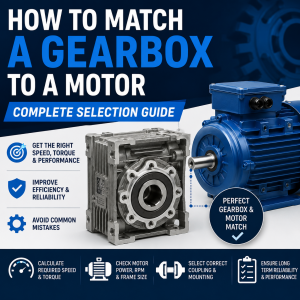
Frame size is especially important when selecting motors for gearboxes, because the motor must physically match the gearbox input flange, shaft size and mounting arrangement.
Why Motor Frame Size Matters
Motor frame size affects much more than just the overall size of the motor. It can affect the shaft diameter, shaft length, mounting hole positions, flange dimensions, terminal box position, weight and compatibility with gearbox input adapters.
If the wrong frame size is selected, the motor may not bolt onto the gearbox, the shaft may not fit the gearbox input bore, or the motor may sit at the wrong height on the machine. This can cause alignment problems, vibration, coupling issues and installation delays.
Frame size should always be checked alongside power, pole speed, voltage, mounting type and duty requirements. If you are starting from scratch, browsing the full AC motors category can help you compare different power ratings, pole speeds and motor construction types.
IEC 56 to IEC 160 Frame Sizes: Quick Overview
| IEC Frame Size | Typical Use | Common Applications |
|---|---|---|
| IEC 56 | Very small electric motors | Small fans, light machinery, compact equipment |
| IEC 63 | Small motors | Small conveyors, pumps, fans and light gearbox applications |
| IEC 71 | Compact industrial motors | Light machinery, small geared motors, automation systems |
| IEC 80 | Small to medium-duty motors | Conveyors, pumps, fans and gearbox drives |
| IEC 90 | Medium-duty motors | Industrial conveyors, machine drives and process equipment |
| IEC 100 | Medium industrial motors | Heavier conveyors, pumps, fans and geared machinery |
| IEC 112 | Medium to heavy-duty motors | Industrial machinery, larger gearboxes and continuous-duty systems |
| IEC 132 | Heavy-duty motors | Large conveyors, mixers, fans, pumps and production machinery |
| IEC 160 | Large industrial motors | Heavy machinery, large geared systems and demanding applications |
This table is a general guide only. The exact power rating available in each frame size depends on pole speed, efficiency class, manufacturer design and motor construction.
Frame Size vs Power Rating
Frame size and power rating are closely connected, but they are not the same thing. A 0.75kW motor, for example, may be available in different frame sizes depending on whether it is 2 pole, 4 pole or 6 pole. The pole speed affects the motor design, torque characteristics and physical size.
As a general rule, higher power motors need larger frames. However, a slower-speed motor can sometimes require a larger frame than a faster-speed motor of the same power because it needs to produce more torque at a lower speed.
This is why it is important to compare power and pole speed together. You can browse 2 pole electric motors, 4 pole electric motors and 6 pole electric motors to compare how speed affects motor selection.
IEC 56 and IEC 63 Motors
IEC 56 and IEC 63 frame motors are normally used for small, light-duty applications. These motors are compact, lightweight and suitable for lower power machinery where space is limited.
Typical applications include small fans, light conveyors, compact pumps, small workshop machines, dosing systems and low-load gearbox applications. These frame sizes are usually selected where the machine does not require high starting torque or heavy continuous-duty performance.
For small gearbox applications, IEC 63 motors may be paired with compact worm gearboxes such as Motovario NMRV030 worm gearboxes or FCNDK30 worm gearboxes, depending on the required ratio, input flange and bore size.
IEC 71 Motors
IEC 71 frame motors are commonly used for small industrial machinery, light conveyors and compact geared drive systems. They are still relatively small, but they offer more capability than very small IEC 56 and IEC 63 motors.
An IEC 71 motor may be suitable for applications where the machine needs a compact motor but still requires reliable industrial performance. These motors are often used with smaller worm gearboxes, automation systems and low-to-medium load machinery.
When selecting an IEC 71 motor for a gearbox, check the motor flange, shaft diameter, shaft length and gearbox input arrangement. The frame size alone does not guarantee fitment.
IEC 80 Motors
IEC 80 is one of the most common frame sizes for smaller industrial drive systems. It is often used for conveyors, fans, pumps and worm gearbox applications where a practical balance of size, power and torque is required.
IEC 80 motors are commonly paired with medium-small gearboxes where the machine needs dependable performance without moving into a large heavy-duty motor frame. They are often found in packaging lines, handling systems, light process equipment and compact production machinery.
For gearbox-driven conveyor systems, IEC 80 motors may be selected from categories such as motors for conveyors depending on the required speed, power and duty cycle.
IEC 90 Motors
IEC 90 motors are used for medium-duty industrial machinery. They are larger and stronger than IEC 71 and IEC 80 motors, making them suitable for applications that need more power, better torque capability or longer running hours.
These motors are commonly used on conveyors, pumps, fans, mixers, production machinery and gearbox-driven equipment. IEC 90 can also be a useful frame size where the application needs a stronger motor but still has limited installation space.
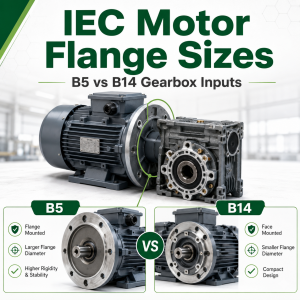
When pairing an IEC 90 motor with a gearbox, always check the gearbox input adapter and the motor mounting style. A B5 flange, B14 face or B3 foot-mounted arrangement can change whether the motor will fit the existing machine.
IEC 100 and IEC 112 Motors
IEC 100 and IEC 112 motors are used for larger medium-duty applications. These frame sizes are commonly found on industrial conveyors, larger pumps, fans, process equipment and geared drive systems with higher torque requirements.
At these sizes, motor weight, starting current, mounting strength and gearbox compatibility become more important. The gearbox must be correctly sized for the motor power and speed, and the machine frame must be strong enough to support the motor and gearbox assembly.
For many industrial applications, IE3 electric motors are a strong choice because they offer modern efficiency performance for continuous-duty machinery.
IEC 132 Motors
IEC 132 motors are generally used for heavier industrial applications. They are suitable for larger conveyors, mixers, pumps, fans, agitators and machinery where higher power and stronger torque performance are required.
At this level, the motor is often paired with larger gearboxes and more robust drive components. The gearbox housing, output shaft, bearing arrangement and service factor should all be checked carefully before installation.
For heavy conveyor systems, it is worth considering both the motor and gearbox as a complete drive package. Larger worm gearboxes such as Motovario NMRV-P090 worm gearboxes or Motovario NMRV-P110 worm gearboxes may be more suitable for demanding gearbox applications than compact light-duty units.
IEC 160 Motors
IEC 160 motors are large industrial motors used for demanding machinery. These motors are normally selected where the application requires high power, long running hours, strong starting performance and robust mechanical construction.
Applications can include large conveyors, heavy fans, pumps, mixers, crushers, processing machinery and industrial production equipment. At this frame size, correct installation and alignment are critical because the motor weight and torque levels are much higher.
For heavy-duty applications, cast iron construction is often preferred. Categories such as Amtecs cast iron motors and Tec cast iron motors are worth comparing when strength, durability and long-term reliability matter.
Motor Frame Size and Mounting Types
Frame size is only one part of the selection. The motor mounting type is just as important. A motor with the correct frame size may still not fit if the mounting arrangement is wrong.
The most common motor mounting types include:
- B3 Foot Mount: Motor mounted using feet on the base.
- B5 Flange Mount: Motor mounted using a large front flange.
- B14 Face Mount: Motor mounted using a smaller face flange.
- B34 Foot and Face Mount: Combination of B3 feet and B14 face.
- B35 Foot and Flange Mount: Combination of B3 feet and B5 flange.
Gearboxes often use flange-mounted motors, especially when the motor bolts directly to the gearbox input adapter. Before ordering, check whether the gearbox requires a B5 or B14 motor flange and confirm the correct IEC frame size.
Motor Frame Size and Gearbox Compatibility
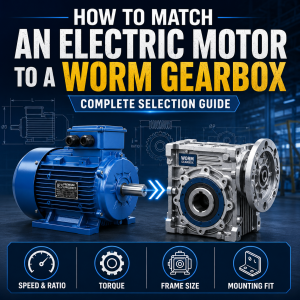
When fitting a motor to a gearbox, the motor frame size must match the gearbox input configuration. This normally includes the motor shaft diameter, shaft length, keyway, flange diameter, bolt circle and register diameter.
A gearbox may be designed to accept several different motor frame sizes using different input flanges or adapters. For example, a worm gearbox may be available with different motor input options depending on whether it is being paired with an IEC 63, 71, 80 or 90 motor.
Smaller gearbox sizes such as Motovario NMRV040 worm gearboxes and Motovario NMRV050 worm gearboxes are typically used with smaller motor frames, while larger gearbox sizes are used where more torque and power are required.
Aluminium vs Cast Iron Motor Frames
Motor frame size also links closely to motor construction. Smaller motors are often available in aluminium housings, while larger or more industrial motors may be supplied in cast iron housings.
Aluminium motors are lightweight, easy to handle and practical for smaller machinery. Cast iron motors are heavier, stronger and better suited to demanding industrial environments where vibration, impact resistance and durability are important.
For compact or medium-duty applications, Amtecs aluminium motors and Tec aluminium motors can be a practical choice. For larger frame sizes or harsher applications, cast iron motors may offer better long-term strength.
Single Phase vs Three Phase Frame Size Considerations
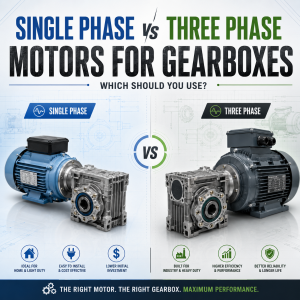
Single phase and three phase motors can sometimes be available in similar frame sizes, but they are not always directly interchangeable. A single phase motor may have different starting components, a different terminal box arrangement or a different capacitor housing.
Single phase motors are usually used on smaller power ratings and light-duty machines. Three phase motors are normally preferred for industrial gearboxes, conveyors and continuous-duty applications because they provide smoother running and better control options.
If your site only has single phase supply, Amtecs single phase motors may be suitable for smaller machines. For industrial gearbox applications, three phase motors are normally the better option where supply is available.
Brake Motors and Frame Size
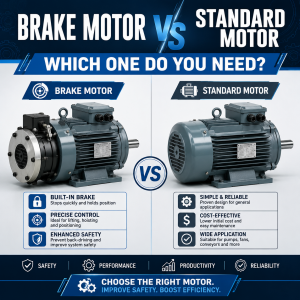
Brake motors also use IEC frame sizes, but the brake assembly adds extra length and weight to the motor. This is important when the motor is fitted to a gearbox or mounted in a tight space.
A brake motor may be required where the gearbox needs to stop quickly, hold position, prevent back-driving or control movement when power is removed. This is common on inclined conveyors, lifting equipment, indexing systems and machinery where uncontrolled movement could cause a problem.
If your gearbox application needs stopping or holding control, browse Amtecs brake motors and check the frame size, brake torque, mounting style and overall motor length before ordering.
Frame Size, Pole Speed and Output Torque
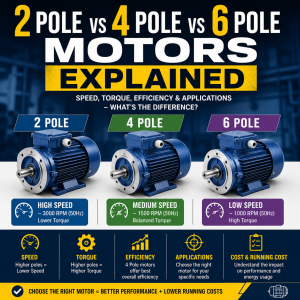
The pole speed of the motor affects the gearbox input speed and final output speed. A 2 pole motor runs faster than a 4 pole motor, while a 6 pole motor runs slower. The gearbox ratio then reduces that input speed and increases output torque.
For many gearbox applications, 4 pole motors are the most common choice because they provide a useful balance of speed, torque and gearbox compatibility. However, a 2 pole motor may be used where higher gearbox input speed is acceptable, and a 6 pole motor may be used where a slower input speed is preferred.
When choosing a motor frame size, always check both the motor speed and the gearbox ratio. A motor may physically fit the gearbox but still produce the wrong final output speed for the machine.
How to Check an Existing Motor Frame Size
If you are replacing an existing motor, the easiest starting point is the motor nameplate. The nameplate may show the frame size, power rating, voltage, speed, current, efficiency class and duty rating.
If the frame size is missing or unreadable, measure the key dimensions:
- Shaft centre height from the mounting foot surface
- Shaft diameter
- Shaft length
- Keyway size
- Foot mounting hole centres
- Flange diameter if flange mounted
- Flange bolt hole pattern
- Register diameter
- Overall motor length
These measurements help confirm whether the replacement motor will fit the existing gearbox, baseplate or machine frame.
Common Mistakes When Choosing Motor Frame Size
Many motor replacement problems happen because buyers match only the kW rating and ignore the frame size. The motor may be electrically suitable but mechanically wrong.
Common mistakes include:
- Ordering the correct kW but the wrong IEC frame size.
- Choosing the correct frame size but the wrong mounting type.
- Assuming B5 and B14 flanges are interchangeable.
- Ignoring shaft diameter and shaft length.
- Replacing a 4 pole motor with a 2 pole motor and changing the gearbox output speed.
- Not checking the terminal box position.
- Forgetting that brake motors are longer than standard motors.
- Using a motor that physically fits but is not suitable for the application duty.
Which IEC Frame Size Do You Need?
The correct IEC frame size depends on the motor power, speed, mounting arrangement and the machine it is being fitted to. For a direct replacement, match the existing nameplate and dimensions as closely as possible. For a new application, start with the required output speed and torque, then select the gearbox ratio and motor power together.
For small machines, IEC 56 to IEC 80 may be suitable. For medium-duty machinery, IEC 90 to IEC 112 is common. For heavier industrial systems, IEC 132 and IEC 160 are often used.
The safest approach is to check the complete drive system rather than selecting the motor in isolation. This includes the motor frame, motor mounting, gearbox input, gearbox output, ratio, load, duty cycle and required final speed.
Final Recommendation
IEC motor frame size is essential when selecting a replacement electric motor or matching a motor to a gearbox. It affects physical fit, shaft compatibility, mounting alignment and gearbox connection. Choosing the wrong frame size can cause installation problems even when the electrical specification looks correct.
For gearbox applications, always check the frame size, flange type, shaft dimensions, pole speed, motor power and duty cycle before ordering. Smaller frames are ideal for compact and light-duty machinery, while larger IEC frames are better suited to industrial conveyors, pumps, fans, mixers and heavy geared drive systems.
At Worm Gear Motors Online, we supply electric motors, gearbox-compatible motors, brake motors, worm gearboxes and industrial drive components for a wide range of applications. Browse our AC motors, motors for gearboxes, motors for pumps, motors for fans and worm gearbox ranges to find the right drive solution for your machinery.
FAQs
What does IEC motor frame size mean?
IEC motor frame size describes the physical size and mounting dimensions of an electric motor. For foot-mounted motors, the frame number usually relates to the shaft centre height in millimetres.
Is motor frame size the same as motor power?
No. Motor power is the output rating, usually shown in kW or HP. Frame size is the physical size of the motor. The two are related, but they are not the same thing.
Can two motors with the same kW have different frame sizes?
Yes. Motors with the same kW rating can have different frame sizes depending on pole speed, efficiency class, manufacturer design and construction type.
Why does frame size matter for gearboxes?
Frame size affects shaft dimensions, flange size and mounting alignment. A motor must match the gearbox input correctly, otherwise it may not fit or may cause alignment problems.
What is the most common motor frame size for gearboxes?
There is no single frame size for all gearboxes, but IEC 71, 80, 90 and 100 are common for smaller and medium-duty gearbox applications. Larger machinery may use IEC 112, 132 or 160 motors.
Can I replace a motor with a larger frame size?
Only if the larger motor physically fits the machine and gearbox. You must check shaft size, flange dimensions, mounting holes, terminal box position and available space.
Do B5 and B14 motors use the same frame size?
They can share the same IEC frame size, but the flange design is different. A B5 flange and B14 face mount are not normally interchangeable unless the gearbox or machine is designed for both.
Are brake motors the same frame size as standard motors?
Brake motors can use the same IEC frame size, but the brake assembly adds length and weight. Always check the overall motor length and brake specification before replacing a standard motor with a brake motor.