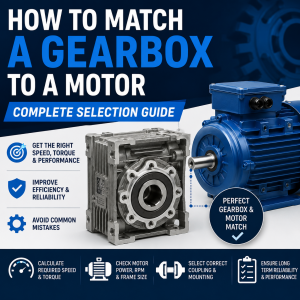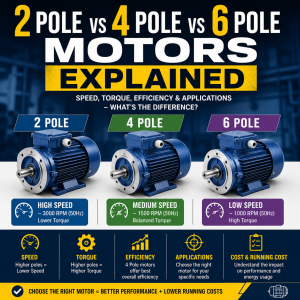

What Is a Worm Gear Motor and When Should You Use One? Complete 2026 Guide for UK Buyers (Applications, Pros, Cons & Selection Tips)
A worm gear motor is a compact geared motor that combines an electric motor with a worm gearbox to reduce speed and increase torque. It’s one of the most common choices for space-saving, high-reduction drives in industrial automation — especially for conveyors, packaging machinery, small lifts, gates, and general material handling.
In this guide, you’ll learn exactly how worm gear motors work, where they make sense (and where they don’t), and how to choose the right ratio, torque, motor power, mounting, and options like brakes. If you’re comparing gearbox types, we’ll also show how worm gearing stacks up against inline and helical alternatives.
Quick Answer: What is a Worm Gear Motor?
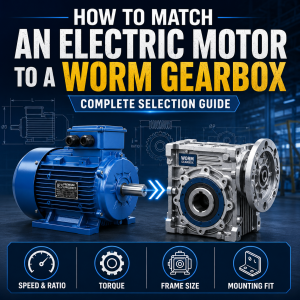
A worm gear motor is a motor + worm gearbox assembly where a worm (screw) drives a worm wheel (gear) at 90°. This geometry allows large speed reductions in a small body, producing high output torque at low RPM.
- Best for: high ratios, compact footprint, smooth low-speed motion
- Common ratios: typically 7.5:1 up to 100:1+ depending on size/series
- Typical output: low RPM, high torque, stable drive behaviour
If you’re still deciding between gearbox types, you may also want to read: Mastering the Power of Inline Gearboxes and Bevel Helical Gearbox Vs Worm Gearboxes.
How Does a Worm Gear Motor Work?
Inside the gearbox, the worm (input) rotates and meshes with the worm wheel (output). Because the worm drives the wheel across a sliding contact, worm gearboxes deliver:
- High reduction ratios in one stage
- Smooth, quiet running at low speed
- Compact right-angle drive layout
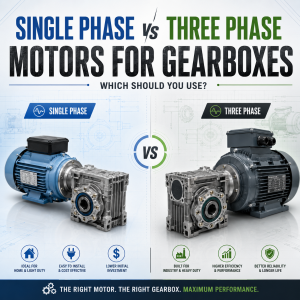
Worm gear motors are often paired with 3-phase motors for industrial reliability and easy speed control, but they can also be supplied with single-phase motors where required. If you want a motor refresher, these will help: How Does A 3 Phase Motor Work? and How does a single phase motor work?.
When Should You Use a Worm Gear Motor? (Best Applications)
Worm gear motors are a great fit when you need high torque at low speed and you want a compact unit that’s easy to mount. Here are the most common use-cases:
✅ Conveyors & Material Handling
- Small-to-medium belt conveyors
- Roller conveyors (light duty)
- Transfer tables and indexing conveyors
✅ Packaging, Food & Light Production Machinery
- Wrapping machines
- Labelers and feeders
- Mixers (light to moderate duty)
✅ Gates, Doors & Automation Systems
- Gate drives where compact right-angle layouts help
- Positioning and control mechanisms
✅ Low-Speed, Smooth Motion Systems
- Rotary tables (light duty)
- Small hoists/winches (application dependent)
If you’re choosing a gearbox for a specific machine, you’ll also want this: Things To Know Before Selecting A Gearbox.
Pros and Cons of Worm Gear Motors
✅ Advantages
- Compact: high ratio in a small footprint
- Right-angle output: ideal for tight machine layouts
- Quiet operation: smooth running at low RPM
- Simple integration: common IEC motor options and easy mounting
⚠️ Limitations (When Not to Use One)
- Lower efficiency than helical/inline gearboxes in many cases (especially at high ratios and continuous duty)
- Heat build-up risk if oversized loads or poor ventilation
- Not ideal for heavy shock loads or high-duty cycle high-torque applications without correct sizing
If your application is continuous-duty and efficiency is critical, you may want to compare alternatives: Inline Gearboxes and Bevel Helical vs Worm Gearboxes.
Key Specs to Check Before You Buy
To select the right worm gear motor, focus on the specs that determine whether the unit will actually survive your load and perform as expected.
1) Output Torque (Nm)
Your load determines the required output torque. For conveyors and rotating loads, you typically calculate torque from the load force and drum/pulley radius. Always include a safety factor (especially for starting loads and intermittent jams).
2) Output Speed (RPM) and Ratio
Worm gear motors are chosen by required output RPM. The ratio is determined by motor speed (often 1400 or 2800 RPM for 50Hz motors) divided by output speed.
3) Motor Power (kW / HP)
Power must match the load and duty cycle. If you’re using an inverter drive (VFD), you can also tune acceleration and torque behaviour. If you’re new to inverters, this intro will help: What is an Inverter?
4) Duty Cycle (S1, S2, S3 etc.)
Continuous duty applications demand more careful gearbox sizing, especially with worm gearing. If your motor runs all day, consider thermal limits and efficiency — not just torque.
5) Mounting Type and Position
Your machine layout determines whether you need foot mount, flange mount, or shaft mount options — and mounting orientation can affect lubrication behaviour.
Do You Need a Brake Motor with a Worm Gearbox?
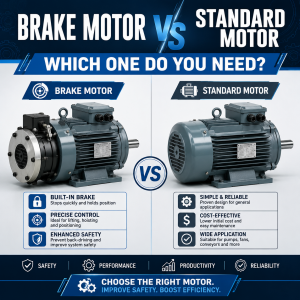
In many applications, a worm gearbox can provide a strong “holding” effect — but you should not assume it replaces a brake in safety-critical systems. If you need controlled stopping, anti-runback protection, or safe holding under load, a brake motor is often the correct choice.
Learn more here: Unleashing the Unstoppable Power of Brake Motors.
Worm Gear Motor vs Inline Gearbox: Which is Better?
This depends on what your machine prioritises.
- Choose worm gear motors when you need high ratios, compact right-angle layout, and smooth low speed.
- Choose inline/helical when you need higher efficiency, heavier duty cycle, and better performance in continuous operation.
If you’re comparing gearbox types in detail, this guide is the best next step: Mastering the Power of Inline Gearboxes.
Common Buying Mistakes (and How to Avoid Them)
- Choosing ratio first and ignoring torque: Always verify required output torque with a safety factor.
- Not checking duty cycle: Worm gearing can overheat if selected purely on torque for continuous operation.
- Assuming “self-locking” equals safe holding: Use brakes where safety or load holding is critical.
- Forgetting mounting constraints: Foot/flange orientation matters for installation and lubrication.
For a selection framework you can reuse for any project, read: Things To Know Before Selecting A Gearbox and How to Choose the Right Worm Gear Motor in 2026.
Shop Worm Gear Motors Online (UK Supply)
If you already know your required torque, ratio, motor power, and mounting type, you can browse worm gear motors and gearboxes suitable for industrial applications.
Not sure what you need yet? Start with the essentials: Gearbox Selection Checklist →
FAQ: Worm Gear Motors
Are worm gear motors self-locking?
Some worm gearboxes can resist back-driving under certain conditions, but this depends on ratio, efficiency, load, and wear. Do not rely on “self-locking” as a safety mechanism — use a brake or mechanical lock where required.
What ratio should I choose?
Choose ratio based on required output RPM and motor speed (typically 1400/2800 RPM at 50Hz). Then confirm torque, thermal limits, and duty cycle.
Can I run a worm gear motor on a VFD?
Yes — VFD control can help tune acceleration and reduce shock loading. Just ensure the motor and gearbox are sized for the operating range and duty. If you’re new to this, read: What is an Inverter?.
Next read: If you’re still narrowing down gearbox options, compare types here: Bevel Helical Gearbox Vs Worm Gearboxes.