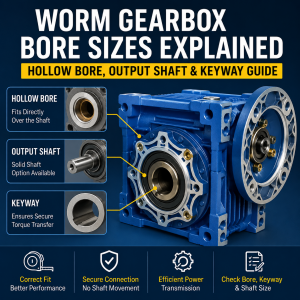
Worm Gearbox Bore Sizes Explained: Hollow Bore, Output Shaft & Keyway Guide
Choosing the correct worm gearbox is not only about ratio, torque, motor power or frame size. The output bore size is one of the most important details because it determines whether the gearbox will physically fit onto the driven shaft of your machine.
A worm gearbox with the wrong hollow bore, output shaft arrangement or keyway size can cause installation problems, poor torque transfer, shaft movement, vibration, premature wear or complete incompatibility with the application. This guide explains how worm gearbox bore sizes work, what hollow bore means, how keyways are used, and what to check before buying a replacement gearbox.
What Is the Bore Size on a Worm Gearbox?
The bore size is the internal diameter of the gearbox output hole where the machine shaft fits. On many modern worm gearboxes, this is a hollow output bore, meaning the gearbox slides directly over the driven shaft instead of using a separate external output shaft.
For example, a worm gearbox may have a hollow bore of 14mm, 18mm, 25mm, 28mm, 35mm, 42mm or larger depending on the gearbox size. This bore must match the shaft diameter on the conveyor, mixer, packaging machine, feeder or other driven equipment.
If you are replacing an existing unit, always measure the machine shaft and compare it with the gearbox data sheet before ordering. You can browse our main Gearboxes range or view dedicated Worm Gearboxes by size, ratio and brand.
What Is a Hollow Bore Worm Gearbox?
A hollow bore worm gearbox has a hollow output sleeve instead of a solid projecting shaft. The driven machine shaft fits directly into the hollow bore, allowing the gearbox to mount compactly onto the equipment.
This is very common on conveyors, packaging machines, food processing equipment, gates, mixers and general industrial machinery because it saves space and can reduce the need for extra couplings.
Benefits of a Hollow Bore Gearbox
- Compact mounting: The gearbox can sit close to the machine frame.
- Simple installation: The driven shaft passes directly into the gearbox bore.
- Reduced components: Fewer couplings, guards and alignment parts may be required.
- Flexible mounting: Many worm gearboxes can be installed in different positions.
- Reliable torque transfer: When correctly keyed and secured, the gearbox can transmit torque effectively.
Hollow bore designs are commonly found across ranges such as Motovario NMRV Worm Gearboxes, Varvel Worm Gearboxes and Bonfiglioli Worm Gearboxes.
Why Bore Size Matters When Selecting a Worm Gearbox
The bore size controls how the gearbox connects to the machine output shaft. Even if the ratio, torque rating and motor input are correct, the gearbox will not fit if the bore is wrong.
A bore that is too small will not slide onto the shaft. A bore that is too large may cause movement, poor key engagement, vibration or damage unless a correct sleeve or adapter is used. This is why bore size should always be checked alongside ratio, gearbox size, mounting position and motor input flange.
Before Ordering a Worm Gearbox, Check:
- Driven shaft diameter: Measure the shaft that the gearbox will fit onto.
- Keyway size: Check that the key width and depth match the gearbox bore.
- Gearbox frame size: Larger frame sizes usually have larger standard bore options.
- Mounting position: Confirm whether the gearbox needs a foot, flange or torque arm.
- Motor input: Check the gearbox accepts the required IEC motor flange.
- Torque rating: Make sure the gearbox can handle the application load.
If the gearbox is for a conveyor, start by checking our Motors for Conveyors and suitable worm gearbox ranges. For pump applications, browse Motors for Pumps alongside your gearbox selection.
Common Worm Gearbox Bore Sizes
Different manufacturers use slightly different gearbox dimensions, but many worm gearboxes follow common frame-size patterns. Smaller gearboxes usually have smaller output bores, while larger units use larger hollow bore sizes for higher torque and larger driven shafts.
| Gearbox Size | Typical Bore Range | Common Applications |
|---|---|---|
| NMRV025 / Size 25 | Small output bore sizes | Light-duty machinery, small feeders, compact automation |
| NMRV030 / Size 30 | Small to medium bore sizes | Light conveyors, packaging equipment, small mechanisms |
| NMRV040 / Size 40 | Medium bore sizes | Conveyors, mixers, small industrial drives |
| NMRV050 / Size 50 | Medium bore sizes | Conveyors, food machinery, automation systems |
| NMRV063 / Size 63 | Medium to larger bore sizes | Heavier conveyors, rotary equipment, handling machinery |
| NMRV075 / Size 75 | Larger bore sizes | Industrial conveyors, heavier processing machinery |
| NMRV090 and above | Large bore sizes | High-torque machinery, larger driven shafts, heavy-duty applications |
For size-specific selections, view Motovario NMRV025 Worm Gearboxes, Motovario NMRV030 Worm Gearboxes, Motovario NMRV040 Worm Gearboxes and Motovario NMRV050 Worm Gearboxes.
What Is the Keyway on a Worm Gearbox Bore?
The keyway is the slot cut into the bore of the gearbox. It works with a matching key on the driven shaft to transfer torque from the gearbox to the machine shaft.
Without the correct keyway engagement, the shaft may slip inside the bore. This can damage the gearbox, shaft, key, driven machine or all of them at the same time. The keyway is especially important on conveyor drives, indexing tables, mixers and applications where the load starts and stops frequently.
The Keyway Must Match:
- The shaft key width
- The shaft key height
- The keyway position
- The length of engagement inside the bore
- The torque being transmitted
If you are replacing an old gearbox, do not only measure the outside frame size. Check the bore diameter and keyway dimensions too.
What Does H8 Mean on a Gearbox Bore?
You may see gearbox data sheets describe a bore as something like “28mm H8”. The “28mm” is the bore diameter, while “H8” refers to the engineering tolerance of the bore.
In simple terms, H8 tells you the bore is manufactured to a controlled tolerance so that it fits correctly with a matching shaft. This matters because a gearbox bore cannot be too tight or too loose. A poor fit can make installation difficult or cause movement during operation.
For ecommerce product descriptions, it is often clearer to describe this as the standard hollow output bore size rather than only writing “H8”, because many buyers simply need to know whether the gearbox will fit their shaft.
Solid Output Shaft vs Hollow Bore Worm Gearbox
Some gearboxes use a solid output shaft, while many worm gearboxes use a hollow bore. The correct option depends on how the gearbox connects to the machine.
| Output Type | How It Works | Best Used For |
|---|---|---|
| Hollow Bore | The machine shaft fits directly into the gearbox bore. | Compact conveyor drives, direct shaft mounting, machinery retrofits. |
| Solid Output Shaft | The gearbox has its own projecting shaft, usually connected by a coupling, pulley or sprocket. | Applications needing external coupling, belt drive, chain drive or offset connection. |
Hollow bore worm gearboxes are popular because they are compact and easy to mount. Solid shaft arrangements can be useful where the driven machine cannot accept a shaft-mounted gearbox or where external drive components are required.
How to Measure Your Shaft Before Buying a Worm Gearbox
If you are replacing a worm gearbox and are unsure which bore size you need, measure the driven shaft carefully before ordering.
Step-by-Step Shaft Check
- Measure the shaft diameter using calipers where the gearbox will mount.
- Measure the keyway width and compare it with the gearbox bore keyway.
- Check the shaft length to make sure it engages far enough into the gearbox bore.
- Check for shoulders or circlips that may affect how far the gearbox can slide on.
- Confirm the mounting style, including foot, flange or torque arm requirements.
- Check the ratio and torque rating against the old gearbox or machine requirement.
If the gearbox is part of a motorised drive assembly, also check the motor size, speed and mounting. You can browse AC Motors, Brake Motors, 4 Pole Electric Motors and IE3 Electric Motors for compatible drive setups.
How Bore Size Relates to Gearbox Torque
Bore size and torque rating are closely connected. Larger gearbox frame sizes normally have larger bearings, larger worm wheels, larger output bores and higher torque ratings. This is why you should not choose a gearbox purely by the bore size alone.
A bore may fit the shaft, but the gearbox may still be too small for the load. Equally, a gearbox may have enough torque capacity but the wrong bore size for the machine shaft.
A Correct Gearbox Selection Should Match:
- Bore size: Fits the machine shaft correctly.
- Keyway: Transfers torque without slipping.
- Ratio: Produces the correct output speed.
- Torque rating: Handles the load safely.
- Service factor: Allows for duty cycle, starts, stops and shock loading.
- Mounting arrangement: Fits the machine layout.
- Motor input: Accepts the correct motor frame and flange.
For heavier-duty applications, consider larger sizes such as Motovario NMRV-P075 Worm Gearboxes, Motovario NMRV-P090 Worm Gearboxes and Motovario NMRV130 Worm Gearboxes.
Common Mistakes When Choosing a Worm Gearbox Bore Size
Many gearbox selection mistakes happen because the buyer checks the ratio or motor power but forgets the output bore. Below are the most common issues.
1. Measuring the Old Gearbox Instead of the Shaft
The most reliable measurement is the driven machine shaft. Old gearbox markings may not always show the bore size clearly, especially if labels are damaged or missing.
2. Assuming All Gearbox Brands Use Identical Bores
Two worm gearboxes may look similar but still have different bore sizes, keyways, flange dimensions or mounting positions. Always compare the data sheet, not just the frame size.
3. Ignoring the Keyway
The bore diameter may be correct, but if the keyway is wrong, the gearbox may not transmit torque properly.
4. Choosing the Smallest Gearbox That Fits the Shaft
A gearbox must be sized for torque, service factor and duty cycle, not only physical fitment.
5. Forgetting the Torque Arm or Mounting Accessories
Shaft-mounted worm gearboxes may need a torque arm or mounting kit to stop the gearbox body rotating under load. You can find related parts under Gearbox Accessories and Motovario Gearbox Accessories.
How to Choose the Correct Worm Gearbox Bore Size
To choose the correct bore size, start with the shaft that the gearbox will drive. The gearbox bore must match that shaft accurately and provide a secure keyed connection.
Use This Checklist:
- Identify the shaft diameter in millimetres.
- Check the keyway size and key length.
- Confirm whether the gearbox is hollow bore or solid shaft.
- Check whether the gearbox needs feet, flange or torque arm mounting.
- Confirm the required reduction ratio.
- Check the output torque requirement.
- Confirm the motor input size if fitting an IEC motor.
- Compare all dimensions against the gearbox data sheet before ordering.
If you need a complete motor and gearbox setup, browse Amtecs Aluminium Motors, Amtecs Cast Iron Motors and our wider Worm Gearboxes range.
Worm Gearbox Bore Size and Ratio Selection
The bore size determines the physical shaft fit, while the ratio determines output speed. Both must be correct.
For example, a 50:1 gearbox may give the correct slow output speed, but if the bore does not match the driven shaft, it cannot be installed. Likewise, a gearbox may fit the shaft perfectly but provide the wrong output speed if the ratio is incorrect.
When choosing a worm gearbox, always check the following together:
- Gearbox ratio
- Output bore size
- Output torque
- Motor speed
- Application duty
- Mounting position
For many conveyor and machinery applications, 4 pole motors are commonly used because they provide a practical base speed before reduction. You can view suitable options in our 4 Pole Electric Motors category.
FAQs About Worm Gearbox Bore Sizes
What does bore size mean on a worm gearbox?
Bore size means the internal diameter of the gearbox output hole where the driven machine shaft fits. On hollow bore worm gearboxes, this must match the shaft diameter of the application.
What is a hollow bore gearbox?
A hollow bore gearbox has a hollow output sleeve that slides directly over the driven shaft. This allows compact mounting without needing a separate coupling in many applications.
Is the bore size the same as the shaft size?
The bore size must match the shaft size, but they are not the same component. The bore is inside the gearbox, while the shaft is part of the driven machine.
What happens if the gearbox bore is too large?
If the bore is too large, the shaft may not locate securely. This can cause movement, poor key engagement, vibration or damage unless a correct sleeve or adapter is used.
What happens if the gearbox bore is too small?
If the bore is too small, the gearbox will not fit over the shaft. The gearbox may need to be changed for the correct bore size.
What is the keyway for?
The keyway allows a key to lock the shaft and gearbox bore together so torque can be transferred without the shaft slipping inside the bore.
Can I choose a gearbox only by bore size?
No. Bore size is important, but you must also check ratio, torque rating, service factor, mounting position, motor input and application duty.
Conclusion: Always Check the Bore Before Ordering
Worm gearbox bore size is one of the most important details when replacing or selecting a gearbox. The gearbox must physically fit the driven shaft, but it also needs the correct keyway, ratio, torque capacity, mounting style and motor input.
Before buying a replacement worm gearbox, measure the driven shaft, check the keyway, confirm the ratio and compare all dimensions against the gearbox data sheet. This helps avoid installation problems and ensures the gearbox is correctly matched to your machine.
At Worm Gear Motors Online, we supply a wide range of Worm Gearboxes, Gearboxes, AC Motors and Gearbox Accessories for industrial applications. Whether you are replacing a compact hollow bore gearbox or selecting a larger worm gearbox for a high-torque application, checking the bore size first will help you choose the correct unit.