
Worm Gearbox Service Factor Explained: What It Means and Why It Matters
When choosing a worm gearbox, it is not enough to select a unit based only on ratio, motor power or output speed. One of the most important factors is the service factor. Service factor helps you understand whether a gearbox is strong enough for the real working conditions of your machine, including operating hours, load type, start-stop frequency, shock loading and duty cycle.
A worm gearbox that looks suitable on paper may still fail early if the service factor is too low for the application. This can lead to overheating, premature wear, bearing failure, damaged gears, oil breakdown or unexpected downtime. That is why service factor should always be considered when selecting a worm gearbox for conveyors, feeders, mixers, packaging machines, indexing systems, lifting equipment and industrial drive systems.
At Worm Gear Motors Online, we supply a wide range of industrial worm gearboxes for different duty levels, including compact units such as Motovario NMRV025 worm gearboxes, medium-duty sizes such as Transtecno CM050 worm gearboxes and larger industrial options such as Motovario NMRV-P110 worm gearboxes.
What Is Service Factor on a Worm Gearbox?
Service factor is a safety margin used when selecting a gearbox. It helps account for the difference between ideal catalogue conditions and real-world operating conditions.
In simple terms, service factor tells you how much extra capacity a gearbox should have compared with the basic calculated load. A gearbox running a smooth, light-duty application for a few hours per day may need a lower service factor. A gearbox running a heavy conveyor, mixer or feeder for long hours with shock loads may need a much higher service factor.
For example, if your application needs 100Nm of output torque and the recommended service factor is 1.5, you should select a gearbox with a rated output torque of at least:
100Nm × 1.5 = 150Nm
This means the gearbox is not only capable of moving the load, but also has a suitable safety margin for the real operating conditions.
You can also use our Service Factor Calculator to estimate the correct service factor for your application.
Why Service Factor Matters
Service factor matters because industrial machines rarely operate under perfect conditions. Gearboxes are exposed to different loads, starting forces, stopping forces, shock loads, vibration, temperature changes and operating hours.
A gearbox that is too small may work at first, but it may not last. The damage often happens gradually. The gearbox may run hot, become noisy, leak oil, wear the bronze wheel faster or eventually fail under load.
Choosing the correct service factor helps to:
- Improve gearbox life: The gearbox is less likely to be overloaded during normal operation.
- Reduce overheating: Correct sizing helps avoid excessive thermal stress.
- Protect bearings and shafts: Higher service margins help absorb real-world forces.
- Reduce downtime: A correctly selected gearbox is less likely to fail unexpectedly.
- Improve reliability: The gearbox is better matched to the application.
- Prevent under-sizing: The gearbox has enough capacity beyond the basic calculated torque.
How Service Factor Is Calculated
The required service factor depends on several operating conditions. The most important factors are:
- Operating hours per day: Longer running times usually require a higher service factor.
- Load type: Smooth loads need less allowance than shock or impact loads.
- Start-stop frequency: Frequent starts and stops increase stress on the gearbox.
- Application type: Conveyors, mixers, crushers and feeders all create different loads.
- Motor power: Higher motor power can overload a small gearbox if not matched correctly.
- Duty cycle: Continuous-duty applications need more careful selection than occasional use.
- Ambient conditions: Heat, dust, vibration and harsh environments can increase gearbox stress.
As a general guide, lighter applications may use a service factor around 1.0 to 1.25. Medium-duty industrial applications may need around 1.25 to 1.5. Heavy-duty, high-shock or long-running applications may need 1.5, 2.0 or higher depending on the exact conditions.
Typical Service Factor Guide
| Application Type | Load Condition | Typical Service Factor Range |
|---|---|---|
| Light-duty conveyor | Smooth load, low shock | 1.0 to 1.25 |
| Packaging machine | Moderate starts and stops | 1.25 to 1.5 |
| Feeder or screw conveyor | Variable load | 1.5 to 1.75 |
| Mixer or agitator | Heavy load, possible shock | 1.5 to 2.0 |
| Indexing or stop-start system | Frequent starts and stops | 1.5 to 2.0+ |
| Heavy industrial machinery | Shock loading or long duty | 2.0+ |
This table should be used as a starting point only. The exact gearbox selection should always be checked against torque, ratio, frame size, motor power and duty cycle.
Example: Why Service Factor Changes Gearbox Selection
Imagine a machine needs a gearbox output torque of 200Nm. If the application is smooth and only runs occasionally, a service factor of 1.25 may be enough.
200Nm × 1.25 = 250Nm required gearbox rating
However, if the same load is used on a feeder running long hours with shock loading, the recommended service factor may be closer to 1.75.
200Nm × 1.75 = 350Nm required gearbox rating
Both applications need the same basic torque, but the second application needs a much stronger gearbox because the working conditions are more demanding. This is why service factor is so important when selecting a worm gearbox.
Service Factor and Gearbox Frame Size
Service factor often affects the gearbox frame size. If a gearbox is too small, increasing the service factor may push the selection into the next frame size up.
For example, a compact gearbox may be suitable for a light-duty application, but a larger frame may be needed for the same ratio and motor power if the application runs continuously or sees shock loads.
Smaller units such as Transtecno CM040 worm gearboxes and Varvel FRS40 worm gearboxes are often used for compact machinery and lighter-duty applications. Larger units such as Bonfiglioli W 86 worm gearboxes and STM RMI 70 worm gearboxes are more suitable where higher torque capacity or heavier-duty operation is required.
Service Factor and Operating Hours
The number of hours a gearbox runs each day has a major effect on service factor. A gearbox running for 30 minutes per day is under much less stress than one running for 16 hours per day.
| Operating Time | Selection Risk | Service Factor Impact |
|---|---|---|
| Occasional use | Lower | Lower service factor may be acceptable |
| Several hours per day | Medium | Moderate service factor recommended |
| Full shift operation | Higher | Higher service factor usually required |
| Continuous operation | Highest | Careful sizing and thermal checks required |
Continuous operation can also increase the importance of gearbox efficiency, oil temperature and housing size. A gearbox may have enough mechanical torque capacity but still run too hot if it is undersized thermally.
Service Factor and Load Type
Not all loads are equal. A smooth-running conveyor creates a very different load from a mixer, feeder, crusher or indexing system. Shock loads and sudden stops place much higher stress on the gearbox teeth, bearings, shafts and housing.
Smooth Loads
Smooth loads are predictable and steady. Examples include light conveyors, rollers and simple rotary motion. These usually need a lower service factor.
Moderate Loads
Moderate loads include machines with regular starts and stops, variable loads or intermittent resistance. Packaging machines, transfer conveyors and light feeders may fall into this category.
Heavy or Shock Loads
Heavy loads include mixers, agitators, screw conveyors, indexing tables and systems where the load can suddenly increase. These usually need a higher service factor and may require a larger gearbox frame.
For medium-duty industrial applications, categories such as Varvel FRS50 worm gearboxes, STM RMI 50 worm gearboxes and SITI MI40 worm gearboxes can be useful starting points depending on the required torque, ratio and mounting style.
Service Factor and Worm Gearbox Ratio
Gearbox ratio also matters when considering service factor. Higher ratios reduce output speed and increase torque multiplication, but they can also reduce efficiency and increase heat generation inside the gearbox.
A high-ratio worm gearbox may be suitable for slow-speed applications, but it should still be checked carefully if the machine runs for long periods or carries heavy loads. In some cases, selecting a larger frame size is better than using the smallest gearbox that technically meets the torque requirement.
For high-ratio or heavier-duty applications, it is important to check:
- Output torque rating
- Gearbox efficiency
- Thermal capacity
- Lubrication requirements
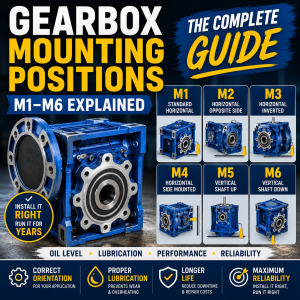
- Mounting position
- Service factor
- Motor power compatibility
Common Problems Caused by Low Service Factor
If the service factor is too low, the gearbox may be under-sized for the real operating conditions. This can cause several common problems:
- Overheating: The gearbox runs hotter than expected due to excessive load or duty cycle.
- Premature gear wear: The worm wheel can wear faster under high load.
- Bearing failure: Bearings can become overloaded by shock loads or misapplied torque.
- Oil breakdown: High temperature can reduce lubricant life and protection.
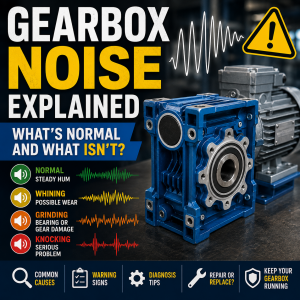
- Noise and vibration: Internal wear can make the gearbox louder over time.
- Seal leaks: Heat and pressure can contribute to oil leakage.
- Unexpected downtime: Gearbox failure can stop production and increase repair costs.
These problems can often be avoided by choosing a gearbox with a suitable service factor from the beginning.
How to Choose the Correct Service Factor
To choose the correct service factor, gather the key application details before selecting the gearbox:
- What is the required output speed?
- What output torque is needed?
- What motor power and speed will be used?
- How many hours per day will the gearbox run?
- Is the load smooth, moderate or heavy shock?
- How often does the machine start and stop?
- Is the gearbox used on a conveyor, mixer, feeder, packaging machine or indexing system?
- Will the gearbox run in a hot, dusty, wet or harsh environment?
- Is there enough space to use a larger gearbox if needed?
Once you know these details, you can use the required torque and service factor to choose a gearbox with enough rated capacity.
For a quick starting point, use our Service Factor Calculator to estimate the recommended service factor for your application.
Recommended Worm Gearbox Categories
If you are selecting a worm gearbox and need to compare different sizes or brands, these categories are useful starting points:
- Motovario NMRV025 Worm Gearboxes
- Transtecno CM040 Worm Gearboxes
- Transtecno CM050 Worm Gearboxes
- Varvel FRS40 Worm Gearboxes
- Varvel FRS50 Worm Gearboxes
- STM RMI 40 Worm Gearboxes
- STM RMI 50 Worm Gearboxes
- STM RMI 70 Worm Gearboxes
- Bonfiglioli W 86 Worm Gearboxes
- SITI MI40 Worm Gearbox – 19mm Hollow Bore
Frequently Asked Questions
What does service factor mean on a worm gearbox?
Service factor is a safety margin used when selecting a gearbox. It allows for real operating conditions such as running hours, shock loading, start-stop frequency, load type and duty cycle.
Is a higher service factor better?
A higher service factor gives more safety margin, but it may also mean using a larger or more expensive gearbox. The best service factor is the one that matches the application properly without under-sizing or over-sizing the gearbox.
What happens if the gearbox service factor is too low?
If the service factor is too low, the gearbox may overheat, wear quickly, become noisy, leak oil or fail early. This is especially common in heavy-duty, long-running or shock-loaded applications.
Do conveyors need a high service factor?
It depends on the conveyor. A light conveyor with a smooth load may only need a moderate service factor. A heavily loaded conveyor, incline conveyor, stop-start conveyor or conveyor running long hours may need a higher service factor.
Does service factor affect gearbox size?
Yes. A higher service factor may require a larger gearbox frame size because the gearbox must have enough torque capacity for the calculated load plus the safety margin.
Can I use a smaller gearbox if the ratio is correct?
Not always. The ratio only controls speed reduction. The gearbox still needs enough torque capacity, thermal capacity and service factor for the application.
Final Advice: Do Not Ignore Service Factor
Service factor is one of the most important parts of worm gearbox selection. It helps make sure the gearbox can handle the real conditions of the machine, not just the basic calculated load.
Before choosing a worm gearbox, always check the output speed, torque requirement, ratio, frame size, motor power, duty cycle, load type and service factor. This will help you avoid under-sizing the gearbox and improve long-term reliability.
For a quick estimate, try our Service Factor Calculator, or browse our worm gearbox categories to compare suitable sizes and brands for your application.