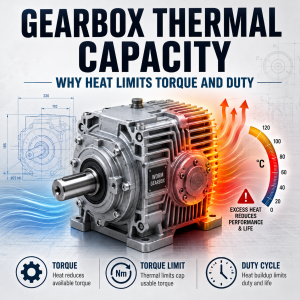
Gearbox Thermal Capacity Explained: Why Heat Limits Torque and Duty
When selecting a gearbox, most buyers focus on output torque, ratio, bore size, mounting position and motor power. However, one of the most important limits is often overlooked: gearbox thermal capacity.
Thermal capacity is the gearbox’s ability to handle heat during operation. A gearbox can be mechanically strong enough to transmit a certain torque, but still overheat if it runs for too long, carries too much load, uses a high reduction ratio or operates in a hot environment.
This guide explains what gearbox thermal capacity means, why heat limits torque and duty cycle, and what to check when choosing a gearbox for conveyors, pumps, fans, mixers and industrial machinery.
What Is Gearbox Thermal Capacity?
Gearbox thermal capacity refers to the amount of power and load a gearbox can handle without overheating. As a gearbox runs, friction is created inside the gear set, bearings, seals and lubricant. That friction generates heat.
If the gearbox can release heat into the surrounding air faster than it generates heat, it will usually run within a safe temperature range. If the gearbox generates more heat than it can dissipate, the oil temperature rises, seals become stressed, lubricant breaks down and internal wear increases.
This is especially important for worm gearboxes, because worm gear designs naturally generate more sliding friction than some other gearbox types.
Mechanical Rating vs Thermal Rating
A gearbox normally has two important performance limits: mechanical rating and thermal rating.
- Mechanical rating: The torque or power the gearbox can physically transmit without damaging the gears, shafts, bearings or housing.
- Thermal rating: The power the gearbox can handle continuously without overheating.
A gearbox may appear suitable based on mechanical torque, but it can still be unsuitable if the thermal rating is too low for the duty cycle. This is why continuous-running applications need more careful selection than short intermittent applications.
For general gearbox selection, start with the full gearboxes range, then narrow the choice by ratio, output torque, mounting style, motor size and duty requirements.
Why Gearboxes Generate Heat
Heat is created whenever mechanical energy is lost inside the gearbox. No gearbox is 100% efficient, so some of the motor power is converted into heat instead of useful output torque.
Main causes of gearbox heat include:
- Gear tooth friction
- Bearing friction
- Seal drag
- Oil churning
- High input speed
- High reduction ratios
- Overloading
- Poor lubrication
- Incorrect mounting position
- High ambient temperature
The higher the load and the longer the gearbox runs, the more important thermal capacity becomes.
Why Worm Gearboxes Need Thermal Checking
Worm gearboxes are compact, simple and excellent for right-angle drive systems, but they are less efficient than many helical or bevel gear designs. This is because a worm gearbox uses a sliding gear contact between the worm screw and worm wheel.
Sliding contact creates more friction, especially at high ratios. The result is more heat. This does not mean worm gearboxes are unsuitable — it simply means they must be selected correctly for the load and duty cycle.
Compact units such as Motovario NMRV030 worm gearboxes, Motovario NMRV040 worm gearboxes and Motovario NMRV050 worm gearboxes are ideal for smaller machinery, but they should not be overloaded or used beyond their thermal limits.
How Heat Limits Gearbox Torque
A gearbox may be able to transmit high torque for a short time, but not continuously. This is because short bursts of torque may not create enough heat to cause a problem, while continuous torque can gradually raise the gearbox temperature until it exceeds the safe operating range.
For example, a gearbox used on a small indexing table may only run for a few seconds at a time. The same gearbox used on a conveyor running all day may overheat because the heat has no recovery period.
This is why two applications with the same torque requirement can need different gearbox sizes. The continuous-duty application often needs a larger gearbox, better lubrication, lower ratio, reduced motor power or a higher service factor.
Duty Cycle and Thermal Capacity
Duty cycle describes how long the gearbox runs compared with how long it rests. A gearbox that runs for 10 minutes and rests for 30 minutes has a much easier thermal duty than a gearbox running continuously for 8 hours.
Common duty types include:
- Intermittent duty: The gearbox runs for short periods with cooling time between cycles.
- Frequent start-stop duty: The gearbox starts and stops repeatedly, often creating extra heat and shock loading.
- Continuous duty: The gearbox runs for long periods with little or no cooling time.
- Heavy-duty continuous operation: The gearbox runs continuously under high load, often requiring a larger frame size.
For continuous conveyor applications, it is worth checking both the gearbox and motor together. Categories such as motors for conveyors and motors for gearboxes can help when building a matched drive system.
High Ratios Create More Heat
Gearbox ratio has a major effect on heat generation. Higher ratios usually mean more gear contact, more sliding action and greater losses inside the gearbox. In worm gearboxes, very high ratios can generate more heat than lower ratios under the same motor input power.
A low ratio such as 5:1 or 7.5:1 may run cooler than a high ratio such as 60:1 or 80:1, depending on load, speed and gearbox size. If the application needs very slow output speed, it may be better to use a larger gearbox, a different motor speed, or inverter control rather than forcing a small gearbox to do all the speed reduction.
For medium and larger gearbox applications, larger units such as Motovario NMRV-P063 worm gearboxes, Motovario NMRV-P075 worm gearboxes and Motovario NMRV-P090 worm gearboxes may provide better thermal performance than smaller frames.
Input Speed and Heat Build-Up
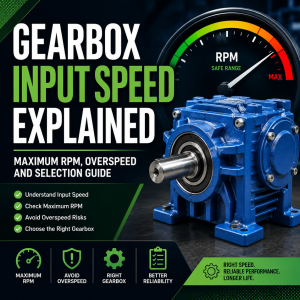
The faster the motor runs into the gearbox, the more heat the gearbox may generate. Higher input speed increases bearing activity, seal friction and oil churning. This can raise the operating temperature, especially on high-ratio gearboxes.
Many gearbox applications use 4 pole electric motors because they offer a practical balance between speed and torque. A 2 pole motor runs faster, which may increase gearbox heat in some applications. A 6 pole motor runs slower, which may help reduce gearbox input speed but changes the available output speed and torque relationship.
When selecting motor speed, compare 2 pole electric motors, 4 pole electric motors and 6 pole electric motors against the gearbox ratio and required final output speed.
Ambient Temperature Matters
A gearbox running in a cool workshop has more ability to lose heat than a gearbox running inside a hot factory, near an oven, inside a machine guard or outdoors in direct sunlight. Ambient temperature can reduce the gearbox’s ability to cool itself.
If the surrounding air is already hot, the temperature difference between the gearbox housing and the air is smaller. This means the gearbox releases heat less effectively. Applications in hot environments may need a larger gearbox, improved ventilation, synthetic lubricant, reduced load or a lower duty cycle.
This is especially important for food production, packaging machinery, processing lines and enclosed industrial systems where airflow may be restricted.
Mounting Position and Lubrication
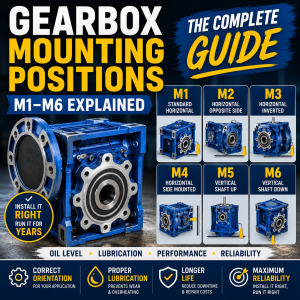
Gearbox mounting position affects lubrication and heat control. The oil level inside the gearbox must suit the way the gearbox is mounted. If the gearbox is installed in the wrong position without checking oil level, some bearings or gear contacts may not receive proper lubrication.
Poor lubrication increases friction, heat and wear. Too much oil can also create excess churning losses, which increases temperature and reduces efficiency.
Before installation, always check the correct oil level, breather position and mounting orientation. This is especially important when fitting worm gearboxes in vertical or non-standard positions.
Service Factor and Thermal Duty
Service factor is used to allow for real-world working conditions. A gearbox used on a smooth, lightly loaded application may need a lower service factor than a gearbox used on a conveyor, mixer, crusher or application with frequent starts.
Thermal capacity and service factor are closely linked because severe duty usually creates more heat. A gearbox that is just large enough for the calculated torque may not be large enough once thermal load, start-stop cycles, shock loading and ambient temperature are considered.
For heavy-duty gearbox applications, it is often safer to choose the next gearbox size up rather than running a smaller gearbox at its limit.
How to Tell If a Gearbox Is Running Too Hot
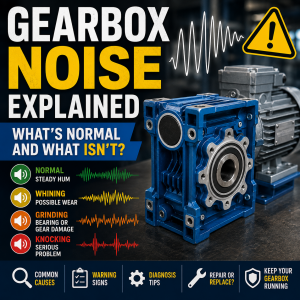
Some warmth during operation is normal. Gearboxes are mechanical units, and they will generate heat under load. However, excessive heat is a warning sign that something may be wrong.
Common signs of overheating include:
- The gearbox housing becomes too hot to touch safely.
- Oil leaks from seals or breathers.
- The gearbox smells hot or burnt.
- Lubricant darkens or breaks down quickly.
- Noise increases during operation.
- Output torque becomes inconsistent.
- Bearings or seals fail prematurely.
- The motor current rises under the same load.
If a gearbox overheats, do not simply replace it with the same size without checking the cause. The application may need a larger gearbox, different ratio, better oil, improved ventilation or reduced load.
Thermal Capacity and Conveyor Gearboxes
Conveyors are one of the most common applications where thermal capacity matters. A conveyor may look like a simple load, but it can run for long periods and may start under load with product already on the belt.
Heat risk increases when the conveyor:
- Runs continuously for long shifts
- Starts and stops frequently
- Runs at a high reduction ratio
- Moves heavy product
- Operates in a hot or dusty environment
- Uses an undersized gearbox
- Has poor belt alignment or high friction
For conveyor systems, choose the gearbox, motor and control method together. A matched setup using suitable conveyor motors and correctly sized gearbox can improve reliability and reduce overheating risk.
Thermal Capacity and Inverter Drives
Inverter drives are useful because they control motor speed, acceleration and deceleration. However, changing motor speed also changes the gearbox operating conditions.
Running a gearbox slower can reduce input speed, but the gearbox may still carry high torque for long periods. Running faster can increase heat generation. Rapid acceleration and deceleration can also increase mechanical stress.
For variable speed applications, categories such as Invertek Optidrive E3 drives and Tec three phase TecDrive inverters may be useful when building a controlled drive system.
Aluminium vs Cast Iron Housings and Heat
Gearbox housing material also affects heat dissipation and durability. Aluminium housings are lightweight and can dissipate heat well on smaller gearboxes. Cast iron housings are heavier and more rigid, making them suitable for larger, higher-load industrial applications.
On small to medium worm gearboxes, aluminium housings are common and practical. On larger, heavy-duty gearboxes, cast iron construction is often preferred because the housing must handle higher loads, vibration and long-duty operation.
For heavier worm gearbox applications, larger units such as Varvel FRS85 worm gearboxes, Varvel FRS110 worm gearboxes and Bonfiglioli W 110 worm gearboxes may be more suitable than small compact gearboxes.
How to Reduce Gearbox Heat
If a gearbox is running too hot, the solution depends on the cause. In some cases, a simple maintenance issue may be responsible. In other cases, the gearbox may be undersized for the application.
Ways to reduce gearbox heat include:
- Select a larger gearbox frame size.
- Use a lower reduction ratio where possible.
- Reduce input speed.
- Use the correct oil grade and oil level.
- Improve airflow around the gearbox.
- Avoid enclosing the gearbox without ventilation.
- Check for overloading or mechanical binding.
- Check conveyor alignment and friction.
- Use a suitable service factor.
- Reduce frequent start-stop cycling where possible.
- Use an inverter for controlled acceleration and deceleration.
- Check mounting position and breather arrangement.
Choosing the Right Gearbox for Thermal Duty
To choose the correct gearbox, do not rely only on motor power or output torque. You should also check how the gearbox will be used throughout the day.
Before selecting a gearbox, consider:
- Required output torque
- Required output speed
- Gearbox ratio
- Motor power and speed
- Duty cycle
- Hours per day
- Start-stop frequency
- Shock loading
- Ambient temperature
- Mounting position
- Lubrication requirements
- Service factor
- Ventilation around the gearbox
For demanding applications, it is better to choose a gearbox with thermal margin rather than running a smaller gearbox at its limit. A slightly larger gearbox may cost more initially, but it can reduce downtime, oil breakdown, seal failure and premature wear.
Common Mistakes with Gearbox Thermal Capacity
Many gearbox failures happen because the gearbox was chosen only by ratio and output bore, without checking the full duty. Thermal overload is often gradual, so the gearbox may work at first but fail early after repeated overheating.
Common mistakes include:
- Choosing the smallest gearbox that physically fits.
- Ignoring continuous-duty requirements.
- Using a high-ratio worm gearbox on a heavy continuous load.
- Assuming mechanical torque rating is enough.
- Not checking oil level after changing mounting position.
- Running the gearbox inside a hot, enclosed machine guard.
- Using a faster motor without checking heat generation.
- Ignoring shock loads and frequent starts.
- Replacing a failed gearbox with the same size without identifying the cause.
Which Applications Need the Most Thermal Checking?
Thermal capacity should be checked carefully for any gearbox that runs for long periods, carries heavy loads or operates in a harsh environment.
Applications that need extra attention include:
- Conveyors
- Mixers
- Augers
- Screw feeders
- Pumps
- Fans
- Packaging lines
- Food processing machinery
- Industrial production equipment
- High-ratio worm gearbox systems
For pump and fan systems, also check the motor selection. Categories such as motors for pumps and motors for fans can help when matching the motor side of the drive system.
Final Recommendation
Gearbox thermal capacity is one of the most important factors in long-term reliability. A gearbox can be mechanically strong enough for the torque but still fail if it cannot control heat during operation.
For light intermittent applications, a compact gearbox may be perfectly suitable. For continuous-duty conveyors, high-ratio worm gearboxes, hot environments or heavy industrial machinery, thermal capacity must be checked carefully. The safest approach is to select the gearbox based on torque, ratio, motor speed, duty cycle, service factor and operating environment together.
At Worm Gear Motors Online, we supply compact and heavy-duty worm gearboxes, electric motors, conveyor motors and inverter drives for a wide range of industrial applications. Browse our gearboxes, worm gearboxes, AC motors and motors for gearboxes to build the right drive solution for your machinery.
FAQs
What does gearbox thermal capacity mean?
Gearbox thermal capacity is the gearbox’s ability to handle heat during operation. It shows whether the gearbox can run under load without overheating.
Can a gearbox be strong enough but still overheat?
Yes. A gearbox may have enough mechanical torque capacity but still overheat if it runs continuously, uses a high ratio, carries too much load or operates in a hot environment.
Why do worm gearboxes generate heat?
Worm gearboxes generate heat because they use sliding contact between the worm screw and worm wheel. This creates more friction than some other gearbox designs, especially at higher ratios.
Does a higher gearbox ratio create more heat?
Usually, yes. Higher ratios can create more friction and lower efficiency, especially in worm gearboxes. This can increase heat under load.
How do I stop a gearbox from overheating?
You can reduce gearbox heat by selecting a larger gearbox, reducing load, lowering input speed, using the correct oil, improving ventilation and checking the mounting position and service factor.
Is a hot gearbox always a problem?
Some warmth is normal, but excessive heat is a warning sign. If the gearbox becomes very hot, leaks oil, smells burnt or fails seals, the application should be checked.
Does motor speed affect gearbox temperature?
Yes. Higher input speed can increase oil churning, bearing activity and friction, which may raise gearbox temperature.
Should I choose a larger gearbox for continuous duty?
Often, yes. Continuous-duty applications usually need more thermal margin than intermittent applications, especially with high loads or high reduction ratios.
Can an inverter drive help with gearbox heat?
An inverter can help by controlling acceleration, deceleration and speed, but the gearbox must still be correctly rated for torque, duty cycle and operating conditions.