
How to Choose the Right Worm Gearbox Ratio for Your Application
Choosing the right worm gearbox ratio is one of the most important steps when selecting a gearbox for a conveyor, packaging machine, lifting mechanism, mixer, turntable, feeder or general industrial drive system. The gearbox ratio controls how much the motor speed is reduced and how much output torque is increased, so choosing the wrong ratio can lead to poor machine performance, overheating, low torque, excessive wear or an output speed that is too fast or too slow.
In simple terms, a worm gearbox ratio tells you how many times the input shaft turns compared with the output shaft. For example, a 50:1 worm gearbox means the motor or input shaft turns 50 times for every 1 turn of the gearbox output shaft. The higher the ratio, the slower the output speed and the higher the torque multiplication.
At Worm Gear Motors Online, we supply a wide range of worm gearboxes for industrial and OEM applications, including Motovario NMRV040 worm gearboxes, Motovario NMRV050 worm gearboxes, Motovario NMRV-P063 worm gearboxes and larger frame sizes for heavier-duty applications.
What Does Worm Gearbox Ratio Mean?
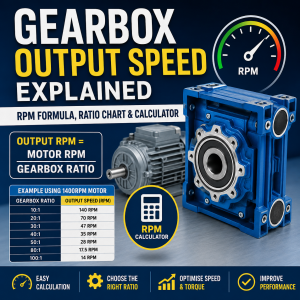
The gearbox ratio is the relationship between the input speed and the output speed. If you have a motor running at 1400rpm and fit a 20:1 worm gearbox, the approximate output speed will be 70rpm before allowing for efficiency losses.
| Gearbox Ratio | Approximate Output Speed from 1400rpm Motor | Typical Use |
|---|---|---|
| 5:1 | 280rpm | Fast output speed, light reduction |
| 10:1 | 140rpm | Moderate speed reduction |
| 20:1 | 70rpm | Common conveyor and machinery ratio |
| 30:1 | 46.6rpm | Slower movement with increased torque |
| 50:1 | 28rpm | Popular for conveyors, feeders and indexing |
| 60:1 | 23.3rpm | Low-speed, higher-torque applications |
| 100:1 | 14rpm | Very slow output speed and high reduction |
This calculation gives a useful starting point, but the final selection should also consider torque, gearbox size, duty cycle, load type, motor power, efficiency, mounting style and service factor.
Step 1: Work Out the Output Speed You Need
The first step is to decide how fast the machine needs to move. This could be the speed of a conveyor belt, the rotation speed of a turntable, the feed speed of a screw conveyor or the movement speed of a mechanical arm.
Once you know the required output speed, you can estimate the ratio using this simple formula:
Gearbox Ratio = Motor Speed ÷ Required Output Speed
For example, if your motor runs at 1400rpm and you need an output speed of approximately 28rpm, the required ratio would be:
1400 ÷ 28 = 50:1
This means a 50:1 worm gearbox would be a sensible starting point.
If you are selecting a gearbox for a compact machine, smaller frame sizes such as Motovario NMRV030 worm gearboxes and Motovario NMRV040 worm gearboxes are commonly used for lighter-duty applications where space is limited.
Step 2: Understand How Ratio Affects Torque
As the gearbox ratio increases, the output speed decreases and the output torque usually increases. This is one of the main reasons worm gearboxes are used in industrial machinery. They allow a standard electric motor to drive heavier loads at controlled speeds.
A lower ratio such as 5:1 or 10:1 gives a faster output speed but less torque multiplication. A higher ratio such as 50:1, 60:1 or 100:1 gives a slower output speed but greater torque multiplication.
| Ratio Range | Output Speed | Torque Increase | Best For |
|---|---|---|---|
| 5:1 to 10:1 | Fast | Lower | Light-duty machinery, faster driven shafts |
| 15:1 to 30:1 | Medium | Medium | Conveyors, packaging machines, general automation |
| 40:1 to 60:1 | Slow | High | Feeders, indexing, handling equipment, heavier loads |
| 80:1 to 100:1 | Very slow | Very high | Slow movement, positioning, high reduction requirements |
For medium-duty industrial systems, frame sizes such as Motovario NMRV050 worm gearboxes, Motovario NMRV-P063 worm gearboxes and Transtecno CM063 worm gearboxes are often used where a balance of compact size, torque capacity and flexibility is needed.
Step 3: Match the Ratio to the Application
Different applications normally require different speed and torque ranges. A conveyor that needs steady movement may use a different ratio from a mixer, rotary table, hoist, feeder or indexing system.
Conveyors
For conveyors, ratios such as 20:1, 30:1, 40:1 and 50:1 are common because they provide controlled speed with useful torque. The correct choice depends on the belt speed, roller diameter, load weight and duty cycle.
Packaging Machines
Packaging machinery often needs repeatable, controlled movement. Medium ratios such as 15:1, 20:1 and 30:1 are often suitable, especially where the machine needs a balance of speed and torque.
Mixers and Agitators
Mixers usually need slower speed and higher torque. Ratios such as 40:1, 50:1 or 60:1 may be more suitable, depending on the material being mixed and the required shaft speed.
Rotary Tables and Indexing Systems
Rotary tables often need slow, controlled rotation. Higher ratios such as 50:1, 60:1 or 100:1 may be used where controlled movement is more important than high speed.
Heavy-Duty Handling Equipment
For heavier loads, you may need a larger gearbox frame as well as a suitable ratio. Larger units such as Motovario NMRV-P075 worm gearboxes, Motovario NMRV-P090 worm gearboxes and Bonfiglioli W 75 worm gearboxes are commonly considered for more demanding applications.
Step 4: Do Not Choose Ratio Alone
Although the ratio is important, it should never be the only factor used to choose a worm gearbox. Two gearboxes with the same ratio can have very different torque ratings, shaft sizes, mounting dimensions, thermal limits and service capabilities.
Before choosing a gearbox, check the following:
- Required output speed: The final shaft speed needed by the machine.
- Required output torque: The torque needed to move the load safely.
- Motor power: The kW or HP rating of the motor being used.
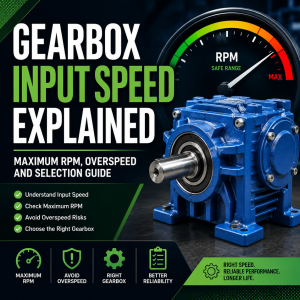
- Input speed: Common motor speeds include 1400rpm, 900rpm and 2800rpm.
- Duty cycle: Whether the machine runs occasionally, frequently or continuously.
- Load type: Smooth, moderate shock or heavy shock loading.
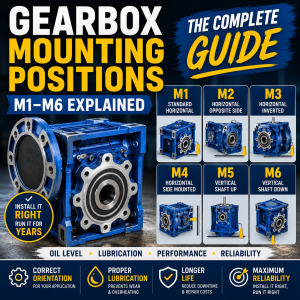
- Mounting position: Foot, flange, hollow bore or shaft-mounted arrangement.
- Frame size: The physical gearbox size and torque capacity.
- Service factor: A safety allowance for real-world operating conditions.
If the gearbox is too small, even the correct ratio may not be enough. It may overheat, wear quickly or fail under load. If the gearbox is too large, it may work well but cost more than necessary and take up extra space.
Step 5: Consider Gearbox Efficiency at Higher Ratios
Worm gearboxes are compact, cost-effective and excellent for speed reduction, but efficiency can reduce as the ratio increases. Higher ratios create more sliding contact between the worm and wheel, which can increase heat and reduce mechanical efficiency.
This means a 100:1 worm gearbox may provide a very slow output speed, but it may not always be the best solution for continuous high-load applications. In some cases, a different gearbox type, larger frame size or two-stage arrangement may be more suitable.
For many general applications, ratios between 20:1 and 60:1 provide a strong balance between output speed, torque, size and cost.
Step 6: Choose the Correct Frame Size
The gearbox frame size is just as important as the ratio. A small gearbox with a high ratio may still not be suitable if the output torque requirement is too high. Larger frame sizes usually offer higher torque capacity, larger bearings, stronger shafts and better heat dissipation.
As a general guide:
| Gearbox Size | Typical Use |
|---|---|
| NMRV025 to NMRV040 | Small machines, light conveyors, compact automation |
| NMRV050 to NMRV063 | General industrial machinery, conveyors, feeders |
| NMRV075 to NMRV090 | Medium to heavier-duty applications |
| NMRV110 and above | Larger loads, higher torque, heavier machinery |
For larger torque requirements, browse our Motovario NMRV-P110 worm gearboxes or compare alternative ranges such as Varvel FRS85 worm gearboxes and STM RMI 70 worm gearboxes.
Step 7: Check the Motor Speed Before Final Selection
The same gearbox ratio will give a different output speed depending on the motor speed. A 50:1 gearbox fitted to a 1400rpm motor gives approximately 28rpm output speed. The same 50:1 gearbox fitted to a 900rpm motor gives approximately 18rpm.
| Motor Speed | Gearbox Ratio | Approximate Output Speed |
|---|---|---|
| 2800rpm | 50:1 | 56rpm |
| 1400rpm | 50:1 | 28rpm |
| 900rpm | 50:1 | 18rpm |
| 700rpm | 50:1 | 14rpm |
This is why it is important to know the motor speed before selecting the gearbox ratio. If you change the motor pole speed, the final gearbox output speed will also change.
Common Worm Gearbox Ratio Mistakes
Many gearbox problems come from choosing based only on ratio rather than looking at the full application. Common mistakes include:
- Choosing a high ratio without checking gearbox efficiency and heat.
- Using a gearbox frame size that is too small for the required torque.
- Forgetting to allow for shock loads, start-stop duty or heavy loads.
- Matching the ratio to speed but ignoring service factor.
- Using the wrong motor speed in the ratio calculation.
- Assuming two gearboxes with the same ratio have the same torque rating.
- Not checking shaft size, bore size, flange size or mounting position.
Quick Guide: Which Worm Gearbox Ratio Should You Choose?
| Application Requirement | Suggested Ratio Range |
|---|---|
| Fast output speed with light reduction | 5:1 to 10:1 |
| General machinery speed reduction | 15:1 to 30:1 |
| Conveyors and handling systems | 20:1 to 50:1 |
| Slow movement with higher torque | 40:1 to 60:1 |
| Very slow movement or indexing | 80:1 to 100:1 |
This table is a useful starting point, but the best gearbox ratio always depends on the actual load, required speed, torque demand, duty cycle and operating environment.
Recommended Worm Gearbox Categories
If you already know the frame size or brand you need, you can browse our popular worm gearbox categories below:
- Motovario NMRV030 Worm Gearboxes
- Motovario NMRV040 Worm Gearboxes
- Motovario NMRV050 Worm Gearboxes
- Motovario NMRV-P063 Worm Gearboxes
- Motovario NMRV-P075 Worm Gearboxes
- Motovario NMRV-P090 Worm Gearboxes
- Bonfiglioli W 75 Worm Gearboxes
- Transtecno CM063 Worm Gearboxes
- Varvel FRS85 Worm Gearboxes
- STM RMI 70 Worm Gearboxes
Frequently Asked Questions
What is the best worm gearbox ratio?
There is no single best worm gearbox ratio because the correct ratio depends on the required output speed, torque, motor speed and application. For many conveyors and general industrial machines, ratios between 20:1 and 50:1 are commonly used.
Does a higher gearbox ratio mean more torque?
In general, a higher gearbox ratio reduces output speed and increases torque multiplication. However, gearbox efficiency, frame size, service factor and thermal limits must also be checked before selecting a gearbox.
How do I calculate worm gearbox output speed?
Divide the motor speed by the gearbox ratio. For example, a 1400rpm motor with a 50:1 gearbox gives an approximate output speed of 28rpm.
Is a 100:1 worm gearbox always better for high torque?
Not always. A 100:1 gearbox gives very slow output speed and high reduction, but efficiency can be lower at high ratios. For continuous or heavy-duty applications, you should check the gearbox torque rating, service factor and heat limits carefully.
What ratio should I use for a conveyor?
Many conveyors use ratios between 20:1 and 50:1, but the correct choice depends on the belt speed, roller diameter, load weight, motor speed and duty cycle.
Can I change the gearbox ratio without changing the motor?
Yes, changing the gearbox ratio will change the output speed and torque. However, you must check that the new gearbox is suitable for the motor power, load and application.
Final Advice: Choose Speed First, Then Check Torque and Frame Size
The best way to choose the right worm gearbox ratio is to start with the output speed you need, calculate the approximate ratio, then confirm the torque rating, gearbox size, service factor, mounting style and motor compatibility.
If you only choose by ratio, you may end up with a gearbox that turns at the right speed but cannot handle the load. If you choose by torque alone, you may end up with a gearbox that is too slow or too large for the application. The correct selection should balance speed, torque, frame size, duty cycle and real-world operating conditions.
For help choosing the right worm gearbox ratio, browse our worm gearbox categories or contact Worm Gear Motors Online for support with gearbox selection, replacement and matching.