Motor Duty Cycles Explained (S1–S9) and Why They Matter for Correct Motor Selection
When selecting an electric motor, most people focus only on power (kW) and speed (RPM). However, one of the most important — and most overlooked — specifications is the motor duty cycle.
Motor duty cycle defines how long a motor runs, rests, starts, stops, and loads during operation. Choosing the wrong duty rating can cause overheating, nuisance trips, or premature motor failure even when the power rating looks correct on paper.
In this guide, we explain all motor duty cycles from S1 to S9, what they mean in real-world applications, and how to choose the correct electric motor, geared motor, or VFD for reliable operation.
What Is a Motor Duty Cycle?
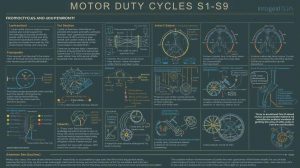
A duty cycle describes the operating pattern of a motor over time — including running time, rest time, starting frequency, and load variation.
Motors generate heat during operation. If the motor does not have enough time to cool between cycles, temperature rises and insulation life reduces dramatically.
This is why duty rating is just as important as motor power.
Why Motor Duty Cycles Matter
- Prevents overheating and insulation failure
- Improves reliability and lifespan
- Ensures correct motor sizing
- Reduces unexpected downtime
- Avoids unnecessary oversizing
For example, a 5.5 kW motor rated S1 may fail quickly if used in an S4 start/stop application without proper sizing.
S1 – Continuous Duty (Most Common)
S1 duty means the motor runs continuously at constant load long enough to reach thermal equilibrium.
Typical Applications
- Pumps
- Fans
- Blowers
- Conveyors
Most standard AC induction motors are rated for S1 duty.
If your application runs continuously, S1 is usually sufficient.
S2 – Short-Time Duty
S2 duty means the motor runs for a short, fixed period and then rests long enough to fully cool down.
Examples
- Hoists
- Actuators
- Gate motors
These motors can often be smaller than S1 motors because they do not operate continuously.
S3 – Intermittent Periodic Duty
S3 duty consists of repeated cycles of running and rest without reaching full temperature.
No significant starting current effects are considered.
Examples
- Packaging machines
- Light conveyors
- Indexing systems
Duty cycle is typically expressed as a percentage (e.g., 40% on, 60% off).
S4 – Intermittent Duty with Starting
S4 duty includes frequent starts, which generate high inrush current and extra heating.
Examples
- Lifts
- Crushers
- Heavy conveyors
These applications often require:
- Oversized motors
- Inverter-rated motors
- VFDs for soft starting
S5 – Intermittent Duty with Starting and Braking
S5 duty adds electric braking to frequent starts and stops.
This creates even higher thermal stress.
Examples
- Cranes
- Winches
- Rapid positioning machinery
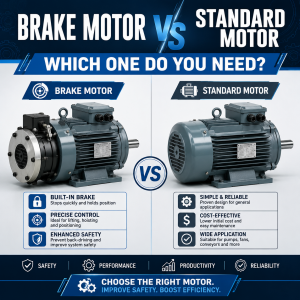
Brake motors or external braking solutions are often required.
S6 – Continuous Duty with Intermittent Load
S6 duty means the motor runs continuously but with varying load levels.
There are no rest periods.
Examples
- Compressors
- Mixers
- Processing lines
A VFD is often used to improve efficiency during low-load periods.
S7 – Continuous Duty with Starting and Braking
S7 duty combines continuous running with frequent starts and braking, without cooling periods.
This is a severe duty classification requiring heavy-duty motors and drives.
S8 – Continuous Duty with Speed Changes
S8 duty includes frequent speed changes under load.
This is common when using variable frequency drives.
Examples
- Automated production systems
- Test rigs
- Variable speed conveyors
S9 – Non-Periodic Duty with Variable Loads
S9 duty represents unpredictable loads and speeds with occasional overloads.
Motors must be selected conservatively with high service factors.
How to Choose the Correct Duty Cycle
Ask these questions:
- How long does the motor run continuously?
- How often does it start/stop?
- Does it rest between cycles?
- Are loads constant or variable?
For frequent start-stop or variable speed applications, pairing the motor with a VFD or using a geared motor can reduce stress and improve reliability.
Common Motor Duty Selection Mistakes
- Selecting S1 for start/stop machinery
- Ignoring thermal buildup
- Undersizing motors for braking loads
- Not considering inverter operation (S8)
Frequently Asked Questions
What is the most common motor duty?
S1 continuous duty is the most common for pumps and fans.
Can I use an S1 motor for intermittent duty?
Sometimes, but frequent starts may cause overheating.
Do VFDs affect duty cycle?
Yes. Variable speed and braking increase thermal stress, often requiring S8-rated motors.
Should I oversize for heavy duty?
Often yes — or use a higher duty-rated motor.
What happens if the duty cycle is wrong?
Reduced lifespan, insulation failure, and unexpected breakdowns.
Need Help Choosing the Right Motor?
At Worm Gear Motors Online, we supply high-quality electric motors, geared motors, gearboxes, and inverter drives for every duty cycle and application.
If you’re unsure which motor rating or duty classification is correct, contact our team and we’ll help you select the right solution first time.