
How to Read a Gearbox Nameplate: Complete Guide to Ratios, Torque, RPM & Model Numbers
A gearbox nameplate tells you the most important technical information about a gearbox, including its model, ratio, output speed, torque rating, input size, mounting position and serial number. If you are replacing a gearbox, matching a motor, ordering spare parts or checking whether a gearbox is suitable for an application, the nameplate is usually the best place to start.
This guide explains how to read a gearbox nameplate properly, what each marking means, and which details matter most when selecting a replacement gearbox.
What Is a Gearbox Nameplate?
A gearbox nameplate is the metal or printed label fitted to the gearbox housing. It normally includes the manufacturer, gearbox type, size, ratio, serial number and key technical ratings.
On some gearboxes, the nameplate may be a riveted metal plate. On smaller aluminium gearboxes, it may be a printed adhesive label. If the gearbox has been painted, damaged or used in a harsh environment, some information may be difficult to read.
If you are replacing an existing unit, always try to photograph the nameplate before removing the gearbox from the machine.
Quick Gearbox Nameplate Checklist
When reading a gearbox nameplate, look for these details first:
| Nameplate Detail | What It Means | Why It Matters |
|---|---|---|
| Manufacturer | Brand name such as Motovario, Tramec, Varvel or Bonfiglioli | Helps identify the correct replacement range |
| Model / Type | The gearbox series and size | Confirms the physical gearbox frame |
| Ratio | Reduction ratio such as 20:1, 40:1 or 100:1 | Controls output speed and torque |
| Input size | Motor flange or input bore size | Confirms motor compatibility |
| Output bore | Hollow bore or shaft diameter | Must match the driven shaft |
| Torque rating | Output torque, usually shown in Nm | Confirms whether the gearbox can handle the load |
| Output speed | Output RPM | Confirms the final shaft speed |
| Mounting position | Position such as M1, M2, M3, M4, M5 or M6 | Affects oil level and installation orientation |
| Serial number | Unique production reference | Useful for traceability and spare parts |
Example Gearbox Nameplate
A typical gearbox nameplate may look something like this:
| Nameplate Marking | Example | Meaning |
|---|---|---|
| Type | NMRV050 | Gearbox range and size |
| Ratio / i | 30 | 30:1 reduction ratio |
| Input | 71B14 | Motor frame and flange size |
| Output bore | 25mm | Hollow bore diameter |
| Torque | Nm | Rated output torque |
| RPM | 47rpm | Approximate output speed |
| Mounting | M1 | Gearbox mounting position |
| Serial No. | Manufacturer reference | Traceability number |
For worm gearboxes, browse our Motovario NMRV050 worm gearboxes, Tramec XC63 worm gearboxes and Varvel FRS50 worm gearboxes.
1. Manufacturer or Brand
The first thing to identify is the gearbox manufacturer. Common gearbox brands include Motovario, Tramec, Varvel, Bonfiglioli, STM, Rossi, SEW, Renold and many others.
The brand matters because different manufacturers use different model codes, dimensions, input options, mounting styles and spare parts. A 50 size worm gearbox from one brand may not be exactly the same as a 50 size gearbox from another brand.
Popular gearbox ranges include:
- Motovario NMRV040 worm gearboxes
- Motovario NMRV-P075 worm gearboxes
- Tramec XC75 worm gearboxes
- Bonfiglioli W75 worm gearboxes
- Varvel FRS70 worm gearboxes
2. Gearbox Model or Type Code
The model or type code identifies the gearbox series and frame size. This is one of the most important details on the nameplate.
Examples include:
- NMRV050 — Motovario worm gearbox, size 050
- NMRV-P090 — Motovario larger worm gearbox, size 090
- XC63 — Tramec XC worm gearbox, size 63
- FRS70 — Varvel FRS worm gearbox, size 70
- BA52 — Motovario helical bevel gearbox size 52
The model code normally controls the gearbox body size, output bore options, torque rating, mounting dimensions and compatible input flanges.
If you are replacing a gearbox, the model code is usually more important than the colour or appearance of the gearbox.
3. Gearbox Ratio
The gearbox ratio is often shown as i, ratio, reduction or simply as a number such as 30, 40 or 100.
The ratio tells you how many turns of the input shaft are required for one turn of the output shaft.
| Ratio | Meaning | Effect |
|---|---|---|
| 10:1 | 10 input turns for 1 output turn | Faster output speed |
| 30:1 | 30 input turns for 1 output turn | Medium speed reduction |
| 60:1 | 60 input turns for 1 output turn | Slower output speed |
| 100:1 | 100 input turns for 1 output turn | Very slow output speed |
The higher the ratio, the slower the output speed. In many cases, a higher ratio also increases output torque, but gearbox efficiency, service factor and gearbox size must still be checked.
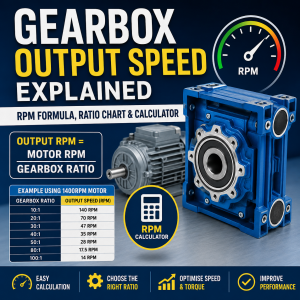
Formula: Output RPM = Motor RPM ÷ Gearbox Ratio
For example, a 1400rpm motor with a 30:1 gearbox gives approximately 47rpm output speed.
4. Output Speed / RPM
Some gearbox nameplates show the output speed directly. This may be written as:
- n2
- Output RPM
- r/min
- min⁻¹
If the output speed is not shown, you can calculate it using the motor speed and gearbox ratio.
| Motor Speed | Gearbox Ratio | Approx. Output Speed |
|---|---|---|
| 1400rpm | 10:1 | 140rpm |
| 1400rpm | 20:1 | 70rpm |
| 1400rpm | 30:1 | 47rpm |
| 1400rpm | 50:1 | 28rpm |
| 1400rpm | 100:1 | 14rpm |
If speed control is required, the gearbox may be used with an inverter. Browse single phase TecDrive inverters and three phase TecDrive inverters.
5. Input Speed
Input speed is usually the speed of the motor driving the gearbox. This may be shown as:
- n1
- Input RPM
- Motor speed
- r/min
Common motor speeds at 50Hz are:
| Motor Type | Approx. Speed | Common Use |
|---|---|---|
| 2 pole motor | 2800rpm | Higher speed applications |
| 4 pole motor | 1400rpm | Most gearbox applications |
| 6 pole motor | 900rpm | Slower speed applications |
For most gearbox applications, a 4 pole electric motor is the most common choice. You can also view 2 pole electric motors, 6 pole electric motors and our full range of AC motors.
6. Output Torque
Torque is usually shown in Nm. This tells you how much turning force the gearbox can deliver at the output shaft.
Output torque may be shown as:
- T2
- Output torque
- Torque Nm
- Rated torque
The torque rating is critical. Two gearboxes may have the same ratio but completely different torque capacities because they are different sizes.
For example, a small 30:1 gearbox and a larger 30:1 gearbox may both provide similar output speed, but the larger gearbox will usually handle more torque and load.
When replacing a gearbox, never match on ratio alone. Always check the gearbox size, torque rating, service factor and driven load.
7. Power Rating
Gearbox nameplates may show a power rating in kW or HP. This is often linked to the motor size the gearbox is designed to accept.
Power may be shown as:
- P1
- kW
- HP
- Input power
A gearbox must be suitable for the motor power fitted to it. A gearbox that is too small for the motor and load may overheat, wear quickly or fail mechanically.
If you are choosing a gearbox for a motor, check both the input flange size and the gearbox torque rating.
8. Input Flange and Motor Frame Size
Many gearboxes are designed to accept standard IEC electric motors. The nameplate or product code may include a motor frame and flange size such as:
- 63B5
- 63B14
- 71B5
- 71B14
- 80B5
- 80B14
- 90B5
- 90B14
The number refers to the motor frame size. The B5 or B14 refers to the motor mounting flange.
| Marking | Meaning |
|---|---|
| 71B14 | 71 frame motor with B14 face mount flange |
| 80B5 | 80 frame motor with B5 flange mount |
| 90B5 | 90 frame motor with B5 flange mount |
This matters because the motor must physically fit the gearbox input. A gearbox with a 71B14 input will not directly accept an 80B5 motor without the correct adaptor arrangement.
9. Output Bore or Shaft Size
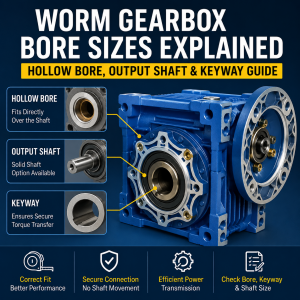
The output bore is the hole through the gearbox output hub. On a hollow bore gearbox, this must match the shaft on the machine.
The nameplate may show the output bore directly, or it may need to be checked from the gearbox size and specification.
Common output bore sizes include:
- 14mm
- 18mm
- 25mm
- 28mm
- 35mm
- 42mm
- 50mm
Always check the bore size, keyway size and shaft fit before ordering a replacement gearbox.
For common worm gearbox options, view Motovario NMRV-P090 worm gearboxes, Tramec XC90 worm gearboxes and Varvel FRS85 worm gearboxes.
10. Mounting Position
The mounting position tells you how the gearbox is installed. This is important because the oil level inside the gearbox can change depending on orientation.
Mounting position may be shown as:
- M1
- M2
- M3
- M4
- M5
- M6
If the gearbox is fitted in the wrong mounting position, lubrication may be incorrect. This can cause overheating, premature bearing wear, oil leakage or gearbox failure.
When replacing a gearbox, check whether the gearbox is mounted horizontally, vertically, shaft-up, shaft-down or side-mounted.
11. Lubrication Information
Some gearbox nameplates include oil or lubrication details. This may include:
- Oil type
- Oil quantity
- Lubricant grade
- Synthetic or mineral oil
- Food-grade lubricant information
Many smaller worm gearboxes are supplied pre-filled for life, while larger gearboxes may require oil checks or oil changes depending on duty cycle and installation conditions.
If a gearbox has been leaking oil, overheating or running noisily, lubrication should be checked before assuming the gearbox itself is incorrectly sized.
12. Service Factor
Service factor is sometimes shown on the nameplate or datasheet. It may be written as:
- SF
- fs
- Service factor
Service factor allows for operating conditions such as duty cycle, shock load, start frequency and running hours. A gearbox used on a light, steady load may need a lower service factor than a gearbox used on a heavy conveyor or machine with frequent starts and stops.
If the gearbox is failing regularly, the service factor may be too low for the application even if the ratio appears correct.
13. Serial Number
The serial number is the unique production reference for the gearbox. It helps the manufacturer or supplier identify the original build details.
This is especially useful when:
- The model code is hard to read
- The gearbox has special options
- You need spare parts
- You need to confirm the original ratio
- You need to trace the original build
If you are requesting a replacement gearbox, send a clear photo of the serial number where possible.
How to Read a Worm Gearbox Nameplate
Worm gearbox nameplates usually focus on the gearbox size, ratio, input flange and output bore.
For example:
| Code | Meaning |
|---|---|
| NMRV050 | Worm gearbox size 050 |
| i = 40 | 40:1 gearbox ratio |
| 71B14 | Input for 71 frame B14 motor |
| 25mm bore | Output bore size |
| M1 | Mounting position |
Worm gearboxes are commonly used for conveyors, small machinery, packaging equipment and general speed reduction applications.
Browse our main gearboxes range or view Motovario NMRV025 worm gearboxes, Tramec XC50 worm gearboxes and Bonfiglioli MVF49 worm gearboxes.
How to Read an Inline Gearbox Nameplate
Inline gearbox nameplates usually include the gearbox type, ratio, torque rating, input speed, output speed, motor power and mounting arrangement.
Inline gearboxes are often used where the input and output shafts are in line rather than at a right angle.
Important details include:
- Gearbox size
- Ratio
- Output speed
- Rated torque
- Motor frame size
- Mounting style
If you need a straight-through reduction gearbox, browse our inline gearboxes.
How to Read a Helical Bevel Gearbox Nameplate
Helical bevel gearboxes normally have more detailed nameplates because they are often used in heavier industrial applications.
Key details to check include:
- Gearbox series and size
- Reduction ratio
- Input and output arrangement
- Mounting position
- Rated torque
- Motor power
- Service factor
- Lubrication details
For right angle helical bevel applications, view Motovario BA52 helical bevel gearboxes, Motovario BA72 helical bevel gearboxes and Motovario B103 helical bevel gearboxes.
Most Important Details When Replacing a Gearbox
If you are replacing a gearbox, the most important details are:
- Gearbox brand and model — confirms the original range and size.
- Ratio — controls output speed.
- Output bore or shaft size — must match the machine shaft.
- Input flange — must match the motor.
- Mounting position — affects fitment and oil level.
- Torque rating — must suit the load.
- Overall dimensions — must physically fit the machine.
If only one detail is wrong, the gearbox may not fit or may not perform correctly.
What If the Gearbox Nameplate Is Missing?
If the nameplate is missing or unreadable, you can still identify the gearbox by checking:
- Gearbox body size
- Output bore diameter
- Input flange size
- Motor frame size
- Shaft centre height
- Mounting hole positions
- Overall dimensions
- Output speed or machine speed
- Photos of the gearbox from several angles
For a replacement, clear photos and measurements are often enough to identify a suitable match.
Common Gearbox Nameplate Abbreviations
| Abbreviation | Meaning |
|---|---|
| i | Gearbox ratio |
| n1 | Input speed |
| n2 | Output speed |
| T2 | Output torque |
| P1 | Input power |
| SF / fs | Service factor |
| Nm | Newton metres of torque |
| RPM | Revolutions per minute |
| kW | Kilowatts of power |
| B5 | Flange mounted motor |
| B14 | Face mounted motor |
Gearbox Nameplate FAQ
Where is the gearbox nameplate located?
The gearbox nameplate is usually fitted to the gearbox housing, often on the side, top or near the input flange. On smaller gearboxes, it may be an adhesive label.
What does i mean on a gearbox nameplate?
The letter i normally means gearbox ratio. For example, i = 30 means the gearbox has a 30:1 reduction ratio.
What does n1 mean on a gearbox?
n1 usually means input speed. This is normally the speed of the motor driving the gearbox.
What does n2 mean on a gearbox?
n2 usually means output speed. This is the speed of the gearbox output shaft after reduction.
What does T2 mean on a gearbox?
T2 usually means output torque. This is the amount of torque available at the gearbox output shaft.
Can I replace a gearbox using only the ratio?
No. Ratio is important, but you must also check gearbox size, torque rating, input flange, output bore, mounting position and dimensions.
What if my gearbox nameplate is unreadable?
If the nameplate is unreadable, measure the gearbox, output bore, input flange, mounting holes and motor frame size. Photos from multiple angles can also help identify a replacement.
Does the motor nameplate matter too?
Yes. The motor nameplate confirms motor power, speed, voltage, frame size and mounting style. This is important when matching a motor to a gearbox.
Need Help Identifying a Gearbox?
If you are replacing a gearbox, the nameplate is the best starting point. Look for the brand, model, ratio, input size, output bore, mounting position, torque rating and serial number.
If the nameplate is missing, clear photos and basic measurements can usually help identify the correct replacement.
Browse our main gearboxes, inline gearboxes, AC motors and motors for conveyors to find a suitable gearbox, geared motor or replacement unit.