
Gearbox Output Speed Explained: RPM Formula, Ratio Chart & Calculator
Choosing the correct gearbox ratio is one of the most important steps when buying a gearbox or geared motor. The gearbox ratio controls how fast the output shaft turns, how much torque is available, and whether the gearbox is suitable for conveyors, mixers, pumps, fans, rotary tables or general machinery.
In simple terms, gearbox output speed is calculated by dividing the motor speed by the gearbox ratio:
Output RPM = Motor RPM ÷ Gearbox Ratio
For example, if you use a 1400rpm motor with a 20:1 gearbox, the output speed will be:
1400 ÷ 20 = 70rpm output speed
This guide explains how to calculate gearbox RPM, how different motor speeds affect the final output, and how to choose the right ratio for your application.
Quick Gearbox RPM Calculator Formula
Use this simple formula:
| Calculation | Formula | Example |
|---|---|---|
| Output speed | Motor RPM ÷ Gearbox Ratio | 1400rpm ÷ 30:1 = 46.6rpm |
| Required ratio | Motor RPM ÷ Desired Output RPM | 1400rpm ÷ 70rpm = 20:1 |
| Motor speed needed | Output RPM × Gearbox Ratio | 50rpm × 25:1 = 1250rpm |
If you already know the gearbox ratio and motor speed, you can calculate the approximate output RPM in seconds.
Common Motor Speeds Used With Gearboxes
Most industrial AC motors run at a speed linked to the number of poles inside the motor. The most common options are 2 pole, 4 pole and 6 pole motors.
| Motor Type | Approximate Speed at 50Hz | Common Use |
|---|---|---|
| 2 pole motor | 2800rpm | Higher speed applications |
| 4 pole motor | 1400rpm | Most common gearbox applications |
| 6 pole motor | 900rpm | Slower speed, higher control applications |
For most standard gearbox and geared motor applications, a 4 pole electric motor is the most common choice because it gives a practical balance of speed, torque and efficiency.
You can also browse 2 pole electric motors, 6 pole electric motors and our full range of AC motors.
Gearbox Ratio Chart Using a 1400rpm Motor
The table below shows typical output speeds when using a standard 4 pole 1400rpm motor.
| Gearbox Ratio | Calculation | Approx. Output Speed |
|---|---|---|
| 5:1 | 1400 ÷ 5 | 280rpm |
| 7.5:1 | 1400 ÷ 7.5 | 187rpm |
| 10:1 | 1400 ÷ 10 | 140rpm |
| 15:1 | 1400 ÷ 15 | 93rpm |
| 20:1 | 1400 ÷ 20 | 70rpm |
| 25:1 | 1400 ÷ 25 | 56rpm |
| 30:1 | 1400 ÷ 30 | 47rpm |
| 40:1 | 1400 ÷ 40 | 35rpm |
| 50:1 | 1400 ÷ 50 | 28rpm |
| 60:1 | 1400 ÷ 60 | 23rpm |
| 80:1 | 1400 ÷ 80 | 17.5rpm |
| 100:1 | 1400 ÷ 100 | 14rpm |
This is why a 100:1 gearbox gives a very slow output speed, while a 5:1 gearbox gives a much faster output speed.
Gearbox Ratio Chart Using a 2800rpm Motor
If you use a 2 pole motor instead, the output speed roughly doubles compared with a 1400rpm motor.
| Gearbox Ratio | Calculation | Approx. Output Speed |
|---|---|---|
| 5:1 | 2800 ÷ 5 | 560rpm |
| 10:1 | 2800 ÷ 10 | 280rpm |
| 20:1 | 2800 ÷ 20 | 140rpm |
| 30:1 | 2800 ÷ 30 | 93rpm |
| 40:1 | 2800 ÷ 40 | 70rpm |
| 50:1 | 2800 ÷ 50 | 56rpm |
| 60:1 | 2800 ÷ 60 | 47rpm |
| 80:1 | 2800 ÷ 80 | 35rpm |
| 100:1 | 2800 ÷ 100 | 28rpm |
This is important because two gearboxes with the same ratio can produce very different output speeds depending on the motor fitted to them.
What Does Gearbox Ratio Mean?
A gearbox ratio tells you how many times the input shaft turns for one full turn of the output shaft.
For example:
- 10:1 ratio means the motor turns 10 times for 1 output shaft rotation.
- 30:1 ratio means the motor turns 30 times for 1 output shaft rotation.
- 100:1 ratio means the motor turns 100 times for 1 output shaft rotation.
The higher the ratio, the slower the output speed. In most cases, a higher ratio also increases output torque, although gearbox efficiency and service factor must also be considered.
For standard right angle reductions, browse our main gearboxes range or view our Motovario NMRV050 worm gearboxes, Motovario NMRV-P075 worm gearboxes and Tramec XC63 worm gearboxes.
How to Choose the Correct Gearbox Output Speed
To choose the correct output speed, start with the machine requirement rather than the gearbox. Ask:
- How fast does the conveyor, roller, mixer, wheel or shaft need to turn?
- What motor speed will be used?
- What output torque is required?
- Will the gearbox run continuously or intermittently?
- Is the load smooth, moderate or shock loaded?
- Is speed adjustment required?
Once you know the required output RPM, divide the motor speed by the required RPM to find the gearbox ratio.
Example: You need a conveyor shaft to turn at approximately 35rpm. You are using a 1400rpm 4 pole motor.
1400 ÷ 35 = 40
You would normally look for a gearbox ratio close to 40:1.
For conveyor applications, our motors for conveyors category is a useful place to compare suitable motor options.
Common Output Speeds by Application
| Application | Typical Output Speed Range | Common Gearbox Type |
|---|---|---|
| Small conveyors | 20–100rpm | Worm gearbox or geared motor |
| Mixers and agitators | 10–80rpm | Worm, inline or bevel gearbox |
| Rotary tables | 1–20rpm | High ratio gearbox |
| Pumps and fans | Usually direct motor speed | Motor or inverter controlled motor |
| Packaging machinery | Variable | Gearbox with inverter control |
These are only general examples. The correct speed depends on the machine design, shaft diameter, load, duty cycle and required torque.
Worm Gearbox Output Speed
A worm gearbox is commonly used when a compact right angle drive is needed. They are popular for conveyors, packaging machinery, small automation systems, agricultural equipment and general industrial machinery.
Worm gearboxes are available in a wide range of ratios, commonly including 5:1, 7.5:1, 10:1, 15:1, 20:1, 30:1, 40:1, 50:1, 60:1, 80:1 and 100:1.
For example, with a 1400rpm motor:
- A 10:1 worm gearbox gives approximately 140rpm output.
- A 30:1 worm gearbox gives approximately 47rpm output.
- A 50:1 worm gearbox gives approximately 28rpm output.
- A 100:1 worm gearbox gives approximately 14rpm output.
If you are choosing a worm gearbox, compare the ratio, torque rating, input flange, output bore, mounting position and service factor.
Popular options include Motovario NMRV040 worm gearboxes, Motovario NMRV-P090 worm gearboxes, Tramec XC75 worm gearboxes and Varvel FRS50 worm gearboxes.
Inline Gearbox Output Speed
An inline gearbox reduces speed in the same shaft direction as the motor. Inline gearboxes are often used where higher efficiency, compact installation and straight-through power transmission are required.
The same formula applies:
Output RPM = Motor RPM ÷ Gearbox Ratio
For example, a 1400rpm motor with a 25:1 inline gearbox gives approximately 56rpm output speed.
You can view suitable options in our inline gearboxes category.
Does a Higher Gearbox Ratio Give More Torque?
Generally, increasing the gearbox ratio reduces speed and increases output torque. However, the real usable torque depends on gearbox efficiency, gearbox size, service factor, motor power and load type.
For example, a 0.75kW motor fitted to a 10:1 gearbox will produce a faster output speed than the same motor fitted to a 50:1 gearbox. The 50:1 gearbox will normally provide more output torque, but it must still be correctly sized for the application.
Do not choose a gearbox by output speed alone. Always check:
- Output torque rating
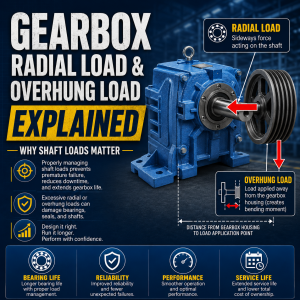
- Radial load capacity
- Service factor
- Duty cycle
- Gearbox efficiency
- Mounting position
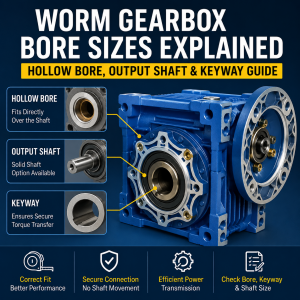
- Output bore size
- Motor frame and flange size
Using an Inverter to Adjust Gearbox Output Speed
If you need variable speed, an inverter can control the motor frequency and change the gearbox output RPM.
For example, a 1400rpm motor running through a 20:1 gearbox gives around 70rpm at 50Hz. If the inverter runs the motor at approximately 25Hz, the output speed will be roughly half, around 35rpm.
This is useful for conveyors, mixers, packaging machines and applications where the required speed may change.
You can browse single phase TecDrive inverters and three phase TecDrive inverters.
Gearbox Output Speed Examples
Example 1: 1400rpm Motor With 30:1 Gearbox
1400 ÷ 30 = 46.6rpm
The gearbox output shaft will turn at approximately 47rpm.
Example 2: 1400rpm Motor With 80:1 Gearbox
1400 ÷ 80 = 17.5rpm
This would be suitable for slower applications where more reduction is required.
Example 3: 2800rpm Motor With 40:1 Gearbox
2800 ÷ 40 = 70rpm
This gives the same approximate output speed as a 1400rpm motor with a 20:1 gearbox.
Example 4: Required Output Speed of 28rpm
If you need around 28rpm and you are using a 1400rpm motor:
1400 ÷ 28 = 50
You would normally choose a ratio close to 50:1.
Best Gearbox Ratio for Conveyors
Conveyors often use gearbox ratios between 20:1 and 80:1, depending on pulley size, belt speed and load. A small conveyor may need 40rpm to 80rpm at the drive shaft, while a heavier or slower conveyor may need a lower output speed.
A common setup is:
- 0.37kW to 1.5kW 4 pole motor
- Worm gearbox or inline gearbox
- 20:1 to 60:1 ratio
- Optional inverter for speed control
For conveyor projects, start with the required belt speed and pulley diameter, then calculate the shaft RPM before choosing the gearbox ratio.
Common Mistakes When Calculating Gearbox Output Speed
- Using the wrong motor speed: A 2 pole motor and 4 pole motor will give very different output speeds.
- Ignoring inverter speed control: If the motor is inverter controlled, the motor speed may not always be 1400rpm or 2800rpm.
- Choosing speed without checking torque: The ratio may be correct, but the gearbox may still be too small.
- Forgetting efficiency losses: Worm gearboxes are compact and useful, but efficiency varies by ratio.
- Not checking mounting and bore size: The gearbox must physically fit the motor and driven shaft.
Gearbox Output Speed FAQ
How do you calculate gearbox output RPM?
Divide the motor RPM by the gearbox ratio. For example, a 1400rpm motor with a 20:1 gearbox gives 70rpm output speed.
What is the output speed of a 50:1 gearbox?
With a 1400rpm motor, a 50:1 gearbox gives approximately 28rpm. With a 2800rpm motor, it gives approximately 56rpm.
What is the output speed of a 100:1 gearbox?
With a 1400rpm motor, a 100:1 gearbox gives approximately 14rpm. With a 2800rpm motor, it gives approximately 28rpm.
Does gearbox ratio affect torque?
Yes. A higher gearbox ratio normally reduces output speed and increases output torque, but the gearbox must still be correctly sized for the motor power and load.
Can I change gearbox output speed?
Yes. You can change output speed by using a different gearbox ratio, changing motor pole speed, or using an inverter to control motor frequency.
What gearbox ratio do I need for 70rpm?
With a 1400rpm motor, you would normally use a 20:1 gearbox because 1400 ÷ 20 = 70rpm.
What gearbox ratio do I need for 35rpm?
With a 1400rpm motor, you would normally use a 40:1 gearbox because 1400 ÷ 40 = 35rpm.
Need Help Choosing the Correct Gearbox Ratio?
If you know your required output speed, motor power, shaft size and application, it is much easier to choose the correct gearbox. The most important starting point is the simple formula:
Output RPM = Motor RPM ÷ Gearbox Ratio
From there, you can compare gearbox size, torque rating, mounting style and motor compatibility.
Browse our main gearboxes, inline gearboxes, AC motors and 4 pole electric motors to find a suitable gearbox and motor combination.