
How to Size an Electric Motor Correctly (Torque, Speed & Load Explained)
Choosing the correct electric motor size is one of the most important decisions in any industrial, commercial, or automation project. An undersized motor will overheat, stall, or fail prematurely, while an oversized motor wastes energy, increases costs, and reduces efficiency.
In this complete guide, we explain how to size an electric motor correctly by breaking down torque, speed, load type, duty cycle, and real-world application factors. Whether you are selecting a motor for a conveyor, pump, fan, gearbox, or machine build, this guide will help you get it right the first time.
Why Correct Electric Motor Sizing Matters
Motor sizing directly affects reliability, efficiency, operating costs, and lifespan. Incorrect sizing is one of the most common causes of motor failure in industrial environments.
- ⚠️ Undersized motors overheat and trip
- ⚡ Oversized motors waste power and money
- 🔧 Incorrect torque leads to mechanical damage
- 📉 Poor efficiency increases running costs
Correct sizing ensures optimal performance, reduced maintenance, and compliance with modern efficiency standards such as IE2, IE3, and IE4.
The Three Core Motor Sizing Factors
Every electric motor selection starts with three fundamental parameters:
- Torque – the turning force required
- Speed – the rotational speed (RPM)
- Load – the resistance the motor must overcome
Understanding how these work together is key to choosing the correct motor.
1. Understanding Torque in Electric Motors
Torque is the rotational force produced by the motor and is typically measured in Nm (Newton-metres). Many applications fail not because of insufficient power (kW), but because the motor cannot deliver enough torque.
Torque is calculated using the formula:
Torque (Nm) = (9550 × Power (kW)) ÷ Speed (RPM)
This means:
- Lower speed = higher torque
- Higher speed = lower torque
For high-torque, low-speed applications, a gear motor or worm gearbox is usually required.
2. Motor Speed (RPM) Explained
Most standard AC motors run at fixed synchronous speeds based on pole count:
- 2-pole ≈ 3000 RPM
- 4-pole ≈ 1500 RPM
- 6-pole ≈ 1000 RPM
- 8-pole ≈ 750 RPM
If your application requires variable speed control, pairing the motor with a variable frequency drive (VFD) allows precise speed adjustment without changing the motor.
3. Load Types and Why They Matter
Different loads behave differently under acceleration, steady operation, and stopping. Motor sizing must consider the load profile.
Common Load Types
- Constant torque – conveyors, mixers, crushers
- Variable torque – fans, pumps, blowers
- Constant power – machine tools, spindles
Constant torque applications usually require higher starting torque, while variable torque loads can often use smaller motors.
Duty Cycle and Operating Conditions
Duty cycle defines how long a motor runs and how often it starts and stops.
- S1 – Continuous duty
- S2 – Short-time duty
- S3 – Intermittent duty
- S4–S9 – Heavy start/stop or variable load duty
High start-stop frequency or heavy loads may require a larger motor or inverter-rated motor to avoid overheating.
Environmental Factors That Affect Motor Size
Real-world conditions often require oversizing beyond theoretical calculations.
- High ambient temperatures
- Altitude above sea level
- Dust, moisture, or washdown environments
- Mounting method and cooling airflow
For harsh environments, consider motors with higher IP ratings such as IP55 or IP66.
Should You Oversize an Electric Motor?
A small safety margin is recommended, but excessive oversizing is counterproductive.
- ✔️ 10–20% margin for load variation
- ❌ Avoid doubling motor size “just in case”
If load varies significantly, a VFD is often a better solution than oversizing.
Motor Power (kW vs HP) Explained
Motor power is often quoted in kilowatts (kW) or horsepower (HP).
1 HP ≈ 0.746 kW
Power alone is not enough — torque and speed must always be considered together.
Using a Gearbox to Reduce Motor Size
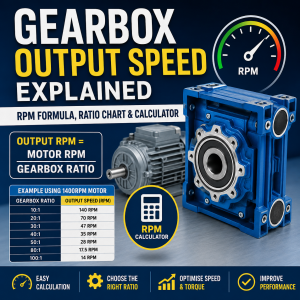
Gearboxes multiply torque and reduce speed, allowing a smaller motor to drive heavy loads.
- Worm gearboxes for compact, high-reduction applications
- Helical gearboxes for high efficiency
- Geared motors for integrated solutions
Electric Motor Sizing Example
Example: A conveyor requires 50 Nm of torque at 60 RPM.
Required power:
Power = (Torque × Speed) ÷ 9550
Power = (50 × 60) ÷ 9550 ≈ 0.31 kW
A 0.37 kW motor paired with a gearbox would be a suitable choice.
Electric Motor Sizing FAQs
1. What happens if an electric motor is undersized?
An undersized motor overheats, stalls, trips protection devices, and fails prematurely.
2. Is it bad to oversize an electric motor?
Yes. Oversized motors waste energy, reduce efficiency, and increase costs.
3. How do I calculate motor torque?
Torque (Nm) = (9550 × Power (kW)) ÷ Speed (RPM).
4. Do I size a motor by kW or torque?
Torque and speed determine kW. Torque is often the limiting factor.
5. What motor speed should I choose?
Choose based on application needs and gearbox use. 4-pole motors are most common.
6. Can a VFD replace motor oversizing?
In many cases, yes. A VFD allows torque and speed control.
7. What is starting torque?
Starting torque is the torque required to start the load from standstill.
8. Do conveyors need high starting torque?
Yes, especially if loaded at startup.
9. How does load inertia affect motor size?
High inertia loads require higher starting torque and longer acceleration times.
10. What motor is best for variable speed?
An inverter-rated AC motor paired with a VFD.
11. Does voltage affect motor size?
Voltage affects current draw but not mechanical output.
12. Should I use IE3 or IE4 motors?
IE3 and IE4 offer higher efficiency and lower running costs.
13. Can gearboxes reduce motor power?
Yes, by increasing torque at lower speeds.
14. What duty cycle needs a larger motor?
High start-stop or intermittent heavy load duties.
15. Do fans need the same torque as conveyors?
No. Fans are variable torque loads.
16. How much safety margin should I add?
Typically 10–20%.
17. What IP rating do I need?
Depends on environment — IP55 is common for industrial use.
18. Can altitude affect motor performance?
Yes. High altitude reduces cooling effectiveness.
19. What is motor slip?
Slip is the difference between synchronous and actual speed.
20. Is single-phase or three-phase better?
Three-phase motors are more efficient and reliable.
21. Do I need a brake motor?
Yes, for vertical loads or precise stopping.
22. What motor is best for continuous duty?
S1 rated AC induction motors.
23. How do I size a motor for a pump?
Use flow rate, head pressure, and pump curve data.
24. Can I reuse an existing motor?
Only if torque, speed, and duty match the application.
25. What causes motor overheating?
Overload, poor cooling, or incorrect sizing.
26. Should I size for peak or average load?
Always size for peak load.
27. What is service factor?
Service factor indicates allowable short-term overload.
28. Are DC motors easier to size?
They offer good torque control but are less common today.
29. Do gear motors simplify sizing?
Yes, they integrate motor and gearbox selection.
30. Can you help size a motor for my application?
Yes — our team can help you choose the correct motor, gearbox, and drive.
Need Help Sizing an Electric Motor?
At Worm Gear Motors Online, we stock a wide range of electric motors, geared motors, gearboxes, and inverter drives at highly competitive prices.
If you are unsure which motor size is right for your application, contact our team and we’ll help you select the correct solution first time.