
Gearbox Mounting Positions Explained: M1–M6 Complete Guide
Gearbox mounting position describes the orientation in which a gearbox is installed. Common designations include M1, M2, M3, M4, M5 and M6, although the exact meaning can vary between gearbox manufacturers and gearbox types.
Choosing the correct mounting position is not only about making the gearbox physically fit the machine. The installation orientation can affect:
- Gearbox lubrication
- Oil level and oil quantity
- Breather and drain-plug locations
- Bearing lubrication
- Seal life
- Operating temperature
- Gearbox reliability
- Motor and terminal-box orientation
A gearbox supplied for the wrong mounting position may still bolt into place, but its internal components may not receive the correct lubrication. This can cause overheating, leakage, bearing wear and premature gearbox failure.
Important: M1–M6 mounting codes are not completely universal. Always check the manufacturer’s mounting-position diagram for the exact gearbox series being installed.
This complete guide explains the common gearbox mounting positions, why orientation matters, how mounting position affects oil level and what to check when ordering or replacing a gearbox.
What Is a Gearbox Mounting Position?
A gearbox mounting position identifies how the gearbox housing, input shaft and output shaft are orientated when installed.
For example, a gearbox may be mounted:
- Horizontally on its base
- Horizontally on the opposite face
- Vertically with the output shaft pointing upwards
- Vertically with the output shaft pointing downwards
- With the input motor above the gearbox
- With the input motor below the gearbox
The mounting code is normally shown on the gearbox nameplate, order confirmation, technical drawing or manufacturer’s data sheet.
If you are replacing an existing unit, identify both the gearbox model and its mounting orientation before ordering. Browse our main range of industrial gearboxes, including worm gearboxes, inline gearboxes and helical bevel gearbox options.
Quick Guide to M1–M6 Gearbox Mounting Positions
The table below gives a general overview of how M1–M6 codes are commonly used. The exact orientation must still be confirmed from the manufacturer’s own drawing.
| Mounting Position | Common General Description | Typical Installation |
|---|---|---|
| M1 | Standard horizontal mounting | Gearbox mounted on its normal base or feet |
| M2 | Horizontal mounting on an alternative face | Gearbox rotated from the standard position |
| M3 | Horizontal inverted or opposite-face mounting | Housing mounted differently from M1 |
| M4 | Alternative horizontal or side-mounted position | Common on side-mounted machinery |
| M5 | Vertical mounting with shaft orientation one way | Shaft-up or vertical installation |
| M6 | Vertical mounting with shaft orientation reversed | Shaft-down or opposite vertical installation |
These are broad descriptions only. On some worm gearbox ranges, M1–M6 may refer to the position of the worm shaft, output bore, feet or motor relative to the gearbox housing. On inline and helical bevel gearboxes, the manufacturer may use a different diagram entirely.
Why Gearbox Mounting Position Matters
The mounting position changes where the lubricant sits inside the gearbox housing. Internal gears and bearings rely on the correct oil level, oil splash or grease distribution.
If the mounting position is wrong, one part of the gearbox may receive too little lubricant while another part is submerged too deeply.
Incorrect mounting position can cause:
- Insufficient lubrication to upper bearings
- Excess oil churning
- Gearbox overheating
- Oil leakage from seals or breathers
- Accelerated gear wear
- Bearing damage
- Foaming or pressure build-up
- Reduced gearbox efficiency
- Shortened service life
Mounting position should therefore be treated as part of the gearbox specification, alongside ratio, torque rating, motor input size and output bore.
M1 Gearbox Mounting Position
M1 is commonly the standard horizontal mounting position. On many gearbox ranges, this means the unit is mounted on its normal base, feet or primary mounting face.
In a typical M1 installation:
- The gearbox is horizontal
- The normal mounting feet or base are at the bottom
- The oil level is set for horizontal operation
- The drain plug is normally at the lowest practical point
- The breather is normally at or near the top
M1 is often the default position when no special orientation is specified, but this should never be assumed without checking the manufacturer’s literature.
Common standard worm gearbox ranges include Motovario NMRV050 worm gearboxes, Tramec XC63 worm gearboxes and Varvel FRS70 worm gearboxes.
M2 Gearbox Mounting Position
M2 normally represents a gearbox rotated away from the standard M1 position. Depending on the gearbox range, the housing may be mounted on a different side or face.
This can affect:
- Which plug becomes the oil-level plug
- Where the drain plug is positioned
- Where the breather must be fitted
- Whether upper bearings remain properly lubricated
- The oil fill quantity
A gearbox originally supplied for M1 should not automatically be rotated into M2 without confirming that the oil quantity and plug arrangement are suitable.
M3 Gearbox Mounting Position
M3 commonly describes another horizontal orientation, sometimes opposite or inverted relative to M1. The precise meaning depends on the gearbox manufacturer.
When changing from M1 to M3, check:
- Oil fill quantity
- Oil-level position
- Breather location
- Seal exposure to oil
- Bearing lubrication
- Motor terminal-box access
- Drain access for maintenance
An inverted installation can place seals and bearings under different lubrication conditions, so it must be correctly specified.
M4 Gearbox Mounting Position
M4 is often another side-mounted or horizontal housing orientation. It may be used where machine space, shaft direction or mounting-hole position makes M1 unsuitable.
M4 applications may include:
- Side-mounted conveyors
- Packaging machinery
- Agitators
- Material-handling systems
- Compact machinery
The gearbox may look physically similar to an M1 unit, but its correct oil fill and plug positions may differ.
M5 Gearbox Mounting Position
M5 commonly represents a vertical gearbox position. Depending on the gearbox type, the output shaft or input shaft may point upwards.
Vertical mounting requires particular attention because bearings positioned high in the gearbox may not receive the same splash lubrication as they would in a horizontal installation.
M5 considerations include:
- Increased oil quantity may be required
- Upper bearings must receive adequate lubrication
- A special bearing arrangement may be needed
- Seals may remain submerged in oil
- Breather position must be correct
- Oil leakage risk may increase
- Motor weight and support must be considered
Do not install a standard horizontal gearbox vertically unless the manufacturer confirms it is suitable for that orientation.
M6 Gearbox Mounting Position
M6 is commonly the opposite vertical orientation to M5. The shaft direction, motor location or gearbox housing position may be reversed.
M6 can be especially demanding where an output shaft points downwards because:
- The lower seal may be continuously exposed to oil
- Oil pressure at the seal can increase
- Upper bearings may be further from the oil bath
- Oil quantity may differ from M5
- Special lubrication arrangements may be required
The correct oil level and seal specification are essential for reliable shaft-down operation.
Are M1–M6 Gearbox Positions Universal?
No. This is one of the most important points when specifying a gearbox.
Although M1–M6 are widely used, manufacturers can define the positions differently depending on:
- Gearbox series
- Gearbox type
- Housing design
- Input and output arrangement
- Foot or flange mounting
- Motor orientation
An M1 position on one manufacturer’s worm gearbox may not visually match M1 on another manufacturer’s inline or helical bevel gearbox.
Always compare the code with the actual mounting-position drawing from the correct product series.
Worm Gearbox Mounting Positions
Worm gearboxes are particularly sensitive to mounting orientation because the worm shaft and worm wheel sit at right angles to each other.
Rotating the gearbox changes:
- The height of the worm shaft relative to the oil
- The lubrication of input bearings
- The lubrication of the output bearings
- Which seals are submerged
- The amount of oil churning
- The correct positions of the filler, drain and level plugs
A standard horizontal worm gearbox may have the worm shaft above, below or beside the output bore, depending on the mounting code.
Browse popular worm gearbox categories including:
- Motovario NMRV040 worm gearboxes
- Motovario NMRV-P075 worm gearboxes
- Motovario NMRV-P090 worm gearboxes
- Tramec XC75 worm gearboxes
- Varvel FRS50 worm gearboxes
Inline Gearbox Mounting Positions
Inline gearboxes have input and output shafts arranged along the same general axis. Their mounting positions can include foot-mounted, flange-mounted, vertical shaft-up and vertical shaft-down configurations.
Important checks include:
- Foot or flange orientation
- Input motor position
- Output-shaft direction
- Oil level
- Breather location
- Bearing lubrication
- Access for maintenance
Inline gearboxes are commonly selected for conveyors, processing machinery, mixers and applications requiring efficient straight-through power transmission.
View our full range of inline gearboxes.
Helical Bevel Gearbox Mounting Positions
Helical bevel gearboxes provide right-angle power transmission with helical and bevel gearing. They are frequently used in conveyors, heavy-duty machinery and industrial processing systems.
Because these gearboxes often have multiple housing, foot, flange and shaft options, mounting position is a key part of the order code.
Check:
- Input motor orientation
- Output shaft side
- Foot or flange mounting
- Torque-arm position
- Oil level and quantity
- Breather and drain positions
- Direction of the driven shaft
Popular options include Motovario BA52 helical bevel gearboxes, Motovario BA72 helical bevel gearboxes and Motovario B103 helical bevel gearboxes.
How Mounting Position Affects Gearbox Oil Level
The correct gearbox oil level is determined by where the gears and bearings sit when the unit is installed.
The same gearbox housing can require different oil quantities in different mounting positions.
| Mounting Situation | Possible Lubrication Effect |
|---|---|
| Standard horizontal mounting | Normal oil bath and splash lubrication |
| Housing rotated onto another side | Oil-level and breather positions change |
| Vertical shaft-up mounting | Upper bearings may require more oil or special lubrication |
| Vertical shaft-down mounting | Lower seal may be continuously submerged |
| Overfilled gearbox | Churning, heat, foaming and leakage |
| Underfilled gearbox | Poor lubrication, wear, noise and overheating |
Never use the visible oil level from one mounting position as the correct level for another orientation without checking the manufacturer’s instructions.
How Mounting Position Affects Oil Quantity
A gearbox installed vertically often requires more oil than the same gearbox installed horizontally because the lubricant must reach bearings and gear meshes positioned higher in the housing.
However, simply filling the gearbox completely is not the solution. Excess oil can create:
- High churning losses
- Increased temperature
- Foaming
- Pressure build-up
- Leakage through seals and breathers
- Reduced efficiency
Always use the oil quantity specified for the exact gearbox size, ratio and mounting position.
Gearbox Filler, Level, Drain and Breather Plugs
Many industrial gearboxes include several threaded plug positions around the housing. The correct plugs are selected according to mounting orientation.
Filler plug
The filler plug provides access for adding lubricant. It should be positioned where oil can be added safely and cleanly.
Oil-level plug
The level plug indicates the correct oil height for the specified mounting position. Oil may be added until it reaches the level opening, where this method is approved by the manufacturer.
Drain plug
The drain plug should normally be located at the lowest practical point so old lubricant can be removed.
Breather plug
The breather allows pressure created by heat and oil expansion to escape. It should normally be fitted in an upper position.
If a transport plug is left in place instead of a breather, internal pressure may build and force oil through the seals.
Can You Change a Gearbox Mounting Position?
Sometimes, but the change must be approved for the gearbox concerned.
Changing mounting position may require:
- Changing the oil quantity
- Moving the breather plug
- Moving the oil-level plug
- Moving the drain plug
- Changing seals
- Adding grease lubrication to upper bearings
- Using an oil expansion tank
- Changing internal oil-management components
- Using a different gearbox build
For a small, grease-filled gearbox, orientation may be less restrictive. For a larger oil-filled gearbox, the correct position is usually more critical.
Do not rotate an installed gearbox simply because the mounting holes line up.
Can a Worm Gearbox Be Mounted in Any Position?
Some compact worm gearboxes are advertised as universal mounting, but this does not always mean every position can be used without adjustment.
Universal mounting may mean:
- The housing has multiple mounting faces
- The gearbox can be supplied for several orientations
- Plug positions can be rearranged
- The lubricant fill suits a range of positions
It does not necessarily mean that oil level, breather location and lubrication requirements can be ignored.
Always check the instructions for the exact model and size.
Foot-Mounted vs Flange-Mounted Gearboxes
Mounting position and mounting style are related but not identical.
Foot-mounted gearbox
A foot-mounted gearbox has feet or a base that bolts to a machine frame.
Advantages include:
- Simple base mounting
- Good support for heavier units
- Easy coupling to a separate shaft
- Common use on conveyors and machinery
Flange-mounted gearbox
A flange-mounted gearbox bolts directly to a machine face, bearing housing or driven equipment.
Advantages include:
- Compact installation
- Good shaft alignment
- Reduced need for a separate base
- Suitable for vertical or machine-face mounting
A flange-mounted gearbox can still have multiple possible mounting positions depending on shaft and motor orientation.
Torque-Arm Mounting
Shaft-mounted gearboxes often use a torque arm to stop the gearbox housing from rotating around the driven shaft.
The torque arm must:
- Be installed in the approved position
- Allow the required movement without binding
- Be securely attached
- Avoid transmitting excessive bending load
- Be suitable for the direction of torque
An incorrectly installed torque arm can cause vibration, damaged bearings, loose bolts and housing stress.
Suitable installation components may be available within our gearbox accessories range.
How Mounting Position Affects the Electric Motor
The gearbox mounting position also determines how the motor is installed.
Check:
- Whether the motor is horizontal or vertical
- Whether the motor shaft points up or down
- Motor-bearing suitability
- Terminal-box access
- Cooling-air clearance
- Drain holes and condensation protection
- Brake-motor orientation
- Support for motor weight
Standard applications commonly use 4 pole electric motors. You can also browse our complete range of AC motors and brake motors.
Vertical Motor and Gearbox Installation
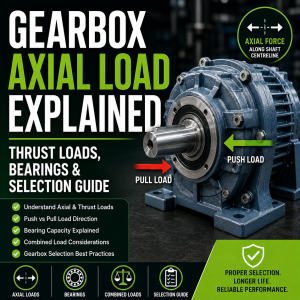
Vertical installation can place different axial loads on motor and gearbox bearings.
Important considerations include:
- Motor shaft-up or shaft-down suitability
- Gearbox input-bearing lubrication
- Output-bearing thrust load
- Motor weight acting on the gearbox flange
- Water or contamination collecting around seals
- Brake operation on vertical loads
Heavy vertical motors may require separate support rather than relying entirely on the gearbox input flange.
Mounting Position and Gearbox Direction of Rotation
Changing the physical orientation of a gearbox does not normally change its internal ratio, but it can change how clockwise and anticlockwise rotation appear when viewed from a different side.
Before commissioning, confirm:
- Motor rotation direction
- Input-shaft viewing direction
- Output-shaft viewing direction
- Required machine movement
- Whether a reverse rotation could damage the process
For three-phase motors, direction can usually be reversed by swapping two phases, but this should be carried out only by a suitably qualified person.
Mounting Position and Self-Locking
Mounting position does not by itself guarantee that a worm gearbox will hold a suspended load.
Worm gearbox self-locking depends on factors including:
- Gear ratio
- Lead angle
- Efficiency
- Lubrication
- Wear
- Vibration
- External load
Applications involving suspended or safety-critical loads should use a properly designed brake or holding system rather than relying only on gearbox friction.
For these applications, consider an appropriate brake motor and obtain professional engineering approval.
Mounting Position and Gearbox Noise
An incorrect mounting position can contribute to abnormal gearbox noise.
Possible causes include:
- Upper bearings receiving insufficient lubrication
- Oil churning due to overfilling
- Breather pressure problems
- Misalignment caused by poor mounting
- Loose feet or flange bolts
- Resonance through the machine frame
If a gearbox becomes louder after being rotated or reinstalled, confirm that the oil quantity, plug positions and alignment are correct.
Mounting Position and Gearbox Temperature
Gearbox temperature can change with orientation because oil distribution, churning and heat dissipation are affected.
A gearbox may run hotter if:
- It is overfilled for the mounting position
- Bearings are insufficiently lubricated
- The breather is incorrectly positioned
- The motor or gearbox cooling airflow is restricted
- The gearbox is overloaded
- The unit is installed close to another heat source
A sudden temperature increase after an installation change should be investigated.
How to Identify the Existing Gearbox Mounting Position
If the original documentation is unavailable, record the actual installation carefully.
Take photographs showing:
- The entire gearbox and motor
- The input side
- The output side
- The mounting feet or flange
- The position of the motor
- The gearbox nameplate
- The filler, level, drain and breather plugs
Record:
- Which way the input shaft points
- Which way the output shaft points
- Which housing face is at the bottom
- Whether the motor is above, below or beside the output shaft
- Whether the gearbox is foot, flange or shaft mounted
Do not rely on the mounting code alone if you do not have the matching manufacturer’s diagram.
How to Order the Correct Gearbox Mounting Position
When requesting a quotation or ordering a gearbox, provide:
- Gearbox manufacturer and model
- Gearbox size
- Ratio
- Motor frame and flange size
- Output bore or shaft size
- Mounting position code
- A photo or drawing of the orientation
- Foot, flange or shaft mounting
- Motor position and terminal-box preference
- Application and required torque
A photograph is especially useful because mounting codes may differ between manufacturers.
Common Gearbox Mounting Mistakes
Assuming M1 means the same for every gearbox
Always check the series-specific mounting diagram.
Rotating a pre-filled gearbox without adjusting the oil
The oil quantity and level may no longer be correct.
Leaving the breather in the wrong position
A breather mounted low in the housing can leak oil, while a sealed transport plug can allow pressure build-up.
Ignoring vertical-bearing lubrication
Upper bearings may require additional lubrication or a special build.
Matching only the gearbox ratio
A replacement must also match orientation, torque, bore, flange and dimensions.
Failing to support a heavy vertical motor
Excess motor weight can overload the gearbox input flange or housing.
Installing the drain plug where it cannot be accessed
Maintenance access should be considered during installation.
Gearbox Mounting Position Inspection Checklist
| Check | Question to Ask |
|---|---|
| Mounting code | Has the correct manufacturer diagram been checked? |
| Physical orientation | Does the installed position match the order specification? |
| Oil quantity | Is it correct for this gearbox position? |
| Oil-level plug | Is the correct plug being used? |
| Breather | Is it fitted in an upper position? |
| Drain plug | Is it at the lowest practical point and accessible? |
| Bearings | Are upper and vertical bearings properly lubricated? |
| Seals | Are they suitable for continuous oil exposure? |
| Motor | Is the motor suitable and properly supported? |
| Alignment | Are the motor, gearbox and driven shaft aligned? |
| Mounting bolts | Are all feet, flanges and torque arms secure? |
| Maintenance access | Can the plugs, nameplate and motor be reached? |
Gearbox Mounting Position FAQ
What does M1 mean on a gearbox?
M1 commonly refers to the standard horizontal gearbox position, but the exact orientation depends on the manufacturer and gearbox series. Always check the relevant mounting diagram.
What do M1, M2, M3, M4, M5 and M6 mean?
They are mounting-position codes used to identify different gearbox orientations. They can describe horizontal, side-mounted, inverted and vertical installations, but their precise meaning is not universal.
Can I mount a gearbox vertically?
Only if the gearbox is approved for vertical installation. Vertical mounting may require a different oil quantity, plug arrangement, bearing lubrication or seal specification.
Can I rotate a worm gearbox onto another side?
Possibly, but you must confirm the new position is approved and adjust the oil level, breather, filler and drain arrangement where required.
Does gearbox mounting position affect oil quantity?
Yes. The same gearbox can require different oil quantities in horizontal and vertical positions because the lubricant must reach different gears and bearings.
What happens if a gearbox has too much oil?
Overfilling can cause oil churning, excessive heat, foaming, pressure build-up, leakage and reduced efficiency.
What happens if a gearbox has too little oil?
Insufficient oil can cause poor lubrication, abnormal noise, overheating, bearing damage and accelerated gear wear.
Where should the gearbox breather be fitted?
The breather is normally installed in an upper plug position where it can release internal pressure without allowing oil to escape. Follow the manufacturer’s instructions.
Is M1 the same for Motovario, Tramec and Varvel gearboxes?
Not necessarily. Similar codes may be used, but the actual orientation can vary by manufacturer and product range. Compare the correct mounting-position drawings.
What information should I provide when ordering a gearbox?
Provide the gearbox model, ratio, motor input, output bore, mounting code, physical orientation, motor position and application details. A clear photograph or drawing is highly recommended.
Need Help Choosing the Correct Gearbox Mounting Position?
Choosing the correct mounting position is essential for gearbox fitment, lubrication and long-term reliability.
Before ordering or changing a gearbox orientation, confirm:
- The exact manufacturer mounting diagram
- Gearbox model and size
- Mounting code
- Oil quantity
- Filler, level, drain and breather positions
- Motor orientation
- Output-shaft direction
- Foot, flange or shaft mounting
- Bearing and seal requirements
Browse our complete range of industrial gearboxes, worm gearboxes, inline gearboxes, gearbox accessories and AC motors.
If you are replacing an existing gearbox, send a clear photo of the gearbox nameplate and the complete installed orientation. This helps confirm the correct ratio, input, output and mounting position before supply.