Worm Gearbox Self-Locking Explained: Can a Worm Gearbox Backdrive?
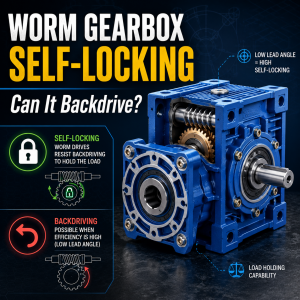
Worm gearboxes are often chosen because they provide high reduction ratios, compact right-angle drive and useful resistance to reverse motion. In some applications, this is described as self-locking, meaning the gearbox can be difficult to drive backwards from the output side.
However, self-locking should be understood carefully. A worm gearbox may resist backdriving under certain conditions, but it should not automatically be treated as a safety brake. The actual behaviour depends on the gearbox ratio, worm angle, efficiency, lubrication, vibration, wear, load direction and application duty.
This guide explains what worm gearbox self-locking means, when a worm gearbox may backdrive, and when you should use a brake motor or additional holding device for safe operation.
What Does Self-Locking Mean on a Worm Gearbox?
Self-locking means the gearbox resists being driven backwards from the output shaft. In a standard drive arrangement, the motor turns the worm, the worm turns the worm wheel, and the gearbox output rotates at a reduced speed.
Backdriving is the opposite. It happens when the load on the output side tries to turn the gearbox backwards, causing the worm wheel to drive the worm and potentially rotate the motor.
In many worm gearbox applications, the sliding contact between the worm and worm wheel creates friction. This friction can make it difficult for the output side to drive the gearbox backwards, especially at higher reduction ratios.
This is one reason why worm gearboxes are widely used on conveyors, gates, adjusters, lifting mechanisms, indexing systems and compact industrial drive applications.
Can a Worm Gearbox Backdrive?
Yes, a worm gearbox can backdrive in some conditions. Although many worm gearboxes resist reverse motion, they are not always completely self-locking.
Whether a worm gearbox can backdrive depends on several factors:
- Reduction ratio: Higher ratios are generally more resistant to backdriving than lower ratios.
- Gearbox efficiency: More efficient worm gearboxes are usually easier to backdrive.
- Worm lead angle: A larger lead angle can make backdriving more likely.
- Lubrication: Better lubrication reduces friction and can reduce self-locking behaviour.
- Vibration: External vibration can help a load overcome static friction.
- Wear: A worn gearbox may behave differently from a new unit.
- Load direction: Gravity, shock loads and dynamic loads can all affect holding ability.
For this reason, a worm gearbox should not be used as the only holding method in safety-critical applications. If the load must be held securely, especially in vertical movement or lifting duties, a brake motor or separate mechanical brake should be considered.
Why Worm Gearboxes Resist Backdriving
A worm gearbox works differently from a spur, helical or bevel gearbox. The worm screw drives the worm wheel through sliding contact rather than simple rolling contact. This sliding action creates friction between the gear surfaces.
That friction can make it hard for the output side to reverse-drive the input. In simple terms, the worm can turn the wheel easily, but the wheel may struggle to turn the worm back, depending on the gearbox design and ratio.
This is one of the reasons customers often choose Motovario NMRV worm gearboxes, Varvel worm gearboxes and Bonfiglioli worm gearboxes for compact machinery where holding resistance is useful.
Is a Worm Gearbox the Same as a Brake?
No. A worm gearbox is not the same as a brake.
A worm gearbox may offer resistance to backdriving, but it is still a gearbox. It is designed to transmit torque and reduce speed, not to act as a certified safety holding brake.
A brake is specifically designed to hold a shaft, stop motion or secure a load when power is removed. A gearbox may help resist movement, but it should not be the only protection where load drop, machine movement or operator safety is a concern.
Use a Brake Motor When:
- The load must stop quickly and accurately.
- The machine has vertical movement.
- The load could fall, unwind or move under gravity.
- The application needs controlled stopping.
- The drive starts and stops frequently.
- The application has safety or holding requirements.
For these applications, view our brake motors, including Amtecs brake motors and related motors for conveyors.
How Gearbox Ratio Affects Self-Locking
Gearbox ratio has a major effect on self-locking behaviour. Higher worm gearbox ratios usually create more resistance to backdriving because the gear geometry and friction make it harder for the output side to rotate the input.
For example, a high-ratio worm gearbox such as 60:1, 80:1 or 100:1 will usually be more resistant to backdriving than a low-ratio worm gearbox such as 5:1, 7.5:1 or 10:1.
However, ratio alone does not guarantee self-locking. Gearbox design, lubrication, load, vibration and wear can all change how the unit behaves in real operation.
General Rule:
- Lower ratios: More likely to backdrive.
- Medium ratios: May resist backdriving, but should be checked carefully.
- Higher ratios: More likely to be difficult to backdrive, but still not a safety brake.
When choosing from ranges such as Motovario NMRV040 worm gearboxes, Motovario NMRV050 worm gearboxes or Varvel FRS60 worm gearboxes, always check both the ratio and the application load before relying on holding resistance.
Self-Locking and Gearbox Efficiency
Efficiency is another important factor. A gearbox with higher friction is generally less efficient, but may be more resistant to backdriving. A gearbox with lower friction is more efficient, but may be easier to backdrive.
This creates a trade-off. In some applications, customers want maximum efficiency and low heat build-up. In others, they value compact drive, high reduction and resistance to reverse motion.
Worm gearboxes are often selected because they offer a practical balance of compact size, right-angle mounting, high reduction ratio and useful holding resistance.
For applications where efficiency is more important than self-locking, an inline or helical gearbox may be a better option. You can browse wider gearboxes if your application needs a different gearbox type.
Applications Where Worm Gearbox Self-Locking Can Help
Self-locking behaviour can be useful in many industrial applications, especially where the load may try to move when the motor stops.
Conveyors
On some conveyors, a worm gearbox can help resist movement when the motor is stopped. This can be useful where the conveyor is inclined or where product weight may pull the belt backwards.
For conveyor drive setups, view motors for conveyors, 4 pole electric motors and compatible worm gearboxes.
Gates and Barriers
Worm gearboxes are commonly used in gates and barriers because the gearbox can help resist external force on the output side. However, security, wind loading and safety requirements may still require additional locking or braking systems.
Mixers and Agitators
Mixers may experience load reversal, product drag or movement after the motor stops. Worm gearbox resistance can help, but the gearbox must still be sized correctly for torque, duty cycle and shock load.
For these applications, browse motors for mixers and suitable worm gearbox ranges.
Lifting and Vertical Movement
Vertical loads require extra care. A worm gearbox may resist backdriving, but it should not be trusted as the only safety holding device for suspended or lifting loads.
Where a load could fall, drop or unwind, use a properly selected brake motor, mechanical brake or approved holding system.
When You Should Not Rely on Worm Gearbox Self-Locking
There are many situations where a worm gearbox should not be relied on as the only holding method.
Do Not Rely on Self-Locking Alone If:
- The load is vertical or suspended.
- People could be injured if the load moves.
- The machine must hold position during power loss.
- The gearbox is exposed to vibration.
- The load creates shock or reversing forces.
- The gearbox is worn or has unknown condition.
- The application requires certified safety braking.
In these cases, self-locking should only be treated as a helpful characteristic, not the main safety device. A brake motor or dedicated brake system is the safer option.
Self-Locking vs Holding Torque
Self-locking and holding torque are related, but they are not exactly the same.
Self-locking describes the gearbox’s resistance to being backdriven from the output side.
Holding torque describes the amount of torque needed to hold a load in position without movement.
A worm gearbox may resist movement, but the holding requirement should still be calculated properly. The application load, shaft radius, incline angle, product weight and duty cycle all affect the torque required to hold the system safely.
This is especially important for conveyors, lifting screws, rotary tables and machinery where load movement could damage equipment.
Does Lubrication Affect Self-Locking?
Yes. Lubrication affects friction between the worm and worm wheel. Better lubrication reduces friction, improves efficiency and helps protect the gearbox, but it can also reduce the resistance to backdriving.
This is why self-locking behaviour can vary between a dry, worn, new, fully lubricated or hot-running gearbox. A gearbox that resists backdriving when cold may behave differently when warm and fully lubricated.
This is another reason not to treat a worm gearbox as a guaranteed brake.
Does Wear Affect Backdriving?
Yes. Wear can change how a gearbox behaves. Over time, the worm wheel, worm shaft, bearings and seals can wear. Backlash may increase, friction may change, and the gearbox may not hold the same way it did when new.
If a machine previously stayed in position but now creeps, drops or moves after stopping, the gearbox, brake and drive system should be inspected.
Replacement options include compact Motovario NMRV030 worm gearboxes, mid-size Motovario NMRV-P075 worm gearboxes and larger Motovario NMRV130 worm gearboxes.
Worm Gearbox Self-Locking and Brake Motors
A brake motor is often the best solution when a drive needs controlled stopping or secure holding. The brake is fitted to the motor and engages when power is removed, helping to stop and hold the motor shaft.
When combined with a worm gearbox, a brake motor can provide a more secure drive arrangement for applications where movement after stopping is not acceptable.
Brake Motors Are Commonly Used For:
- Incline conveyors
- Hoists and lifting mechanisms
- Indexing tables
- Machine positioning
- Packaging equipment
- Automated doors, gates and barriers
- Stop-start machinery
Browse brake motors, Amtecs brake motors, Amtecs aluminium motors and Amtecs cast iron motors for motor and gearbox drive combinations.
How to Choose a Worm Gearbox If Backdriving Matters
If backdriving or load holding is important in your application, do not choose a gearbox by ratio alone. You need to consider the full drive system.
Check the Following:
- Load direction: Is the load horizontal, inclined or vertical?
- Risk of movement: Could the load move when the motor stops?
- Safety risk: Could movement damage equipment or injure someone?
- Gearbox ratio: Higher ratios generally resist backdriving more.
- Motor type: A brake motor may be required.
- Duty cycle: Frequent starts and stops may affect gearbox selection.
- Shock loading: Sudden loads can overcome holding resistance.
- Mounting: The gearbox must be secured correctly using the right accessories.
Related products can be found in gearbox accessories, Motovario gearbox accessories and Varvel gearbox accessories.
Common Mistakes With Worm Gearbox Self-Locking
Self-locking is useful, but it is often misunderstood. Below are the most common mistakes when selecting worm gearboxes for holding or anti-backdrive applications.
1. Assuming Every Worm Gearbox Is Self-Locking
Not every worm gearbox is fully self-locking. Low ratios, high-efficiency designs, lubrication and vibration can all make backdriving possible.
2. Using a Worm Gearbox as a Safety Brake
A gearbox should not be treated as a certified safety brake. If holding is critical, use a brake motor or dedicated braking system.
3. Ignoring Load Direction
A horizontal conveyor and a vertical lifting application create very different risks. The more serious the consequence of movement, the more important proper braking becomes.
4. Forgetting About Wear
A new gearbox and a worn gearbox may not behave the same way. Increased wear can affect backlash, friction and holding resistance.
5. Choosing Ratio Only
Ratio affects self-locking, but torque, duty cycle, load, vibration, motor type and mounting must also be considered.
FAQs About Worm Gearbox Self-Locking
Are all worm gearboxes self-locking?
No. Some worm gearboxes can resist backdriving, especially at higher ratios, but not all worm gearboxes are fully self-locking. The actual behaviour depends on ratio, efficiency, lubrication, load and operating conditions.
Can a worm gearbox backdrive?
Yes. A worm gearbox can backdrive in some conditions, particularly at lower ratios or where vibration, lubrication, wear or external load forces reduce the holding effect.
Can I use a worm gearbox instead of a brake?
No. A worm gearbox should not be used as a direct replacement for a brake in safety-critical applications. If secure holding is required, use a brake motor or dedicated mechanical brake.
Does a higher ratio make a worm gearbox more self-locking?
Generally, higher ratios are more resistant to backdriving. However, ratio alone does not guarantee self-locking.
Do brake motors work with worm gearboxes?
Yes. Brake motors are commonly used with worm gearboxes where controlled stopping, load holding or anti-backdrive performance is required.
Can a worn worm gearbox lose holding resistance?
Yes. Wear can change friction, backlash and gear contact. If a gearbox starts creeping or moving after stopping, it should be inspected.
Conclusion: Self-Locking Is Useful, But It Is Not a Safety Brake
Worm gearbox self-locking can be a useful feature in many applications. The natural resistance to backdriving can help prevent unwanted movement, especially at higher ratios and in compact drive systems.
However, self-locking is not guaranteed in every worm gearbox and should not be treated as a replacement for a brake. Ratio, efficiency, lubrication, wear, vibration and load direction all affect whether a worm gearbox can backdrive.
For applications where movement must be controlled or prevented, especially incline conveyors, lifting systems, gates, indexing machines and vertical loads, a correctly selected brake motor or additional holding device should be used.
At Worm Gear Motors Online, we supply worm gearboxes, brake motors, AC motors and gearbox accessories for industrial drive applications. If backdriving, holding load or stopping control matters in your application, choose the full motor and gearbox setup carefully rather than relying on gearbox self-locking alone.