
IEC Motor Flange Sizes Explained: B5 vs B14 Gearbox Inputs
Choosing the correct motor for a gearbox is not just about power, speed and voltage. The motor must also physically fit the gearbox input. One of the most common mistakes when replacing or buying a geared motor is ordering the correct kW motor but the wrong flange type.
IEC motor flange sizes are used to match electric motors to worm gearboxes, inline gearboxes and other industrial drive units. The two most common flange types used with gearboxes are B5 and B14. Both are flange-mounted designs, but they are not the same. The spigot diameter, fixing holes, bolt pattern and shaft dimensions all need to match the gearbox input.
In this guide, we explain what B5 and B14 motor flanges mean, how they connect to gearbox inputs, and what to check before buying a motor or worm gearbox for conveyors, pumps, mixers, fans and industrial machinery.
What Is an IEC Motor Flange?
An IEC motor flange is the front mounting face of an electric motor. It allows the motor to bolt directly onto a gearbox, pump, fan, machine frame or adapter plate.
When a motor is fitted to a gearbox, the flange does two important jobs:
- It positions the motor correctly: The flange spigot locates inside the gearbox input adapter to keep the motor shaft aligned.
- It secures the motor to the gearbox: The bolt holes allow the motor to be fastened firmly to the gearbox input housing.
If the flange is wrong, the motor may not fit the gearbox at all. Even if the bolt holes look close, poor alignment can cause vibration, bearing wear, input seal damage or coupling failure.
For replacement motors and geared motor assemblies, always check the full motor frame and flange configuration before ordering from categories such as AC Motors, Motors for Gearboxes and Gearboxes.
What Does B5 Mean on an Electric Motor?
A B5 motor has a large front flange with through holes. This type of flange is commonly used when the motor is bolted directly onto a gearbox, machine housing or mounting plate.
B5 flanges are usually larger than B14 flanges. They are often used on larger motor frames, heavier-duty gearbox applications and installations where a strong face-mounted connection is required.
Typical B5 Motor Flange Features
- Large diameter front flange
- Through holes for mounting bolts
- Central locating spigot to align the motor to the gearbox input
- Common on larger IEC motor frames
- Often used for direct gearbox mounting
For example, many worm gearbox inputs are supplied to suit IEC motor frames such as 63B5, 71B5, 80B5, 90B5 and above. The number refers to the IEC motor frame size, while B5 refers to the flange mounting style.
If you are selecting a motor for a conveyor, pump or gearbox-driven machine, B5 motors are often found in categories like Motors for Conveyors, Motors for Pumps and 4 Pole Electric Motors.
What Does B14 Mean on an Electric Motor?
A B14 motor has a smaller face flange with tapped holes. Instead of bolts passing through the flange into the gearbox, the bolts usually pass through the gearbox adapter and screw into the motor flange.
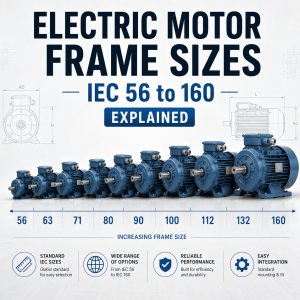
B14 flanges are compact and commonly used with smaller worm gearboxes, compact machinery and space-restricted installations. They are popular on smaller IEC motor frames such as 56, 63, 71 and 80.
Typical B14 Motor Flange Features
- Smaller front flange than B5
- Tapped mounting holes
- Compact design for smaller gearbox inputs
- Common on worm gearboxes and small geared motors
- Often used where space is limited
A motor listed as 63B14, 71B14 or 80B14 is not automatically interchangeable with a 63B5, 71B5 or 80B5 motor. The frame size may be the same, but the flange size, bolt pattern and fitting method are different.
This is why it is important to check both the motor frame and the flange type before matching motors to products such as Motovario NMRV050 Worm Gearboxes, Varvel FRS50 Worm Gearboxes or Bonfiglioli MVF 49 Worm Gearboxes.
B5 vs B14 Motor Flanges: What Is the Difference?
The main difference between B5 and B14 motor flanges is the physical flange design. B5 is normally a larger flange with through holes, while B14 is normally a smaller flange with threaded holes.
| Feature | B5 Motor Flange | B14 Motor Flange |
|---|---|---|
| Flange Size | Larger front flange | Smaller compact flange |
| Fixing Holes | Through holes | Tapped holes |
| Common Use | Larger gearboxes, pumps and machinery | Compact worm gearboxes and smaller machines |
| Mounting Style | Bolts pass through the motor flange | Bolts screw into the motor flange |
| Typical Frame Sizes | 63, 71, 80, 90, 100, 112 and above | 56, 63, 71, 80 and other compact frames |
Both flange styles can be used successfully with gearboxes, but they must match the gearbox input adapter. A gearbox drilled for 71B14 will not normally accept a 71B5 motor without changing the input flange or adapter.
What Does 56B14, 63B5, 71B14 or 80B5 Mean?
Motor input codes such as 56B14, 63B5, 71B14 and 80B5 combine the IEC motor frame size with the mounting flange type.
- 56B14: IEC 56 frame motor with B14 face flange
- 63B5: IEC 63 frame motor with B5 flange
- 71B14: IEC 71 frame motor with B14 face flange
- 80B5: IEC 80 frame motor with B5 flange
The number is not the shaft size. It is the motor frame size. The actual shaft diameter, keyway, spigot diameter and bolt pattern need to be checked separately against the gearbox input.
This is especially important when replacing motors on worm gearboxes from ranges such as Motovario NMRV040 Worm Gearboxes, SITI MI50 Worm Gearboxes and Rossi MVR63 UO3A Worm Gearboxes.
Why Motor Flange Size Matters on a Worm Gearbox
A worm gearbox input is machined to accept a specific motor frame and flange. The input adapter needs to match the motor’s spigot, shaft diameter, shaft length and bolt holes.
If the motor flange is wrong, several problems can happen:
- The motor will not bolt onto the gearbox.
- The motor shaft may not reach the input coupling correctly.
- The spigot may be too large or too small for the gearbox input.
- The bolt holes may not line up.
- The motor may sit out of alignment and damage the gearbox input bearing.
Even a small mismatch can cause long-term reliability issues. Gearboxes rely on accurate motor alignment because the input shaft runs at motor speed. Any misalignment can create noise, heat and premature wear.
What Is the Motor Spigot?
The motor spigot is the raised circular locating diameter on the front of the motor flange. It fits into the gearbox input adapter and centres the motor shaft with the gearbox input bore or coupling.
The spigot is one of the most important dimensions when checking whether a motor will fit a gearbox. The bolt holes secure the motor, but the spigot provides alignment.
When checking an IEC motor flange, look for:
- Spigot diameter
- Flange outside diameter
- Bolt hole PCD
- Number of fixing holes
- Shaft diameter
- Shaft length
- Keyway size
If you are replacing an old motor, do not rely only on the motor kW. Measure the flange and compare it against the gearbox input before ordering a replacement from Amtecs Aluminium Motors, Amtecs Cast Iron Motors or Motovario Motors.
What Is PCD on a Motor Flange?
PCD stands for pitch circle diameter. It is the diameter of the circle that passes through the centre of the mounting holes on the flange.
On a B5 or B14 motor, the PCD must match the gearbox input adapter. If the PCD is different, the bolts will not line up correctly.
For gearbox applications, PCD is especially important because different flange types can look similar at first glance. A motor may appear to be the correct size, but if the PCD is wrong, it will not fit without an adapter or different input flange.
Can You Fit a B5 Motor to a B14 Gearbox Input?
In most cases, you cannot directly fit a B5 motor to a B14 gearbox input. The flange design, fixing method and bolt pattern are different.
A B5 motor may be usable if the gearbox input flange can be changed to a B5 version, or if a suitable adapter is available. However, this depends on the gearbox brand, size and input design.
For example, some worm gearbox ranges allow different motor input options for the same gearbox size. A gearbox may be available in 63B14, 63B5, 71B14 or 71B5 input versions. This gives flexibility, but the input must be selected correctly at the time of purchase.
If you are unsure, it is usually safer to match the original motor code exactly or select the gearbox input based on the motor you already have.
Can You Fit a B14 Motor to a B5 Gearbox Input?
A B14 motor will not normally bolt directly to a B5 gearbox input. The B14 flange is smaller and uses tapped holes, while the B5 flange is larger and uses through holes.
As with the reverse situation, it may be possible if the gearbox input adapter can be changed. But the motor shaft and spigot still need to be correct.
Before changing from B5 to B14 or B14 to B5, always check:
- Gearbox input flange options
- Motor shaft diameter and length
- Spigot diameter
- PCD and bolt hole arrangement
- Motor power and speed suitability
- Application load and service factor
Motor Frame Size vs Flange Size: Why They Are Not the Same
A common mistake is assuming that the IEC frame size tells you everything. It does not.
For example, a 71 frame motor tells you the general motor frame size, but it does not confirm whether the motor is foot mounted, B5 flange mounted, B14 face mounted or a combination mounting.
You may see motor mounting codes such as:
- B3: Foot mounted motor
- B5: Large flange mounted motor
- B14: Small face flange mounted motor
- B35: Foot and B5 flange mounted motor
- B34: Foot and B14 face mounted motor
For gearbox input mounting, B5 and B14 are the most important. B3 foot mounting is useful when the motor sits separately or when the complete geared motor assembly needs additional base support.
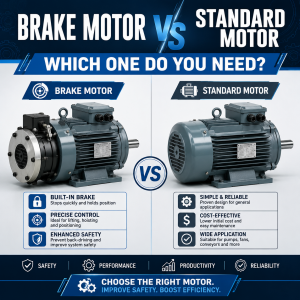
For applications that require stopping and holding load, you may also need to consider Amtecs Brake Motors instead of a standard motor.
Which Motor Flange Is Best for Gearboxes?
There is no single best flange for every gearbox. The correct choice depends on the gearbox size, motor frame, application and available space.
Choose B14 When:
- The gearbox is compact.
- The motor frame is small.
- Space around the gearbox is limited.
- The gearbox input is already designed for B14 mounting.
- You are replacing an existing B14 motor.
Choose B5 When:
- The gearbox input is designed for a larger flange.
- The motor frame is larger or heavier.
- The application needs a strong direct-mounted connection.
- You are replacing an existing B5 motor.
- The machine design already uses a B5 mounting face.
For small worm gearboxes, B14 is very common. For larger geared motor assemblies, B5 is often preferred because of the stronger and larger mounting face.
How to Check Which Motor Flange You Need
Before ordering a replacement motor or gearbox, check the following details from the existing motor nameplate, gearbox datasheet or physical measurements.
1. Check the IEC Frame Size
Look for a frame size such as 56, 63, 71, 80, 90, 100 or 112. This gives the basic motor size.
2. Check the Mounting Code
Look for B5, B14, B3, B35 or B34. For direct gearbox mounting, the key codes are usually B5 or B14.
3. Measure the Motor Shaft
Check the shaft diameter, shaft length and keyway size. These need to match the gearbox input coupling or hollow input bore.
4. Measure the Spigot
The spigot must locate correctly inside the gearbox input adapter. If the spigot is wrong, the motor will not align properly.
5. Check the Bolt Pattern
Measure the PCD and fixing hole arrangement. B5 and B14 flanges use different fixing styles.
6. Confirm the Gearbox Input Version
Gearboxes are often available with several input options. Make sure the gearbox input matches the motor you plan to fit.
Common Applications for B5 and B14 Gearbox Inputs
B5 and B14 motors are used across many industrial applications where an electric motor drives a gearbox directly.
Conveyors
Conveyor gearboxes often use IEC motor inputs because motors need to be replaced easily. A compact B14 motor may be used on smaller conveyors, while B5 motors are common on larger conveyor drives.
Browse suitable options in Motors for Conveyors and 4 Pole Electric Motors.
Pumps
Pump drives can use flange-mounted motors depending on the pump and gearbox design. Correct alignment is important to prevent vibration and bearing wear.
See related products in Motors for Pumps.
Mixers and Agitators
Mixers often need high torque and reliable shaft alignment. The gearbox input flange must be correct because these applications can involve shock loads, start-stop duty and heavy mixing resistance.
See related products in Motors for Mixers.
Fans
Fan applications usually require smooth running and correct motor speed. Flange-mounted motors may be used depending on the fan arrangement and gearbox configuration.
Browse Motors for Fans for suitable motor options.
Motor Flanges and Worm Gearbox Selection
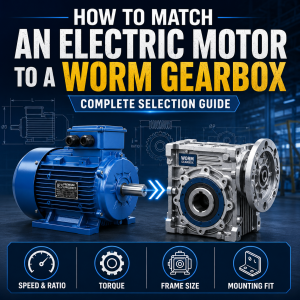
When selecting a worm gearbox, the motor input should be treated as part of the gearbox specification. Ratio, torque and output bore are important, but the input side decides whether your motor will physically fit.
For example, a worm gearbox could be correct in ratio and output torque but still unusable if it has the wrong motor input flange.
Before choosing a gearbox, confirm:
- Required gearbox ratio
- Output torque requirement
- Output bore or shaft size
- Mounting position
- Motor power and speed
- Motor input flange size
- B5 or B14 compatibility
Popular worm gearbox categories include Motovario NMRV040 Worm Gearboxes, Motovario NMRV050 Worm Gearboxes, Varvel FRS60 Worm Gearboxes and Bonfiglioli W 75 Worm Gearboxes.
Do You Need a Foot Mounted Motor as Well?
Some motors are supplied with both feet and a flange. These are commonly identified as B35 or B34 mounting arrangements.
- B35: Foot mounted motor with B5 flange
- B34: Foot mounted motor with B14 flange
This can be useful when the complete motor and gearbox assembly needs extra support from the machine base. However, when a motor is fitted to a worm gearbox, the gearbox itself is often the main mounted component.
If the original machine uses a foot and flange arrangement, replace it with the same mounting style unless the machine layout is being changed.
Common Mistakes When Ordering a Motor for a Gearbox
Most gearbox motor fitment problems happen because one small detail is missed. The motor may be electrically correct but mechanically wrong.
Common Mistakes Include:
- Ordering by kW only and ignoring the flange type
- Confusing B5 and B14 because both are flange-mounted
- Assuming the same frame size means the same fitment
- Not checking shaft diameter or shaft length
- Not checking the motor spigot diameter
- Ignoring the gearbox input adapter size
- Replacing a brake motor with a standard motor when holding force is needed
To avoid these issues, always check the motor nameplate, gearbox model code and physical dimensions before ordering.
Quick Buying Checklist
Use this checklist before buying a motor or gearbox input combination:
- Motor power: Is the kW rating correct for the application?
- Motor speed: Is it 2 pole, 4 pole or another speed?
- Voltage: Does it match the supply or inverter?
- Frame size: Is it 56, 63, 71, 80, 90 or another IEC frame?
- Flange type: Is it B5 or B14?
- Shaft diameter: Does it match the gearbox input?
- Shaft length: Does it engage correctly?
- Spigot diameter: Does it locate into the gearbox adapter?
- PCD: Do the bolt holes line up?
- Application: Is the motor suitable for conveyors, pumps, fans, mixers or brake duty?
FAQs About B5 and B14 Motor Flanges
Is B5 better than B14?
Not always. B5 is larger and often better for heavier-duty or larger motor frames, while B14 is more compact and commonly used on smaller worm gearboxes. The correct choice depends on the gearbox input design.
Can I use a B14 motor instead of a B5 motor?
Usually not without changing the gearbox input adapter. B14 and B5 flanges have different fixing styles, flange sizes and bolt patterns.
Does the motor frame size tell me the flange size?
No. A motor frame size such as 71 or 80 tells you the general motor size, but you still need to check whether it is B5, B14, B3, B35 or B34 mounted.
What does 71B14 mean?
71B14 means the motor is an IEC 71 frame motor with a B14 face flange. This is commonly used on compact gearbox inputs.
What does 80B5 mean?
80B5 means the motor is an IEC 80 frame motor with a B5 flange. This is commonly used where a larger flange-mounted motor is required.
Do worm gearboxes use B5 or B14 motors?
They can use either, depending on the gearbox size and input adapter. Smaller worm gearboxes often use B14 inputs, while larger gearbox sizes may use B5 inputs.
Conclusion: Always Match the Motor Flange to the Gearbox Input
IEC motor flange size is one of the most important details when matching an electric motor to a gearbox. B5 and B14 motors may both be flange-mounted, but they are not directly interchangeable.
Before buying a replacement motor or gearbox, check the motor frame size, flange type, spigot diameter, shaft size, shaft length and bolt pattern. This prevents fitment issues and helps ensure the motor and gearbox run smoothly together.
At Worm Gear Motors Online, we supply a wide range of AC Motors, Motors for Gearboxes, Gearboxes and worm gearbox options for industrial applications. Whether you need a compact B14 motor for a small worm gearbox or a B5 flange motor for a larger drive assembly, choosing the correct input fitment is essential for reliable operation.