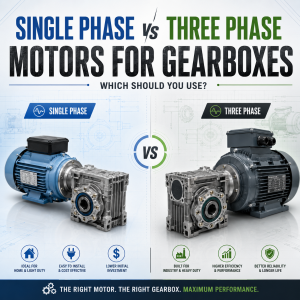
Single Phase vs Three Phase Motors for Gearboxes: Which Should You Use?
Choosing the right motor for a gearbox is just as important as choosing the correct gearbox ratio, output torque, mounting position and bore size. One of the most common questions is whether a single phase motor or a three phase motor should be used with a gearbox.
The answer depends on the available power supply, motor size, starting torque, duty cycle, control method and the type of machine being driven. Single phase motors are useful for smaller applications where only a domestic or light commercial supply is available, while three phase motors are normally the better choice for industrial gearbox applications that require smoother running, higher efficiency and stronger starting performance.
In this guide, we explain the difference between single phase and three phase motors for gearboxes, when each option makes sense, and what to check before buying a complete motor and gearbox setup.
What Is a Single Phase Motor?
A single phase motor runs from a single phase electrical supply, commonly used in homes, small workshops, farms, garages, light commercial units and smaller machinery installations. These motors are often selected when a three phase supply is not available.
Single phase motors are usually used on smaller power ratings and lighter-duty machinery. They are practical, easy to install and suitable for applications where the gearbox does not need to start under heavy load or run continuously at high industrial duty.
For smaller gearbox-driven systems, Amtecs single phase motors can be a suitable option where the site only has a single phase supply available.
What Is a Three Phase Motor?
A three phase motor runs from a three phase electrical supply, which is common in factories, warehouses, production sites, agricultural facilities and industrial buildings. Three phase motors are the standard choice for most industrial gearbox applications because they provide smoother power delivery, better efficiency and stronger performance under load.
Three phase motors are especially useful when the motor needs to start and stop frequently, drive a conveyor, run for long periods, or operate with a variable speed drive. They are usually the preferred option for demanding machinery because the power delivery is more balanced than single phase.
If you are building a new industrial drive system, it is usually worth starting with the full AC motors range and then selecting the correct motor size, pole speed, mounting type and gearbox compatibility.
Single Phase vs Three Phase Motors: Main Differences
| Feature | Single Phase Motor | Three Phase Motor |
|---|---|---|
| Power Supply | Single phase supply | Three phase supply |
| Best For | Small machines, workshops and light-duty applications | Industrial machinery, conveyors and continuous-duty systems |
| Starting Torque | Usually lower than three phase | Stronger and smoother starting performance |
| Efficiency | Generally lower | Generally higher |
| Running Smoothness | Can be less smooth under load | Smoother power delivery |
| Control Options | More limited, especially for variable speed control | Excellent with inverter drives and control panels |
| Typical Gearbox Use | Light-duty gearbox applications | Medium and heavy-duty gearbox applications |
When Should You Use a Single Phase Motor with a Gearbox?
A single phase motor can be the right choice when the machine is small, the load is light, and there is no three phase supply available. This is common in workshops, small farms, light conveyors, small mixers, fans, pumps and simple machinery where the motor does not need to start under a heavy load.
Choose a single phase motor for a gearbox when:
- The site only has a single phase electrical supply.
- The motor power requirement is relatively low.
- The gearbox is driving a light or medium-duty load.
- The machine does not require frequent heavy starts.
- Variable speed control is not a major requirement.
- The application is simple and cost-sensitive.
- The machine is used intermittently rather than continuously.
Single phase motors can work well with smaller gearbox sizes, especially where the driven load is predictable and easy to start. They are often suitable for light-duty applications using compact worm gearboxes, small conveyor drives and simple mechanical systems.
When Should You Use a Three Phase Motor with a Gearbox?
A three phase motor is usually the better choice for gearbox applications where the machine is industrial, the load is heavier, or the motor needs to run for long periods. Three phase motors are better suited to demanding duty cycles and are easier to control using inverter drives.
Choose a three phase motor for a gearbox when:
- The machine is used in an industrial environment.
- The gearbox drives a conveyor, auger, mixer or production machine.
- The motor needs to start under load.
- The machine starts and stops frequently.
- The application requires variable speed control.
- The duty cycle is long or continuous.
- The motor power requirement is above smaller single phase ratings.
- The gearbox is part of a larger automated system.
For most industrial gearbox applications, motors for gearboxes should normally be specified as three phase where supply is available, especially if the drive system is expected to run reliably every day.
Why Three Phase Motors Are Usually Better for Gearboxes
Gearboxes multiply torque and reduce speed, which means the motor and gearbox need to work together correctly. A weak motor choice can cause poor starting, overheating, excessive current draw or premature failure, even if the gearbox itself is correctly sized.
Three phase motors are usually better for gearbox applications because they deliver power more smoothly. This helps reduce vibration and improves performance when the gearbox is under load. They also pair well with inverter drives, making them suitable for adjustable speed conveyor systems, process machinery and industrial automation.
For applications such as conveyors, it is worth looking at dedicated motors for conveyors, as these are commonly selected around torque, speed, duty cycle and gearbox compatibility.
Starting Torque: Why It Matters with Gearboxes
Starting torque is one of the most important differences between single phase and three phase motors. Many gearbox-driven machines need high torque at low speed, especially when starting from rest. Conveyors, mixers, screw feeders and loaded machinery can place a large starting demand on the motor.
Single phase motors can struggle more with heavy starting loads because they do not naturally produce the same smooth rotating magnetic field as a three phase motor. They often rely on capacitors to help with starting and running performance.
Three phase motors are usually stronger and more reliable when starting under load. This makes them the safer choice for gearbox applications where the driven machine may start with material already on the conveyor, product in the mixer, or load on the shaft.
Speed Control: Single Phase vs Three Phase
If you need variable speed control, three phase motors are normally the better option. A three phase motor can be paired with an inverter drive to control speed, acceleration, deceleration and motor protection.
This is particularly useful when the gearbox is used on a conveyor, dosing system, packaging machine or process line where output speed needs to be adjusted. Instead of changing gearbox ratios, the inverter can adjust the motor speed within a controlled range.
For adjustable speed systems, categories such as Invertek Optidrive E3 drives and Tec three phase TecDrive inverters can be useful when selecting a motor control solution.
Can You Run a Three Phase Motor from a Single Phase Supply?
In some cases, yes. A suitable inverter drive can allow a three phase motor to run from a single phase input supply, depending on the motor size, inverter rating and application. This can be a good solution when you only have single phase supply available but still want the benefits of a three phase motor.
This approach is often used for smaller industrial machines, workshop equipment and light production systems where a full three phase supply is not available. However, the inverter must be sized correctly, and the motor should be compatible with inverter operation.
For these setups, Invertek Optidrive E3 single phase drives and Tec single phase TecDrive inverters may be suitable depending on the motor and application.
Which Pole Speed Should You Choose for a Gearbox Motor?
Motor pole speed affects the input speed going into the gearbox. Common options include 2 pole, 4 pole and 6 pole motors. A 2 pole motor normally runs at a higher speed, while a 4 pole motor is often used where a lower motor speed and smoother gearbox setup is preferred.
For many gearbox applications, 4 pole motors are a very common choice because they provide a practical balance between speed, torque and gearbox compatibility. However, the correct option depends on the required output speed, gearbox ratio and torque requirement.
You can compare motor speed options using categories such as 2 pole electric motors, 4 pole electric motors and 6 pole electric motors.
Single Phase Motors for Gearboxes: Advantages and Disadvantages
Advantages of Single Phase Motors
- Useful where only single phase supply is available.
- Practical for smaller machines and workshops.
- Simple to install on light-duty applications.
- Often suitable for smaller gearboxes and lower power ratings.
- Good option for intermittent use.
Disadvantages of Single Phase Motors
- Not ideal for heavy starting loads.
- Usually less efficient than three phase motors.
- Can be less smooth under load.
- Limited for larger industrial gearbox applications.
- Variable speed control can be more restricted.
Three Phase Motors for Gearboxes: Advantages and Disadvantages
Advantages of Three Phase Motors
- Better for industrial gearbox applications.
- Smoother running under load.
- Better starting performance.
- Higher efficiency for continuous duty.
- Excellent compatibility with inverter drives.
- Available across a wider power range.
- Better suited to conveyors, mixers and process machinery.
Disadvantages of Three Phase Motors
- Requires a three phase supply or suitable inverter setup.
- Can involve more electrical planning.
- May be unnecessary for very small, simple machines.
- Control equipment may add cost if variable speed is required.
What About Brake Motors for Gearboxes?
If the gearbox needs to stop quickly, hold a load, or prevent movement when power is removed, a brake motor may be required. This is common on lifting equipment, indexing conveyors, inclined conveyors, machine doors, hoists and applications where controlled stopping is important.
Brake motors can be especially useful when paired with gearboxes because the gearbox increases torque and the driven load may continue to move after power is removed. A brake helps hold the system in position and improves safety in certain applications.
For applications that need stopping or holding control, Amtecs brake motors may be more suitable than a standard motor.
Matching the Motor to the Gearbox
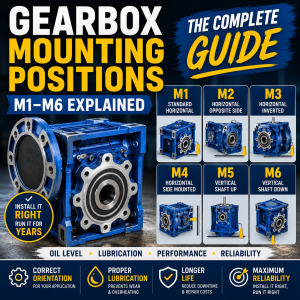
Before choosing between single phase and three phase, the motor must be correctly matched to the gearbox. You should check the motor power, frame size, flange type, shaft size, input speed, mounting position and required output speed.
The gearbox ratio determines how much the motor speed is reduced and how much torque is multiplied. For example, a high ratio gearbox will produce a slower output speed and higher torque, but it may also generate more heat and require careful duty checking.
You should also make sure the motor physically fits the gearbox input. B5 and B14 flange arrangements, shaft dimensions and IEC frame sizes must match the gearbox input design.
If you are selecting the gearbox first, start from the main gearboxes category or browse Motovario NMRV050 worm gearboxes and similar frame-size options to compare gearbox size, ratio and motor compatibility.
Single Phase vs Three Phase for Common Gearbox Applications
| Application | Recommended Motor Type | Reason |
|---|---|---|
| Small workshop machine | Single phase or three phase with inverter | Depends on available supply and load |
| Light conveyor | Single phase for simple use, three phase for industrial use | Three phase is better for frequent starts and speed control |
| Heavy conveyor | Three phase | Better starting torque and continuous-duty performance |
| Pump application | Single phase for small pumps, three phase for industrial pumps | Depends on power, flow demand and duty cycle |
| Fan application | Single phase for smaller fans, three phase for larger fans | Three phase is better for speed control and larger loads |
| Mixer or auger | Three phase | Usually requires stronger starting torque |
| Automated production line | Three phase | Better for control, reliability and continuous operation |
Should You Choose Single Phase or Three Phase?
For small, simple machines where only single phase power is available, a single phase motor can be a practical choice. It can work well with smaller gearboxes, light loads and intermittent-duty applications.
For industrial machinery, conveyors, continuous-duty systems, heavier loads or any application that needs variable speed control, a three phase motor is usually the better long-term option. It will normally run smoother, start better under load and offer more control options when paired with an inverter drive.
As a general rule:
- Use single phase when the machine is small, simple and light-duty.
- Use three phase when the machine is industrial, high-duty or load-sensitive.
- Use a suitable inverter if you need speed control or only have single phase supply but want to run a three phase motor.
- Always match the motor frame, flange, power, speed and duty cycle to the gearbox.
Final Recommendation
If you have a three phase supply available, a three phase motor is normally the best choice for gearbox applications. It gives stronger starting performance, smoother running, better efficiency and more flexibility with inverter control.
If you only have single phase supply, a single phase motor can still be suitable for smaller gearbox-driven machines. For more demanding applications, consider using a single phase input inverter with a compatible three phase motor, as this can provide better control and performance than a standard single phase motor.
At Worm Gear Motors Online, we supply electric motors, gearbox-compatible motors, worm gearboxes, inverter drives and brake motors for a wide range of machinery applications. Browse our motors for gearboxes, gearboxes and inverter drives to build the right motor and gearbox setup for your application.
FAQs
Can I use a single phase motor with a gearbox?
Yes, a single phase motor can be used with a gearbox if the application is light-duty, the motor is correctly sized, and the gearbox does not need to start under a heavy load. It is commonly used where only single phase power is available.
Is a three phase motor better for a gearbox?
In most industrial applications, yes. Three phase motors are usually better for gearboxes because they offer smoother running, stronger starting performance, better efficiency and easier speed control with inverter drives.
Can I run a three phase motor from single phase power?
Yes, in some cases a suitable inverter drive can run a three phase motor from a single phase input supply. The inverter and motor must be correctly rated for the application.
Which motor is best for a conveyor gearbox?
For a small light-duty conveyor, single phase may be suitable. For industrial conveyors, frequent starts, variable speed control or heavier loads, a three phase motor is usually the better option.
Do I need an inverter for a gearbox motor?
You need an inverter if you want variable speed control, controlled acceleration, controlled deceleration or improved motor protection. Inverters are most commonly used with three phase motors.
What pole motor should I use with a gearbox?
Many gearbox applications use 4 pole motors because they offer a practical balance of speed and torque. However, the correct pole speed depends on the required output speed, gearbox ratio and application duty.
Are single phase motors suitable for heavy-duty gearboxes?
Usually not. Heavy-duty gearboxes normally need stronger starting performance and better continuous-duty capability, which makes three phase motors the better option.
Should I choose the motor or gearbox first?
It depends on the application. Usually, you should start with the required output speed and torque, then select the gearbox ratio and motor power together so the full drive system is correctly matched.