Brake Motors Explained: Holding Torque, Safety & Emergency Stop Applications
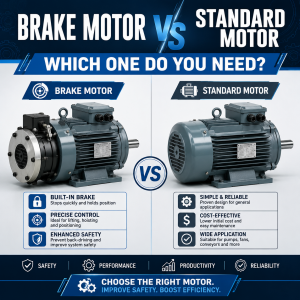
Brake motors are essential in applications where loads must stop quickly, hold position securely, or prevent movement during power loss. Unlike standard motors, a brake motor includes an integrated electromagnetic brake that locks the shaft when power is removed, providing both safety and control.
If you’re specifying equipment for vertical loads, conveyors, hoists, or emergency stop systems, choosing the correct brake motor is critical. In this guide, we explain how brake motors work, what holding torque means, when they are required, and how to select the right solution for your application.
Drive Outlet Megastore supplies a wide range of electric motors, geared motors, gearboxes, and inverter drives suitable for safe stopping and holding applications.
What Is a Brake Motor?
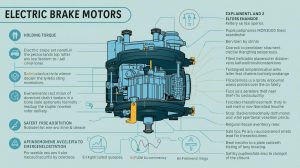
A brake motor is a standard AC or DC motor fitted with a spring-applied, electrically released brake.
When power is applied:
- Brake releases
- Motor rotates normally
When power is removed:
- Brake engages automatically
- Shaft locks instantly
- Load is held safely in position
This “fail-safe” design means the brake activates during power cuts or emergency stops.
Why Use a Brake Motor?
- Prevents loads falling under gravity
- Provides rapid stopping
- Improves machine safety
- Meets safety compliance requirements
- Holds position without continuous power
Without a brake, loads may coast, drift, or drop when power is removed — which can be dangerous and damaging.
What Is Holding Torque?
Holding torque is the maximum torque the brake can resist when the motor is stopped.
It determines how much load the brake can safely hold without slipping.
Example:
- Brake torque = 20 Nm
- Load torque = 15 Nm → safe
- Load torque = 25 Nm → brake may slip
Always select a brake torque rating with a safety margin above your required load torque.
Common Brake Motor Applications
Vertical & Lifting Loads
- Hoists
- Lifts
- Winches
- Crane systems
Position Holding
- Indexing tables
- Packaging machinery
- Automation cells
Quick Stop Systems
- Conveyors
- Saws
- Machine tools
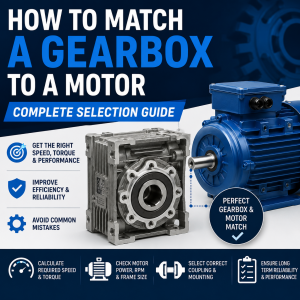
In many of these systems, brake motors are combined with geared motors or gearboxes for higher torque at lower speeds.
Types of Brake Motors
AC Brake Motors
Most common industrial option. Robust, simple, and cost-effective.
DC Brake Motors
Provide smoother, faster braking response. Often used in precision applications.
Geared Brake Motors
Motor + gearbox + brake combined in one compact unit for high torque applications.
These are popular for conveyors and lifting equipment where space is limited.
Brake Motors vs VFD Braking – What’s the Difference?
Brake motors and inverter braking serve different purposes.
Mechanical Brake (Brake Motor)
- Physically locks shaft
- Holds load at zero speed
- Safety critical
Electrical Braking (VFD)
- Slows motor electronically
- Dissipates energy via braking resistor
- Does not hold load when stopped
For safety and holding, a mechanical brake is essential. A VFD alone cannot replace it.
How to Size a Brake Motor Correctly
Step 1 – Calculate Load Torque
Determine required torque including gravity or inertia effects.
Step 2 – Add Safety Margin
Typically 150–200% of load torque.
Step 3 – Choose Motor Power
Match kW and speed requirements.
Step 4 – Check Duty Cycle
Frequent braking (S4/S5 duty) requires heavier-duty components.
Step 5 – Consider Gearbox
A gearbox can reduce required motor size and improve holding performance.
When Is a Brake Motor Required?
You should strongly consider a brake motor when:
- Loads could fall when power is removed
- Position must be held accurately
- Emergency stops are required
- Safety regulations demand fail-safe braking
- Fast stopping is critical
Common Brake Motor Mistakes
- Undersized brake torque
- Assuming a VFD can hold position
- Ignoring duty cycle (overheating brakes)
- Not allowing for load inertia
Frequently Asked Questions
Can a VFD replace a brake motor?
No. A VFD slows the motor but cannot physically hold a load at zero speed.
What happens if power fails?
Spring-applied brakes engage automatically to hold the load.
How much brake torque do I need?
Typically 1.5–2× the required holding torque for safety.
Do brake motors wear out?
Yes. Brake pads wear over time and should be inspected regularly.
Are geared brake motors better?
Often yes — they provide higher torque, compact design, and better load control.
Need a Reliable Brake Motor Solution?
At Worm Gear Motors Online, we supply industrial electric motors, geared motors, gearboxes, and inverter drives suitable for braking, holding, and emergency stop applications.
If you’re unsure which brake motor or torque rating you need, contact our team and we’ll help you select the safest and most reliable option first time.