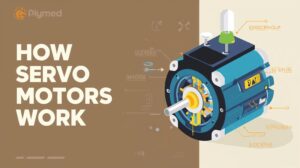
How Do Servo Motors Work?
Servo motors are the quiet workhorses behind modern automation. From high-speed packaging lines to precision robotics, they convert electrical energy into tightly controlled motion using feedback and closed-loop control. At WormGear Motors Online, we mainly specialise in motors and gearboxes, but understanding how servo motors work is key to designing reliable motion systems around them.
In this guide, we’ll walk through:
- The key components of a servo motor system
- A brief history of servo technology
- Common industrial and everyday applications
- How a simple industrial servo motor works
- How advanced servo systems use multiple control loops
What Is a Servo Motor System?
A servo motor system is more than just a motor. It’s a servomechanism made up of three main elements:
- Motor: The device that produces torque and rotation (AC or DC servo motor).
- Feedback device: Typically an encoder, resolver, or tachometer that measures speed and/or position.
- Drive / controller electronics: The “brain” that compares the commanded value to the feedback and adjusts the motor current and voltage accordingly.
Here’s how it works in practice:
A motion controller or PLC sends a command (for example “move to 90°” or “rotate at 1,500 rpm”). The drive then supplies the required current and voltage to the motor. The feedback device constantly reports what the motor is actually doing. The drive compares the commanded value with the measured value and corrects any error in real time. This is what we call a closed-loop system.
A Short History of Servo Motors
The concept of servo control isn’t new. Early feedback systems were developed in the 19th century for tasks like ship steering, where a mechanism would adjust the rudder based on the difference between the desired course and the ship’s actual heading.
Over time, these basic feedback systems evolved from mechanical and hydraulic arrangements into electrical and electronic servomechanisms. With the introduction of:
- Reliable electric motors
- Analogue and then digital control electronics
- High-resolution encoders and resolvers
…servo systems became capable of extremely precise motion control, forming the backbone of today’s CNC machines, robots, and automated production lines.
Where Are Servo Motors Used?
Because servo systems can control torque, speed, and position very accurately, they appear in a huge range of applications, including:
- Industrial automation: Pick-and-place robots, packaging lines, filling machines, indexing tables.
- CNC machinery: Positioning of axes in milling machines, lathes, and machining centres.
- Robotics: Joint control in articulated robots, cobots, and SCARA robots.
- Material handling: Conveyor drives requiring precise indexing or synchronisation.
- Automotive systems: Throttle and valve control, electric power steering, active suspension systems.
- Everyday devices: Camera pan/tilt mechanisms, hobby RC servos, 3D printers, and more.
A common example is cruise control in a vehicle. The system measures the car’s actual speed, compares it to the setpoint, and adjusts the throttle to maintain the desired speed – essentially acting as a servo mechanism.
Inside a Simple Industrial Servo Motor
To understand the basics, imagine a simple servo setup built around an industrial motor with a tachometer fitted to the shaft for speed feedback.
- The motion controller sends a speed command (e.g. 1,000 rpm).
- The servo drive applies a certain voltage and current to the motor.
- The tachometer outputs a voltage proportional to the actual speed.
- The drive constantly compares the commanded speed with the tachometer feedback.
If the motor slows down due to load, the feedback drops. The drive senses the error and increases current to bring the speed back up. This arrangement is known as a closed velocity loop and is the foundation of many industrial servo applications.
Advanced Servo Systems and Embedded Control Loops
Modern servo systems are more sophisticated than a single speed loop. They are usually built from several nested control loops, each managing a different physical quantity:
- Innermost: Current (torque) loop
- Middle: Velocity (speed) loop
- Outermost: Position loop
These loops all work together under the control of a drive and motion controller, ensuring fast response, stability, and accurate positioning.
Current Loop (Torque Control)
The current loop is the fastest inner loop and is directly linked to torque and acceleration.
- A current sensor measures the actual motor current.
- The drive compares this with the commanded current.
- Any difference is corrected almost instantly by adjusting the drive’s output.
Because motor torque is proportional to current, this loop gives the system fine control over how hard the motor “pulls”, allowing rapid acceleration and deceleration without losing control.
Velocity Loop (Speed Control)
The velocity loop sits outside the current loop and uses feedback from a tachometer or encoder to control speed:
- The drive receives a speed command (e.g. 1,500 rpm).
- It measures the actual speed from the feedback device.
- If the motor is running too slowly, the drive increases the torque command (current).
- If it is running too fast, the drive reduces the torque command.
Here, the control system effectively treats voltage as proportional to speed and continuously fine-tunes current to maintain the target speed, even under varying loads.
Position Loop (Motion Control)
The outermost position loop is typically managed by a PLC or motion controller:
- The controller receives a position target (e.g. “move 200 mm forward” or “rotate 45°”).
- It compares the commanded position with the actual position from an encoder.
- The difference (position error) is converted into a required velocity profile.
- The velocity loop then generates the necessary torque commands through the current loop to reach the position smoothly.
With all three loops – current, velocity, and position – working together, the servo system can move quickly, stop accurately, and follow complex motion profiles with high repeatability.
Why Servo Motors Matter in Modern Automation
Servo motors are essential wherever you need precision, repeatability, and dynamic response. They allow designers to:
- Synchronise multiple axes in packaging and printing applications
- Achieve high accuracy in CNC machining
- Control torque precisely in winding, tensioning, and press applications
- Implement smooth, controlled motion in robotics and material handling
In many systems, servo motors work together with gearboxes and mechanical drive components – including worm gear motors and other geared solutions – to deliver the right combination of torque, speed, and positioning accuracy.
Conclusion: Working with Servo Systems at WormGear Motors Online
Understanding how servo motors work – from their basic components to their nested control loops – makes it easier to design and troubleshoot modern motion systems. Whether you’re working with servo-driven axes, geared motors, or integrated drives, the same closed-loop principles apply: measure, compare, and correct.
At Worm Gear Motors Online, we specialise in supplying high-quality motors, gearboxes, and drive solutions for industrial applications. If you’re designing a system that uses servo motors alongside worm gear motors or other geared drives and need help choosing the right configuration, our team is here to help.
Have a project in mind? Get in touch with Worm Gear Motors Online to discuss motor selection, gearbox matching, and practical considerations for your next automation upgrade.