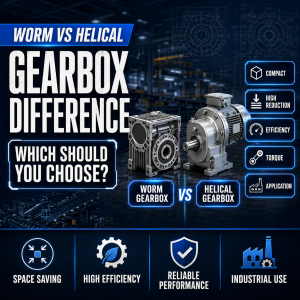
Worm Gearbox vs Helical Gearbox: What’s the Difference and Which Should You Choose?
Choosing between a worm gearbox and a helical gearbox is one of the most important decisions when specifying a drive system. Both are designed to reduce speed and increase torque, but they behave very differently in terms of efficiency, heat generation, compactness, backdrivability and long-term suitability for different applications.
If you are comparing gear reducers for conveyors, packaging machinery, food production lines, handling equipment or general automation systems, this guide explains the real-world differences so you can choose the right gearbox with confidence.
What Is a Worm Gearbox?
A worm gearbox uses a worm shaft and worm wheel to create speed reduction at a 90-degree angle. This design is compact, simple and widely used where space saving, smooth running and high reduction ratios are needed in a small footprint.
Worm gearboxes are especially common on lighter-duty and medium-duty machinery where compact right-angle reduction is more important than maximum efficiency. They are often chosen for their clean layout, good torque multiplication and cost-effective design.
Browse worm gearbox options:
What Is a Helical Gearbox?
A helical gearbox uses angled helical gears that mesh more gradually and efficiently than worm gearing. This makes helical gearboxes better suited to higher-duty industrial use where efficiency, reduced heat build-up and long running hours matter more.
On your site, the closest relevant helical category is the helical bevel gearbox range, which combines helical gearing with a right-angle design. These are typically a stronger choice for demanding conveyor systems, material handling, production lines and applications where energy efficiency is important.
Browse helical gearbox options:
Worm Gearbox vs Helical Gearbox: Key Differences
1. Efficiency
Helical gearboxes are usually much more efficient than worm gearboxes. If your machine runs for long hours every day, a helical gearbox will normally waste less energy and run cooler.
Worm gearboxes are typically less efficient because there is more sliding friction between the gear elements. That does not make them bad, but it does make them less suitable for continuous heavy-duty running where energy loss becomes important.
2. Heat Generation
Because of their lower efficiency, worm gearboxes tend to generate more heat, especially at higher reduction ratios or under heavier load. This is one reason worm boxes are often better for intermittent or lighter-duty use rather than harsh continuous-duty applications.
Helical gearboxes usually run cooler and are often the better option where uptime, efficiency and durability matter.
3. Size and Compactness
Worm gearboxes are often more compact for the amount of reduction they provide, especially in smaller applications. This makes them popular where installation space is limited or where a neat right-angle layout is needed.
Helical gearboxes can be bulkier, but they make up for that with better efficiency and stronger high-duty performance.
4. Backdrivability
One major benefit of some worm gearboxes is that they can offer partial resistance to backdriving, especially at higher ratios. This can be useful in applications where you want the load to resist reverse motion.
Helical gearboxes are generally more freely backdrivable, so if load holding is important you may need a brake motor or another stopping method.
5. Load Capacity and Duty
Helical gearboxes are generally better for higher loads and continuous-duty applications. If you are running long production hours, moving heavier loads or want maximum efficiency, helical is usually the better long-term engineering choice.
Worm gearboxes are excellent for compact, lower-cost, lighter-to-medium duty applications and remain a very popular solution where space and budget are key factors.
When a Worm Gearbox Is the Better Choice
A worm gearbox is often the better option when:
- You need a compact right-angle gearbox
- You want a cost-effective reducer
- The application is light-to-medium duty
- Space is limited
- You need high reduction in a compact housing
- The machine does not run under heavy continuous load all day
Typical examples include smaller conveyors, gates, feeders, packaging equipment, transfer systems and general OEM machinery.
When a Helical Gearbox Is the Better Choice
A helical gearbox is often the better option when:
- You need higher efficiency
- The application runs for long hours continuously
- You want lower heat generation
- You need better performance under heavier load
- Energy consumption matters
- You want a gearbox better suited to demanding industrial duty
Typical examples include production conveyors, processing equipment, material handling systems, automation lines and more demanding industrial machinery.
What About the Motor?
The gearbox is only part of the selection. You also need to match the reducer with the correct motor power, speed and mounting arrangement. In many cases, the final performance depends on choosing the right combination of gear ratio, motor pole count and mounting type.
For example, if you need faster input speed into a gearbox, a 2 pole electric motor may be relevant. For general industrial applications, many buyers also compare full AC motor ranges alongside the gearbox options.
Browse relevant motor categories:
Which One Should You Choose?
Choose a worm gearbox if your priority is compact size, lower upfront cost and a practical right-angle reducer for lighter or medium-duty applications.
Choose a helical gearbox if your priority is efficiency, lower running temperatures, better long-term performance and suitability for heavier-duty or continuous industrial use.
If two gearboxes both appear to do the same job, the real decision often comes down to duty cycle, required efficiency, space constraints and whether backdriving matters.
Quick Comparison Table
| Feature | Worm Gearbox | Helical Gearbox |
|---|---|---|
| Efficiency | Lower | Higher |
| Heat Generation | Higher | Lower |
| Compactness | Very compact | Usually larger |
| Duty Suitability | Light to medium duty | Medium to heavy duty |
| Continuous Running | Less ideal | Better suited |
| Backdriving Resistance | Often better | Usually easier to backdrive |
| Upfront Cost | Often lower | Often higher |
Frequently Asked Questions
Is a worm gearbox better than a helical gearbox?
Not always. A worm gearbox is better for compact, cost-effective right-angle reduction, while a helical gearbox is usually better for efficiency, lower heat and heavier-duty continuous operation.
Do worm gearboxes wear out faster?
They can wear faster in harsh continuous-duty applications if they are undersized or poorly matched. Correct sizing, lubrication and duty matching are important.
Why are helical gearboxes more efficient?
Helical gears mesh more smoothly and with less sliding friction than worm gearing, so they generally waste less energy and produce less heat.
Can I use a worm gearbox on a conveyor?
Yes, worm gearboxes are widely used on conveyors, especially lighter-duty systems where compactness and cost matter. For higher-duty conveyors, a helical gearbox may be the better long-term option.
Do I need a brake motor with a helical gearbox?
In some cases, yes. Because helical gearboxes are more easily backdriven, a brake motor may be needed where controlled stopping or load holding is important.
Need Help Choosing the Right Gearbox?
If you are comparing worm gearboxes and helical gearboxes for a real application, the best choice depends on your load, duty cycle, ratio, available space and motor specification. Browse our gearbox and motor categories below to narrow down the right solution.