Gearbox Radial Load & Overhung Load Explained: Why Shaft Loads Matter
When choosing a gearbox, most people check the ratio, output speed, motor power and torque rating first. Those details are important, but they are not the only things that affect gearbox life. The load placed on the gearbox output shaft can be just as important.
If a pulley, sprocket, belt, chain, coupling or wheel is fitted to the gearbox output shaft, it can create sideways force on the shaft and bearings. This is known as radial load or overhung load. If this load is too high, the gearbox may fail early even if the torque rating appears correct.
This guide explains what radial load and overhung load mean, why shaft loads matter, and what to check when selecting a gearbox for conveyors, mixers, pumps, chain drives and industrial machinery.
What Is Radial Load on a Gearbox?
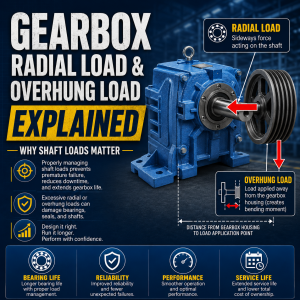
Radial load is the force applied sideways to a rotating shaft. On a gearbox, this usually means a force acting at 90 degrees to the output shaft.
For example, if a belt pulley is fitted to the gearbox output shaft, the belt tension pulls sideways on the shaft. If a chain sprocket is fitted, the chain tension creates a similar sideways force. This side force is carried by the gearbox output shaft and bearings.
Radial load is different from torque. Torque is the twisting force used to rotate the load. Radial load is the bending force applied across the shaft.
When selecting gearboxes or worm gearboxes, both torque and shaft loading should be considered.
What Is Overhung Load?
Overhung load is a radial load applied away from the gearbox bearing support. It is called “overhung” because the load hangs out from the gearbox face or bearing position.
The further the pulley, sprocket or wheel is mounted away from the gearbox housing, the greater the bending effect on the shaft. This creates more stress on the output shaft and bearings.
Common Causes of Overhung Load
- Chain sprockets mounted on the gearbox output shaft
- Belt pulleys driving fans, conveyors or machinery
- V-belt drives with high belt tension
- Timing belts fitted directly to gearbox shafts
- Wheels or rollers mounted directly on the output shaft
- Offset couplings or poorly aligned driven equipment
Overhung load is especially important when selecting shaft-mounted or solid shaft gearboxes from ranges such as Motovario NMRV worm gearboxes, Varvel worm gearboxes and Bonfiglioli worm gearboxes.
Radial Load vs Torque: What Is the Difference?
Torque and radial load are often confused, but they are completely different forces.
| Force Type | What It Means | What It Affects |
|---|---|---|
| Torque | Twisting force that rotates the gearbox output shaft | Gear teeth, worm wheel, output speed and driven load |
| Radial Load | Sideways force acting across the output shaft | Output shaft, bearings, seals and housing |
| Overhung Load | Radial load applied away from the gearbox bearing support | Shaft bending, bearing life and gearbox reliability |
A gearbox can have enough torque capacity but still fail if the output shaft is overloaded sideways. This is why shaft load must be checked when the gearbox drives a belt, chain, pulley or sprocket.
Why Shaft Loads Matter
Gearbox output bearings are designed to support a certain amount of load. If radial load or overhung load is too high, the bearings can wear prematurely. This can lead to noise, heat, oil seal failure, shaft movement and eventual gearbox damage.
Excessive Shaft Load Can Cause:
- Premature bearing failure
- Output shaft bending
- Oil seal wear or leakage
- Increased vibration
- Gear misalignment
- Overheating
- Reduced gearbox service life
This is especially important on conveyor systems, where gearboxes often drive a chain, roller or belt system directly. Browse suitable related categories such as motors for conveyors, 4 pole electric motors and brake motors.
How Pulleys and Sprockets Create Overhung Load
Pulleys and sprockets create overhung load because they are normally mounted outside the gearbox housing. The belt or chain pulls on the pulley or sprocket, and that force is transferred into the gearbox shaft.
The greater the belt tension or chain tension, the higher the radial load. The further the pulley or sprocket is positioned away from the gearbox face, the greater the bending effect.
Overhung Load Increases When:
- The pulley or sprocket is mounted far away from the gearbox housing.
- The belt or chain tension is high.
- The pulley diameter is too small.
- The chain drive has shock loading.
- The driven equipment starts and stops frequently.
- The shaft is unsupported outside the gearbox.
If the gearbox output shaft supports a pulley, sprocket or roller directly, radial load should be checked against the gearbox manufacturer’s rating before ordering.
Hollow Bore Gearboxes and Shaft Loads
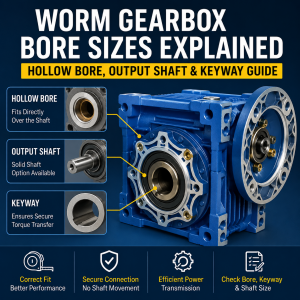
Many worm gearboxes use a hollow output bore, where the driven machine shaft passes directly through the gearbox. In this arrangement, the gearbox may be mounted directly onto the driven shaft rather than using a separate pulley or sprocket on the gearbox shaft.
This can reduce some external shaft loading because the gearbox is fitted directly to the machine shaft. However, the driven shaft, torque arm and mounting arrangement still need to be correct.
With hollow bore worm gearboxes, the main checks are usually:
- Output bore size
- Keyway fitment
- Shaft engagement length
- Torque arm or gearbox restraint
- Machine shaft support
- Load direction
For replacement hollow bore units, view Motovario NMRV040 worm gearboxes, Motovario NMRV050 worm gearboxes and Varvel FRS50 worm gearboxes.
Solid Shaft Gearboxes and Overhung Load
Solid shaft gearboxes are more likely to experience overhung load when a pulley, sprocket, gear, coupling or wheel is fitted directly to the output shaft.
The key issue is the distance between the gearbox bearing and the centre of the external component. The further the component sits from the bearing, the more leverage it creates on the shaft.
For this reason, pulleys and sprockets should normally be mounted as close to the gearbox housing as practical, while still allowing safe clearance and correct alignment.
Best Practice for Solid Shaft Gearboxes
- Mount pulleys and sprockets close to the gearbox housing.
- Avoid excessive belt or chain tension.
- Use correct alignment between driving and driven components.
- Support the driven shaft where necessary.
- Check the gearbox radial load rating.
- Use a larger gearbox if the shaft load is high.
Radial Load and Bearing Life
Bearings are one of the main components affected by radial load. When a shaft is pulled sideways, the bearing carries that load while still supporting rotation.
If the radial load is too high, bearing life reduces. The gearbox may begin to run noisier, hotter or less smoothly. Eventually, bearing wear can cause shaft movement, seal failure and gear misalignment.
In many gearbox failures, the torque rating was not the problem. The real issue was excessive shaft loading, poor alignment or unsupported overhung load.
Radial Load and Gearbox Seals
Output shaft seals are designed to keep oil inside the gearbox and contamination outside. When radial load causes shaft deflection or bearing wear, the seal may no longer run correctly on the shaft.
This can lead to oil leaks, contamination, poor lubrication and further gearbox wear.
Signs of Shaft Load or Bearing Problems
- Oil leaking around the output shaft
- Noise from the output bearing area
- Visible shaft movement
- Excessive heat near the output side
- Vibration under load
- Repeated seal replacement failures
If a gearbox repeatedly leaks after seal replacement, the cause may be bearing wear or shaft load rather than only a faulty seal.
Radial Load in Conveyor Applications
Conveyors are one of the most common applications where radial load matters. A conveyor gearbox may drive a roller, shaft, belt or chain system directly.
If the gearbox output shaft carries the driven roller or a chain sprocket, the bearing load can be significant. Inclined conveyors, heavy loads and frequent starts can increase the stress even further.
For Conveyor Gearbox Selection, Check:
- Conveyor load weight
- Belt or chain tension
- Roller diameter
- Gearbox output torque
- Output shaft arrangement
- Duty cycle and starts per hour
- Whether a brake motor is required
Related categories include motors for conveyors, IE3 electric motors, Amtecs brake motors and our main worm gearboxes category.
Radial Load in Pump, Mixer and Fan Applications
Radial load is not limited to conveyors. Pumps, mixers and fans can also place additional force on shafts depending on how the drive is arranged.
Pumps
Pump drives may use couplings, belts or direct gearbox arrangements. Poor alignment or belt tension can increase shaft load and bearing wear.
Browse related motors for pumps when selecting motor and gearbox combinations.
Mixers
Mixers can create high radial and shock loads, especially when thick material, uneven loading or start-stop operation is involved.
For mixer applications, view motors for mixers and correctly sized gearbox options.
Fans
Fan drives often use belts or pulleys. Incorrect belt tension can increase radial load and shorten gearbox or motor bearing life.
For fan applications, browse motors for fans.
How to Reduce Overhung Load
There are several ways to reduce overhung load and protect the gearbox output bearings.
1. Mount the Pulley or Sprocket Close to the Gearbox
The closer the external component is to the gearbox housing, the lower the bending effect on the shaft.
2. Use Correct Belt or Chain Tension
Over-tight belts and chains increase radial load. Use the correct tension for the drive system.
3. Increase Pulley or Sprocket Diameter
Very small pulleys or sprockets can increase load and reduce component life. A larger diameter may reduce shaft stress in some applications.
4. Add External Shaft Support
Where loads are high, an external bearing or supported shaft arrangement may be required instead of relying only on the gearbox bearings.
5. Use a Larger Gearbox
A larger gearbox may have stronger bearings, a larger output shaft and higher radial load capacity.
6. Use the Correct Mounting Accessories
Torque arms, flanges, feet and output kits can all affect how the gearbox is supported. Browse gearbox accessories, Motovario gearbox accessories and Varvel gearbox accessories for related parts.
How to Check if Shaft Load Is Too High
The correct way to check shaft load is to compare the application load against the gearbox manufacturer’s permitted radial load or overhung load rating.
This may be shown in the gearbox data sheet as permitted radial load, output shaft load, overhung load or bearing load. The value may change depending on output speed, shaft direction, mounting position and where the load is applied on the shaft.
You May Need to Check:
- Gearbox output speed
- Output shaft diameter
- Distance from gearbox face to load centre
- Belt or chain tension
- Pulley or sprocket diameter
- Load direction
- Duty cycle
If the calculated load is close to or above the permitted rating, choose a larger gearbox, change the drive arrangement or add external shaft support.
Common Mistakes With Radial and Overhung Load
1. Selecting a Gearbox by Torque Only
A gearbox may have enough torque capacity but still be unsuitable if the output shaft load is too high.
2. Mounting a Sprocket Too Far From the Gearbox
The further the sprocket sits away from the gearbox housing, the greater the bending force on the shaft.
3. Over-Tightening Belts or Chains
Excessive tension increases bearing load and can shorten gearbox life.
4. Ignoring Shock Loads
Sudden starts, stops, jams and impact loads can increase the stress on the gearbox shaft and bearings.
5. Not Supporting Long Shafts
If the driven shaft is long or heavily loaded, external bearings may be required.
6. Replacing a Failed Gearbox Like-for-Like Without Finding the Cause
If a gearbox failed because of excessive shaft load, fitting the same size again may lead to the same failure.
Radial Load vs Backlash
Radial load and backlash are different gearbox topics.
Backlash is the small amount of movement or free play between gear teeth before motion transfers. It affects precision, reversing movement and positioning accuracy.
Radial load is a sideways force on the gearbox output shaft. It affects bearings, seals, shaft stress and gearbox service life.
A gearbox can have acceptable backlash but still suffer from excessive radial load. Likewise, a gearbox can have poor backlash but not necessarily be overloaded sideways.
FAQs About Gearbox Radial Load and Overhung Load
What does radial load mean on a gearbox?
Radial load is the sideways force acting across the gearbox output shaft, usually caused by belts, chains, pulleys, sprockets or external shaft loads.
What does overhung load mean?
Overhung load is a radial load applied away from the gearbox bearing support. The further the load is from the gearbox housing, the greater the bending effect on the shaft.
Is radial load the same as torque?
No. Torque is twisting force. Radial load is sideways shaft force. Both must be checked when selecting a gearbox.
Can a gearbox fail even if the torque rating is correct?
Yes. A gearbox can fail early if the radial load or overhung load is too high, even when the torque rating is suitable.
Do pulleys create radial load?
Yes. Belt tension from a pulley creates sideways force on the gearbox shaft.
Do sprockets create overhung load?
Yes. A chain sprocket mounted on the gearbox output shaft can create overhung load, especially if it sits far from the gearbox housing.
How can I reduce overhung load?
Mount pulleys or sprockets closer to the gearbox, avoid excessive tension, use external shaft support, increase component diameter or choose a larger gearbox with higher bearing capacity.
Conclusion: Shaft Loads Matter as Much as Torque
Gearbox selection is not only about motor power, ratio and output torque. Radial load and overhung load can have a major effect on gearbox bearing life, shaft stress, oil seal performance and long-term reliability.
If a pulley, sprocket, belt, chain, roller or wheel is mounted on the gearbox output shaft, always check whether the gearbox can handle the sideways force. A gearbox that is correct for torque may still fail early if the shaft load is too high.
At Worm Gear Motors Online, we supply a wide range of gearboxes, worm gearboxes, AC motors, motors for conveyors and gearbox accessories for industrial drive applications. For reliable gearbox selection, always consider torque, ratio, duty cycle, mounting position and shaft load together.