
How to Calculate Gearbox Output Torque (With Simple Formula)
Understanding how to calculate gearbox output torque is essential when selecting the right gearbox for any industrial application. Whether you are sizing a reducer for a conveyor, mixer, packaging machine, feeder, or general automation system, torque is one of the most important values to get right.
If the gearbox output torque is too low, the system may struggle under load, overheat, or fail prematurely. If it is correctly matched, the machine will run more reliably, handle load changes better, and deliver the long service life expected from industrial power transmission equipment.
In this guide, we explain the simple formula used to calculate gearbox output torque, what each part of the formula means, and how to apply it in real-world gearbox selection. We will also cover the difference between theoretical torque and real usable torque, along with common mistakes to avoid when sizing a gearbox.
If you are comparing available products while working through your calculations, you can browse our full range of gearboxes, explore compact worm gearboxes, view the popular Motovario NMRV worm gearboxes range, or look at a common size such as the Motovario NMRV050 worm gearbox.
What Is Gearbox Output Torque?
Gearbox output torque is the turning force delivered at the output shaft of the gearbox after the input power has been reduced in speed and multiplied in torque.
In simple terms, a gearbox takes the higher-speed, lower-torque rotation from an electric motor and converts it into lower-speed, higher-torque output that is better suited to driving machinery.
This output torque is what actually turns the driven load, such as a conveyor roller, auger, mixer shaft, or machine drive component. That is why calculating it correctly is critical when choosing a gearbox.
Why Output Torque Matters
Torque is often the most important value in gearbox selection because it directly affects whether the machine can do the work required. Speed matters too, but if the gearbox cannot deliver enough torque, the system will not perform properly under load.
Knowing the expected output torque helps you:
- Select the correct gearbox size for the application
- Match the gearbox to the motor power
- Avoid overload conditions that can shorten gearbox life
- Compare different ratios and reducer styles
- Choose the right service factor for the operating duty
This is especially important when selecting from broad product ranges such as our industrial gearboxes collection or compact right-angle worm gearboxes.
The Simple Gearbox Output Torque Formula
The basic formula used to calculate output torque is:
Torque (Nm) = 9550 × Power (kW) ÷ Speed (RPM)
This formula calculates torque based on the output power and output speed.
If you already know the motor power and the output speed after gear reduction, this is the simplest way to estimate gearbox output torque.
What the Formula Means
Each part of the formula has a clear role:
- 9550 is a constant used to convert power and rotational speed into torque in Newton metres
- Power (kW) is the mechanical power being delivered
- Speed (RPM) is the rotational speed of the shaft you are calculating torque for
Because torque increases as speed decreases for a given power, a gearbox that reduces speed will increase the available turning force at the output.
Simple Example of Gearbox Output Torque
Let’s say you have a 0.75kW motor and, after the gearbox, the output speed is 30 RPM.
Using the formula:
Torque = 9550 × 0.75 ÷ 30
Torque = 238.75 Nm
So the theoretical gearbox output torque is 238.75 Nm.
This gives you a useful starting point when comparing reducer sizes and checking whether a gearbox is suitable for the machine load.
How to Calculate Output Speed First
In many applications, you will know the motor speed and gearbox ratio before you know the output speed. In that case, you calculate output speed first.
The formula is:
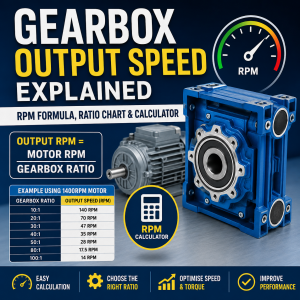
Output Speed (RPM) = Motor Speed (RPM) ÷ Gear Ratio
For example, if you have a 1400 RPM motor and a 50:1 gearbox:
Output Speed = 1400 ÷ 50 = 28 RPM
Then you can plug that output speed into the torque formula.
Full Worked Example
Imagine you are using a 1.1kW motor running at 1400 RPM with a 40:1 gearbox.
Step 1: Calculate Output Speed
Output Speed = 1400 ÷ 40 = 35 RPM
Step 2: Calculate Output Torque
Torque = 9550 × 1.1 ÷ 35
Torque = 300.14 Nm
So the theoretical gearbox output torque is approximately 300 Nm.
This kind of calculation is useful when comparing different reducer options across our gearbox range or checking whether a specific unit like a Motovario NMRV050 worm gearbox is likely to meet the load requirement.
Theoretical Torque vs Real Output Torque
The simple formula gives you a theoretical torque value, but real-world usable output torque is usually lower once gearbox efficiency is taken into account.
No gearbox is 100% efficient. Some power is lost through friction, heat, and internal mechanical losses. This is especially important with worm gearboxes, where efficiency can vary more than with helical designs.
To account for this, you can use an adjusted formula:
Real Output Torque (Nm) = 9550 × Power (kW) × Efficiency ÷ Output Speed (RPM)
If a gearbox is 85% efficient, you would use 0.85 in the formula.
Example with Efficiency Included
Using the same 1.1kW motor and 35 RPM output speed, but now assuming 85% efficiency:
Real Output Torque = 9550 × 1.1 × 0.85 ÷ 35
Real Output Torque = 255.12 Nm
So while the theoretical torque is about 300 Nm, the more realistic usable output torque is closer to 255 Nm.
This is why gearbox efficiency matters so much when selecting the right reducer.
Why Worm Gearbox Efficiency Matters
With worm reducers, efficiency can change depending on size, ratio, lubrication, load conditions, and operating speed. Higher-ratio worm gearboxes often have lower efficiency than lower-ratio models because of the sliding contact between the worm and wheel.
That means two gearboxes with the same motor power and ratio may not always deliver the same real-world output torque if their efficiencies differ.
When reviewing Motovario NMRV worm gearboxes or compact units like the NMRV050 worm gearbox, it is always worth considering not just ratio and size, but also how efficiency affects usable torque.
How Gear Ratio Affects Torque
One of the most important gearbox principles is that higher reduction ratios generally produce lower output speed and higher output torque.
For example:
- 10:1 ratio gives a relatively higher output speed and lower torque multiplication
- 50:1 ratio gives a much lower output speed and stronger torque multiplication
- 100:1 ratio gives even lower output speed and potentially much higher torque output
This is why gearbox ratio selection has such a major impact on machine performance.
If the ratio is too low, the machine may run too fast and lack turning force. If the ratio is too high, the machine may run slower than needed even though torque is available.
Do Not Forget Service Factor
Even if your calculated torque looks correct on paper, you should not size a gearbox only to match the exact running requirement. Real machinery often sees shock loads, start-stop duty, long running hours, reversing, or unexpected load spikes.
That is where service factor comes in.
A service factor adds a safety margin so the gearbox can handle tougher real-world conditions. For example, if your application needs 250 Nm continuously, you may choose a gearbox rated comfortably above that depending on the duty cycle.
This is particularly important for conveyors, mixers, crushers, feeders, and other load-varying industrial applications.
Common Mistakes When Calculating Gearbox Torque
Torque calculations are simple once you know the formula, but several mistakes are common when people size gearboxes too quickly.
- Using motor speed instead of output speed in the torque formula
- Ignoring gearbox efficiency, especially with worm reducers
- Forgetting service factor and real operating conditions
- Assuming all ratios behave the same under load
- Not checking manufacturer ratings against calculated values
The formula gives you a strong starting point, but final gearbox selection should always consider the actual application conditions.
When This Formula Is Most Useful
This torque formula is useful when:
- You are comparing gearbox sizes before purchase
- You want to estimate the turning force available at the output shaft
- You are selecting between different ratios
- You are matching a gearbox to a known motor power
- You are checking whether a compact reducer is likely to suit the application
It is particularly helpful when browsing broad categories such as industrial gearboxes or narrowing down models inside ranges like Motovario NMRV worm gearboxes.
Quick Torque Calculation Summary
If you want the process in the simplest possible form, it looks like this:
- Find the motor power in kW
- Calculate gearbox output speed using motor speed ÷ ratio
- Use the torque formula: 9550 × kW ÷ output RPM
- Adjust for gearbox efficiency if you want a more realistic output value
- Apply service factor before final selection
That gives you a practical and reliable way to estimate output torque before choosing the gearbox.
Final Thoughts
Calculating gearbox output torque is one of the most useful skills in gearbox selection. The formula itself is simple, but using it properly helps you choose a reducer that delivers the right balance of speed, torque, and reliability for your application.
By starting with output speed, applying the torque formula, and then allowing for efficiency and service factor, you can make much better decisions when selecting industrial gear reducers.
If you are comparing products for a real application, browse our full range of gearboxes, view compact worm gearboxes, explore the Motovario NMRV range, or check the popular Motovario NMRV050 worm gearbox category for common industrial options.