Worm Gearbox vs Helical Gearbox: Which Is Better for Your Application?
Choosing the right gearbox is critical for achieving reliable performance, energy efficiency, and long service life in industrial machinery. Two of the most common gearbox types used in conveyors, packaging equipment, automation systems, and processing machinery are worm gearboxes and helical gearboxes. Each has distinct advantages depending on the torque requirements, efficiency targets, installation space, and operating duty cycle.
In this guide, we compare worm gearboxes and helical gearboxes in detail, explaining how they work, their key differences, and when each type is the better choice for your application. We will also look at real industrial examples such as the worm gearboxes range, the efficient helical bevel gearboxes category, popular models like the Motovario NMRV050 worm gearboxes, and the widely used Motovario B083 helical bevel gearboxes.
What Is a Worm Gearbox?
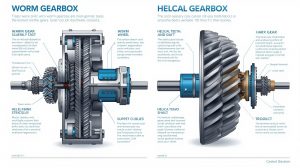
A worm gearbox uses a screw-shaped gear called a worm that meshes with a worm wheel to transmit power and reduce speed. This design creates a compact right-angle gearbox that can achieve large speed reductions within a relatively small housing.
The key feature of worm gearboxes is that the worm gear slides across the worm wheel rather than rolling against it. This sliding contact allows high gear ratios but also introduces friction and heat generation during operation. :contentReference[oaicite:0]{index=0}
Because of their compact design and high reduction capability, worm gearboxes are widely used in applications where space is limited or where slow output speeds are required.
You can explore a wide range of industrial units in our worm gearbox category, including models such as the Motovario NMRV050 worm gearbox.
What Is a Helical Gearbox?
A helical gearbox uses gears with angled teeth that engage gradually as they rotate. This gradual engagement spreads the load across multiple teeth and results in smoother, quieter power transmission compared with many other gear types. :contentReference[oaicite:1]{index=1}
Helical gearboxes are known for their strong efficiency and ability to handle higher loads because the gear teeth share the load more evenly. In many industrial systems, helical gearboxes are preferred where smooth operation and high efficiency are critical. :contentReference[oaicite:2]{index=2}
Many industrial machines use helical bevel gearboxes, which combine helical gearing with a bevel stage to provide a right-angle output while maintaining high efficiency. You can browse our range of helical bevel gearboxes, including the popular Motovario B083 bevel gearbox.
Key Differences Between Worm and Helical Gearboxes
Although both gearbox types are used to reduce speed and increase torque, they differ significantly in efficiency, design, load capacity, and typical applications.
1. Efficiency
Helical gearboxes are generally much more efficient because the gears roll against each other instead of sliding. Helical and helical-bevel gearboxes can reach efficiencies close to 98%, while worm gearboxes often range between roughly 40% and 90% depending on the ratio and design. :contentReference[oaicite:3]{index=3}
This difference becomes particularly important in applications that run continuously or require higher power levels.
2. Gear Contact Type
The fundamental difference lies in how the gears interact:
- Helical gearboxes: Rolling gear contact with angled teeth.
- Worm gearboxes: Sliding contact between worm and worm wheel.
Rolling contact reduces friction, which explains why helical gearboxes typically run cooler and more efficiently. :contentReference[oaicite:4]{index=4}
3. Torque and Load Capacity
Helical gearboxes generally offer higher load capacity and better durability because the load is distributed across multiple teeth. This allows them to handle heavier industrial loads and continuous-duty applications. :contentReference[oaicite:5]{index=5}
Worm gearboxes can still deliver strong torque output, especially in compact designs, but they are typically better suited to light-to-medium-duty machinery.
4. Gear Ratios
Worm gearboxes can achieve very high gear ratios in a single stage, often between 5:1 and 100:1. Helical gearboxes usually achieve smaller ratios per stage, but multiple stages can be used to reach larger reductions. :contentReference[oaicite:6]{index=6}
This is one reason worm gearboxes remain popular for applications requiring very low output speeds.
5. Self-Locking Capability
Many worm gearboxes provide a useful feature known as self-locking, which prevents the output shaft from driving the input shaft backwards. This can be beneficial in lifting systems or positioning equipment where back-driving must be avoided. :contentReference[oaicite:7]{index=7}
Helical gearboxes typically do not provide self-locking and may back-drive under load unless additional braking mechanisms are used.
When to Choose a Worm Gearbox
Worm gearboxes are often the best choice when compact design and high reduction ratios are more important than maximum efficiency.
They are commonly used in:
- Conveyor systems with low-speed requirements
- Packaging machines
- Small mixers and agitators
- Automated gates and positioning equipment
- Light-duty industrial machinery
- Applications requiring self-locking capability
Models such as the Motovario NMRV050 worm gearbox are popular for compact machinery and OEM applications.
When to Choose a Helical Gearbox
Helical gearboxes are usually preferred when efficiency, durability, and continuous-duty performance are the top priorities.
They are widely used in:
- Industrial conveyor systems
- Material handling equipment
- Manufacturing production lines
- Automated packaging systems
- Heavy-duty processing machinery
- Applications requiring long operating hours
Helical bevel gearboxes such as the Motovario B083 are especially popular in industrial environments where strong torque and efficiency are needed.
Energy Efficiency and Operating Cost
Efficiency has a direct impact on operating costs, especially in equipment that runs continuously. Because worm gearboxes lose more energy through friction, they often generate more heat and consume more power than helical gearboxes. :contentReference[oaicite:8]{index=8}
In many industrial plants, upgrading from worm gearboxes to helical bevel gearboxes can significantly reduce energy consumption over time.
Installation Space and Machine Layout
Machine layout also plays a major role in gearbox selection.
Worm gearboxes are often chosen because they are extremely compact and easy to mount. Helical gearboxes, especially multi-stage units, may require more space but provide stronger performance.
When the machine requires a right-angle layout with high efficiency, many engineers choose helical bevel gearboxes as the best compromise between performance and installation flexibility.
Which Gearbox Is Better?
There is no single gearbox type that is always “better.” The right choice depends entirely on the needs of the application.
In general:
- Choose a worm gearbox for compact design, high reduction ratios, and cost-effective solutions.
- Choose a helical gearbox for higher efficiency, greater load capacity, and long-term industrial performance.
Both designs remain essential in modern machinery, and many systems use each type depending on the specific function required.
Explore Worm and Helical Gearboxes
If you are comparing gearbox options for a new project or equipment upgrade, you can explore the available ranges here:
- Worm Gearboxes
- Helical Bevel Gearboxes
- Motovario NMRV050 Worm Gearboxes
- Motovario B083 Helical Bevel Gearboxes
Understanding the strengths of each gearbox type will help ensure you select the most efficient, reliable, and cost-effective solution for your machinery.
Final Thoughts
Worm gearboxes and helical gearboxes both play important roles in industrial power transmission. Worm gearboxes offer compact design and high reduction capability, while helical gearboxes deliver higher efficiency, smoother operation, and stronger load handling.
By considering factors such as torque requirements, efficiency, duty cycle, and machine layout, you can determine which gearbox type is best suited to your application and achieve the most reliable performance from your equipment.